CA PLS Exam Binder
Ultra-condensed quick reference for the California Professional Land Surveyor Exam. Optimized for printing (~27 pages).
8 Sections~27 pagesPrint Optimized
1. CA PLS Exam Overview
Format, weights, and strategy
| Item | Detail |
|---|---|
| Exam | California Professional Land Surveyor Exam |
| Format | ~70 multiple-choice questions |
| Duration | 4 hours (240 minutes) |
| Delivery | Computer-based at Prometric |
| Passing | Scaled score of 75 |
| References | Open-book (bring your own references) |
| Module | Weight | Questions | Key Topics |
|---|---|---|---|
| 1. Business Practices | 10% | ~7 | Ethics, contracts, liability, monument preservation |
| 2. Research & Planning | 16% | ~11 | Records research, control, datums, CCS |
| 3. Field Operations | 20% | ~14 | Measurements, GNSS, leveling, equipment |
| 4. Analysis & Evaluation | 26% | ~18 | Boundary analysis, evidence, retracement |
| 5. Mapping & Documents | 16% | ~11 | Legal descriptions, maps, ROS, plats |
| 6. Professional Consulting | 12% | ~9 | Expert testimony, depositions, consulting |
Time Management Strategy
- First pass: Answer all confident questions (~40-50 questions in 1.5 hrs)
- Second pass: Work through flagged questions, consult references (1.5-2 hrs)
- Final pass: Review marked answers (30 min)
- Never leave a question blank - no penalty for guessing
- Organize your references with tabs/bookmarks for quick lookup
Key Statutes to Have Tabbed
B&P 8726 - Scope of practiceGov. Code 66426 - Final maps (5+ parcels)B&P 8762 - ROS requirementsGov. Code 66428 - Final mapsB&P 8773 - Corner recordsPRC 8801-8819 - CCSB&P 8771 - Monument preservationCommon Law - Evidence hierarchy (Brown's Ch. 5-6)
2. Key Formulas
Traverse, area, curves, GPS, errors
Traverse Computations
Latitude:
Departure:
Closure Error:
Precision Ratio:
Compass Rule (Lat):
Compass Rule (Dep):
Area Computations
Coordinate Method:
DMD Method:
Trapezoidal Rule:
(equal spacing h)
Simpson's 1/3:
(odd # ordinates)
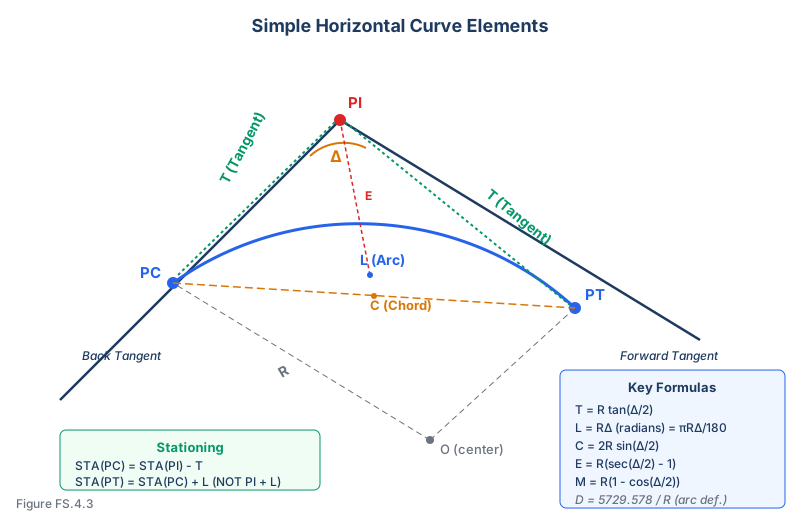
Horizontal Curves
Degree of Curve:
(arc definition)
Tangent:
Length:
(or 100 * Delta/D)
External:
Mid Ordinate:
Long Chord:
PC Station:
PT Station:
Vertical Curves
Rate of change:
(g in %, L in stations)
Elevation on curve:
High/low point:
(from BVC)
Offset from tangent:
(at midpoint; g in %, L in stations)
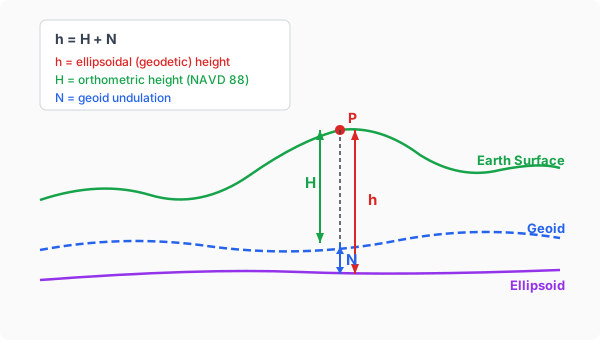
GPS Heights
Height relationship:
(ellipsoid = ortho + geoid)
Orthometric height:
Geoid undulation:
Scale / Grid-Ground Factors
Elevation factor:
(R = Earth radius, h = elevation)
Grid factor:
(varies with distance)
Combined factor:
Grid distance:
Error Theory & Statistics
Std deviation:
Std error of mean:
Error propagation (+/-):
Error propagation (*):
(Q = a*b)
Weighted mean:
(w = 1/sigma^2)
68-95-99.7 rule:
Photogrammetry
Photo scale:
(f = focal length, H = flying height)
Relief displacement:
(r = radial dist, h = obj height)
Flying height (AGL):
(for desired scale S)
Ground coverage:
3. Evidence Hierarchy & Boundary Rules
Common law hierarchy, retracement, unwritten rights
Hierarchy of Calls (Common Law / Brown's Ch. 5-6)
- Lines actually run on the ground - corners established, monuments set, lines marked by creating surveyor
- Natural monuments - rivers, lakes, ridges, trees
- Artificial monuments - stakes, pipes, stones set on ground
- Adjoiners / record boundaries - calls for adjoining tracts, senior rights
- Courses / bearings - direction of boundary lines
- Distances - measured lengths of lines
- Area / quantity - acreage or square footage (lowest weight)
Intent of the parties is the overriding principle governing all elements.
Evidence Hierarchy Pyramid
7 bands: top = Lines Actually Run (highest), bottom = Area (lowest)
| Monument Type | Examples | Relative Weight |
|---|---|---|
| Natural | Rivers, lakes, trees, ridges, rock outcrops | Highest |
| Artificial (original) | Original stakes, stones, mounds set by surveyor | High |
| Artificial (subsequent) | Iron pipes, rebar, mag nails set later | Medium-High |
| Record | Calls to adjoining tracts, recorded plats | Medium |
| Accessory/witness | Bearing trees, reference marks | Support only |
7 Rules of Construction
- Intent of the parties controls
- The deed is construed most strongly against the grantor
- A grant is always construed in favor of the grantee
- The whole instrument is considered, not isolated parts
- Specific descriptions prevail over general ones
- Where two clauses are irreconcilable, the former prevails (CA — the "first-clause" rule; the majority rule is the opposite, that the LATER clause controls)
- Monuments prevail over courses, courses over distances, distances over area
Retracement Principles
- Follow the footsteps of the original surveyor
- The retracing surveyor has NO authority to establish new corners
- Original monuments, when found, are conclusive (even if imprecise)
- Proportionate measurement used when original corners are lost
- An obliterated corner can be restored from evidence; a lost corner cannot
- Obliterated = position can be determined from evidence
- Lost = position cannot be determined beyond reasonable doubt
| Unwritten Right | Key Requirements | Time Period |
|---|---|---|
| Adverse Possession | Open, notorious, continuous, hostile, exclusive, under claim of right, AND payment of taxes | 5 years (CA) |
| Prescriptive Easement | Open, notorious, continuous, hostile use (NO tax payment needed, NO exclusivity needed) | 5 years (CA) |
| Agreed Boundary | Uncertainty + agreement (express or implied) + acquiescence + change in position | No fixed period |
| Boundary by Acquiescence | Occupation to visible line with implied agreement | Statute of limitations |
| Boundary by Estoppel | Representation + reliance + injury if boundary changed | No fixed period |
| Practical Location | Acts on the ground showing where parties treated boundary | Long period of time |
Water Boundary Rules
- Accretion - Gradual, imperceptible additions of land by water action; boundary moves with water
- Reliction - Gradual recession of water; exposed land goes to riparian owner
- Avulsion - Sudden, perceptible change; boundary remains at original location
- Erosion - Gradual wearing away; boundary moves with the water
- Navigable waters: public trust doctrine applies (state owns bed below ordinary high water)
- Non-navigable: riparian owner typically owns to thread (center) of stream
4. California Codes Quick Reference
PLS Act, SMA, PRC, Civil Code, CCP
Professional Land Surveyors Act (B&P Code)
B&P 8726Defines “practice of land surveying” - determines boundaries, positions of fixed works, establishes lines/grades
B&P 8728Restriction on design: surveys do not include design of any structure or fixed works (civil engineering)
B&P 8741Qualifications for LSIT certification or PLS licensure: education, experience, and examination requirements
B&P 8759Written contract required for professional land surveying services before commencing work
B&P 8761Signing and sealing: all land surveying documents must be prepared by/under responsible charge of a PLS or CE; stamp, signature, and date required
B&P 8762Record of Survey (ROS): permissive filing (a); mandatory filing when field survey discloses any of 5 triggers (b); 90-day deadline (c)
B&P 8762.5ROS vs. Parcel Map: if map satisfies ROS requirements, separate ROS not needed
B&P 8764ROS contents: monuments, bearings, distances, coordinates, references
B&P 8765Record of survey exemptions: surveys by public officers (copy filed with county surveyor), and other specified exceptions
B&P 8771Monument setting and perpetuation: monuments must be sufficient in number and durability to perpetuate or reestablish any point or line of the survey
B&P 8773Corner records: required for every PLSS corner (except “lost corners”) established, restored, found, set, reset, or used as control in any survey
B&P 8780Complaints, investigations, disciplinary action: board may investigate and discipline for fraud, negligence, incompetence, contract breach, etc.
5 Mandatory Filing Triggers (B&P 8762(b))
- Material evidence or physical change not shown on any recorded map or survey
- Material discrepancy with recorded maps (position of points/lines, dimensions)
- Evidence suggesting materially alternate positions of lines or points on record
- Points or lines established not shown on any recorded map, not ascertainable from inspection
- Deed parcel points set during field survey not shown on any recorded map
Subdivision Map Act (Government Code)
Gov 66424Defines “subdivision” - division of improved or unimproved land for sale, lease, or financing
Gov 66426Tentative and final map required for subdivisions creating 5+ parcels, 5+ condos, or 5+ unit stock cooperative conversions (with exceptions)
Gov 66426.5Conveyances to government/utility for rights-of-way not counted as land division for parcel computation
Gov 66428Parcel map required where final map is not otherwise required; may be waived by local ordinance
Gov 66436Consent: signed statement by all record title interest holders required for final map recordation (with exceptions for tax liens, trust deeds, easements)
Gov 66452.6Tentative map expiration: 24 months (or as extended by local ordinance)
Gov 66474Advisory agency SHALL deny map if: inconsistent with general/specific plan, design not suitable, site not suitable for type or density, environmental damage, serious public health problems, or conflicts with access easements
Gov 66499.30Prohibition on selling, leasing, or financing any parcel within a subdivision until final or parcel map is recorded
Gov 66499.31Penalties for SMA violations: misdemeanor punishable by fine up to $10,000 and/or imprisonment up to 1 year
California Coordinate System (PRC 8801-8819)
PRC 8801Establishes the California Coordinate System (CCS) for statewide use
PRC 8802CCS27 (NAD27) zones 1-7 defined by Lambert Conformal Conic projection
PRC 8810Plane coordinate standards: East x and North y; US Survey foot for CCS27/CCS83, international foot for CCS2022
PRC 8811Surveys across zone boundaries: positions may refer to either zone; chosen zone must be named in the map title
PRC 8815Coordinate system naming: must suffix with “27” (CCS27), “83” (CCS83), or “2022” (CCS2022) on any map, document, or field notes
PRC 8816Use of State Plane Coordinates is OPTIONAL for any person, corporation, or governmental agency
PRC 8817Does NOT preclude retracement of CCS27 surveys using original datum
Civil Code
CC 829Owner’s rights: the owner of land in fee has the right to the surface and to everything permanently situated beneath or above it
CC 830Water boundaries: tidal = high-water mark; navigable non-tidal = low-water mark; non-navigable = middle of lake or stream
CC 831Road boundaries: owner of land bounded by a road or street is presumed to own to the center of the way
CC 832Lateral and subjacent support: each coterminous owner entitled to support from adjoining land; excavation requires notice and ordinary care
CC 834Boundary trees: trees whose trunks stand partly on the land of two or more coterminous owners belong to them in common
CC 846.5Right of entry: surveyors have right to enter property to investigate boundary evidence and perform surveys; right is NOT contingent on prior notice, but owner SHALL be notified of proposed time of entry where practicable
CC 1014Accretion: gradual deposit of land by water belongs to riparian owner
CC 1015Avulsion: sudden change does NOT change boundary
Code of Civil Procedure
CCP 2077Rules for construing conveyances: monuments paramount over measurements; angles > surfaces; lines > both. Note: full evidence hierarchy is common law (Brown’s Ch. 5-6)
CCP 318Statute of limitations for real property recovery: 5 years
CCP 319No adverse possession of public lands
CCP 325Adverse possession: 5 years continuous + payment of all taxes
CCP 337.15Latent deficiency: 10-year statute for construction defects
5. Legal Descriptions
Types, parts, rules, key terms
| Type | Description | When Used |
|---|---|---|
| Metes & Bounds | Sequential bearings, distances, and curves from POB around perimeter | Irregular parcels, most boundary surveys |
| Lot & Block | Reference to recorded subdivision map (Lot X, Block Y, Tract Z) | Subdivided land, most common in urban areas |
| PLSS / Aliquot | Section, township, range (e.g., NW 1/4 of Sec. 12, T3N, R5W) | Federal lands, rural areas |
| Coordinate | Defined by state plane or other coordinates at each corner | Large tracts, government surveys |
Parts of a Metes & Bounds Description (in order)
- Caption - Identifies the property (county, state, section/lot ref)
- Reference to larger tract - Places parcel within a known area
- Point of Beginning (POB) - Fixed, identifiable starting point
- Courses - Sequential bearings and distances around the parcel
- Curves - Radius, arc length, delta, chord bearing/distance
- Adjoining owners / monuments called - What the line runs along
- Closure statement - Returns to POB
- Area statement - Total acreage (least reliable element)
- Exceptions / reservations - What is excluded from the grant
| Word/Phrase | Legal Meaning |
|---|---|
| "thence" | Continuation from last point; introduces next course |
| "more or less" | Approximate quantity; protects against minor errors |
| "along" | Following a line or feature (not straight unless stated) |
| "to" | Terminus; extends to the object named |
| "by" | Along the boundary of the object named |
| "with" | Following (typically a natural feature) |
| "bounded by" | Limited by a specific feature or monument |
| "running" | Direction of travel from current position |
| "beginning at" | Identifies the POB |
| "corner" | An angle point in the boundary |
| "centerline" | The middle line of a road, stream, or ROW |
| "right-of-way" (ROW) | The strip of land devoted to a specific use |
| "excepting" / "reserving" | Carves out a portion from the grant |
| "together with" | Includes an additional right (e.g., easement) |
| "subject to" | Burdened by an existing right or condition |
Bearing Format & Curve Data
Bearing Format:
N 45° 30' 15" E
(Quadrant from N or S, toward E or W)
Curve Data Required:
- Radius (R)
- Arc length (L) or delta angle
- Chord bearing and distance
- Concavity direction
| Do's | Don'ts |
|---|---|
| Close the description back to POB | Leave gaps or overlaps in the description |
| Use monuments as POB and along lines | Use area as the primary descriptor |
| Include a basis of bearings statement | Omit basis of bearings |
| Reference recorded documents | Rely solely on unrecorded references |
| Include curve data for all curves | Use only chord data for curves |
| State county, state, and section/lot | Assume the reader knows the location |
| Use clear, unambiguous language | Use terms like "approximately" for boundaries |
| Describe exceptions and reservations | Ignore encumbrances or easements |
6. PLSS Reference
Sections, corners, proportionate measurement
Township & Range System
- Township: 6-mile square area (36 sections of ~640 acres each)
- Range: Column of townships E/W of a principal meridian
- Township line: E-W line at 6-mile intervals from baseline
- Range line: N-S line at 6-mile intervals from principal meridian
- Notation: T3N, R5W = Township 3 North, Range 5 West
- California Principal Meridians: Mount Diablo, San Bernardino, Humboldt
Township Grid Diagram
T/R grid showing baselines and principal meridian, numbered townships
Section Numbering (Serpentine from NE)
6
5
4
3
2
1
7
8
9
10
11
12
18
17
16
15
14
13
19
20
21
22
23
24
30
29
28
27
26
25
31
32
33
34
35
36
Numbering begins at NE corner (Section 1), proceeds W to Section 6, then drops and goes E (Section 7-12), etc.
Standard Subdivision of Sections
- Section = ~640 acres (1 mile square)
- Quarter section = ~160 acres (1/2 mile square): NE 1/4, NW 1/4, SE 1/4, SW 1/4
- Quarter-quarter = ~40 acres (1/4 mile square): NE 1/4 of NW 1/4, etc.
- Read descriptions from smallest to largest: “NE 1/4 of SW 1/4 of Sec. 12”
- Fractional sections occur along N and W township boundaries due to convergence
Quarter Section Subdivision Diagram
Section divided into 4 quarters, then each quarter into 4 quarter-quarters, with acreages labeled
| Corner Type | Description | Location |
|---|---|---|
| Township corner | Intersection of township and range lines | Every 6 miles |
| Section corner | Intersection of section lines | Every 1 mile (interior) |
| Quarter-section corner | Midpoint of section line | Every 1/2 mile |
| Meander corner | Where section/township line meets navigable water | Irregular |
| Witness corner | Set near a true corner when corner cannot be placed | Near true point |
| Closing corner | Where survey line meets previously established line | At intersection |
| Angle point | Where a boundary changes direction | As needed |
Proportionate Measurement
- Single proportion: For corners on a line between two existing corners (e.g., quarter corners)
- Double proportion: For corners at intersection of two lines (e.g., section corners) - use both N-S and E-W controls
- Apply proportionate measurement only when corner is lost, never when obliterated
- Lost corner: position cannot be determined beyond reasonable doubt from any evidence
- Obliterated corner: position CAN be determined from evidence (accessories, witnesses, field notes)
- Original corners, when found, are always controlling regardless of precision
7. CCS & Datums
Zones, datums, unit conversions, vertical datums
| CCS83 Zone | CCS27 Zone(s) | Region / Counties |
|---|---|---|
| Zone 1 | Zone 1 | Del Norte, Humboldt, Siskiyou, Trinity (far north) |
| Zone 2 | Zone 2 | Shasta, Tehama, Mendocino, Lake, Butte, Plumas, etc. |
| Zone 3 | Zone 3 | Sacramento, San Joaquin, Contra Costa, Marin, SF, etc. |
| Zone 4 | Zone 4 | Monterey, San Luis Obispo, Santa Barbara, Fresno, etc. |
| Zone 5 | Zones 5 & 7 | Los Angeles, Ventura, Kern, San Bernardino, etc. |
| Zone 6 | Zone 6 | San Diego, Imperial |
CCS Key Rules
- CCS27: 7 zones (Lambert Conformal Conic), based on NAD27, US survey foot
- CCS83: 6 zones (Zone 7 merged into Zone 5), based on NAD83; coordinates in meters (US survey foot for conversions per PRC 8810)
- When state plane coordinates are used on new surveys after Jan 1, 1995, must use CCS83 (PRC 8817); use of state plane coordinates remains optional (PRC 8816)
- Retracement of CCS27 surveys using original datum is still allowed (PRC 8817)
- Must show zone and datum suffix on maps (PRC 8815); epoch and grid-to-ground factor per professional practice standards
- Multi-zone survey: may use either zone; name chosen zone in map title (PRC 8811)
| Datum | Year | Ellipsoid | Key Facts |
|---|---|---|---|
| NAD27 | 1927 | Clarke 1866 | Fixed at Meades Ranch, KS; CCS27 zones 1-7 |
| NAD83 | 1986 | GRS80 | Geocentric; 250,000 stations; CCS83 zones 1-6 |
| NAD83(2011) | 2011 | GRS80 | Current realization; CORS-based adjustments |
| WGS84 | 1984 | WGS84 | GPS native datum; practically = NAD83 at ~1m level |
| NATRF2022 | TBD | GRS80 | Plate-fixed; will replace NAD83; time-dependent |
| Conversion | Value |
|---|---|
| 1 US survey foot | 1200/3937 meters = 0.3048006096... m |
| 1 international foot | 0.3048 meters exactly |
| 1 meter | 3.280833... US survey feet |
| 1 chain (Gunter) | 66 feet = 4 rods = 100 links |
| 1 acre | 43,560 sq ft = 10 sq chains |
| 1 section | 640 acres (nominal) |
| 1 vara (CA) | 33 inches (approximately) |
| 1 rod / pole / perch | 16.5 feet = 1/4 chain |
| 1 link | 0.66 feet = 7.92 inches |
| 1 mile | 5,280 feet = 80 chains |
Grid-Ground Conversion
Elevation factor:
(R ~ 20,902,000 ft (= 6,371,000 m))
Combined factor:
(k = grid scale factor)
Grid distance:
Ground distance:
| Vertical Datum | Year | Key Facts |
|---|---|---|
| NGVD29 | 1929 | 26 tide gauges; mean sea level approximation; now obsolete for new work |
| NAVD88 | 1988 | Single tide gauge (Father Point, Rimouski, Quebec); geopotential based; current standard |
| NAPGD2022 | TBD | Will replace NAVD88; geoid-based; GNSS-accessible |
Geoid Models
- GEOID18 (current): Converts NAD83(2011) ellipsoid heights to NAVD88 orthometric heights
- Geoid undulation (N) varies: CA ranges roughly -29 to -35 meters
- h (ellipsoid) = H (orthometric) + N (geoid undulation)
- GPS gives ellipsoid height (h); GEOID model gives N; compute H = h - N
8. Key Definitions
Boundary, surveying, and legal terms
Boundary & Evidence Terms
Monument - Physical object marking a survey point (natural or artificial)
Bearing tree - Tree marked as accessory to identify/witness a corner
Meander line - Line run near a body of water to approximate its boundary (not the boundary itself)
Riparian - Relating to land abutting a stream or river
Littoral - Relating to land abutting a lake, ocean, or sea
Accretion - Gradual deposit of soil by water; boundary moves with shoreline
Avulsion - Sudden change in watercourse; boundary stays at original location
Reliction - Land exposed by gradual recession of water
Privity - Successive relationship between parties to the same property rights
Tacking - Adding successive periods of possession (e.g., for adverse possession)
Senior right - Earlier conveyance; takes priority over junior (later) grant
Junior right - Later conveyance; yields to senior right where conflict exists
Parol evidence - Oral testimony about intent, circumstance, or meaning of a deed
Patent - Government grant of public land to a private party
Ambulatory boundary - Boundary that moves with the feature it follows (water)
Fixed boundary - Boundary that does not move regardless of feature changes
Excess/deficiency - Parcel is larger/smaller than record calls; apportioned pro rata
Simultaneous conveyance - All lots in a plat conveyed at once; all have equal rights
Sequential conveyance - Lots sold one at a time; earlier grantees have senior rights
Bona fide rights - Rights acquired in good faith, for value, without notice of defect
Surveying & Measurement Terms
Azimuth - Horizontal angle measured clockwise from north (0-360)
Bearing - Horizontal angle from N or S toward E or W (0-90 per quadrant)
Zenith angle - Vertical angle from directly overhead (0 = straight up, 90 = horizontal)
Deflection angle - Angle from extension of previous line to next line (R or L)
Backsight - Sighting to a previously established point for orientation
Foresight - Sighting to a new point to be established
Turning point (TP) - Temporary point used in leveling for instrument setup
Benchmark (BM) - Permanent point with established elevation
Height of instrument (HI) - Elevation of the line of sight above datum
Closure error - Distance between computed and known end position of a traverse
Precision ratio - Ratio of closure error to total traverse length (e.g., 1:10,000)
EDM - Electronic Distance Measurement - measures distances using light/radio waves
Total station - Instrument combining EDM, digital theodolite, and data collector
GNSS/GPS - Global Navigation Satellite System for 3D positioning
RTK - Real-Time Kinematic: cm-level GNSS with real-time corrections
PDOP - Position Dilution of Precision; lower is better satellite geometry
Multipath - Signal reflection causing positioning errors
Ellipsoid height (h) - Height above the reference ellipsoid (from GNSS)
Orthometric height (H) - Height above the geoid (mean sea level approximation)
Geoid undulation (N) - Separation between ellipsoid and geoid; h = H + N
Legal & Professional Terms
Fee simple - Absolute ownership of real property; highest estate
Easement - Right to use another's land for a specific purpose
Appurtenant easement - Attached to the land; transfers with property (dominant/servient)
Easement in gross - Personal right; not tied to land ownership (e.g., utility easement)
Prescriptive easement - Easement by adverse use: open, notorious, hostile, continuous (5 yr CA)
Right-of-way - Right to pass over another's land; or the strip of land itself
Encroachment - Unauthorized intrusion of a structure onto neighboring property
Encumbrance - Any claim or restriction on the title (liens, easements, restrictions)
Covenant - Agreement in a deed restricting land use
Dedication - Voluntary transfer of private land for public use
Eminent domain - Government power to take private property for public use (with compensation)
Adverse possession - Acquiring title by open, hostile, continuous possession + tax payment (5 yr CA)
Quiet title action - Court proceeding to establish or settle title to property
Lis pendens - Notice of pending lawsuit affecting title to real property
Chain of title - Sequence of historical transfers of title to a property
Cloud on title - Any outstanding claim that could impair the owner's title
Quitclaim deed - Transfers whatever interest grantor has; no warranties
Grant deed - Transfers fee title with implied warranties (CA standard)
Warranty deed - Transfers title with full guarantees against all claims
ALTA survey - American Land Title Association survey; standard for title insurance
Subdivision - Division of land into parcels for sale, lease, or financing
Tentative map - Preliminary subdivision map for agency review (expires 24 mo)
Final/tract map - Recorded map for subdivisions of 5+ parcels
Parcel map - Recorded map for subdivisions of 4 or fewer parcels
Certificate of compliance - Certifies a parcel was lawfully created (Gov. Code 66499.35)
Record of Survey - Map filed per B&P 8762 showing survey results and monuments
Corner Record - Filed per B&P 8773 when setting/finding PLSS corners without full ROS
Basis of bearings - Reference system for all bearings on a survey (e.g., record map, GPS)
Standard of care - Level of skill/diligence expected of a competent surveyor
Statute of limitations - Time limit to bring a legal action; varies by claim type