PS Exam Preparation
Comprehensive preparation for the NCEES Principles and Practice of Surveying (PS) exam. 5 modules covering all 5 exam domains with 50 in-depth topics.
Module 1: Legal Principles
Module 2: Professional Survey Practices
Module 3: Standards & Specifications
Module 4: Business Practices
Module 5: Areas of Practice
Professional Conduct & Ethics
Learning Objectives
After completing this topic, you should be able to:
- Explain the Model Law and Model Rules framework for professional conduct
- Identify the ethical obligations of a licensed professional surveyor
- Recognize conflicts of interest and apply appropriate responses
- Understand seal and signature requirements and their legal significance
- Describe continuing education requirements and their purpose
- Apply ethical principles to real-world professional dilemmas
Overview
Professional ethics are not aspirational ideals -- they are enforceable obligations that carry the force of law. Every state licensing board has rules of professional conduct, most based on the Model Rules, that define the minimum standards of behavior expected of licensed surveyors. Violations can result in disciplinary action including reprimand, suspension, or revocation of licensure.
The PS exam tests your ability to apply ethical principles to practical scenarios. The questions are rarely about memorizing rules; they present situations where ethical obligations conflict with business interests, client pressure, or convenience, and ask you to identify the correct professional response.
The Model Law and Model Rules
Model Law
The Model Law provides a template for state licensing statutes. Key provisions include:
| Provision | Purpose |
|---|---|
| Licensure requirements | Education, experience, and examination requirements for licensure |
| Practice definitions | What constitutes the practice of surveying |
| Exemptions | Activities exempt from licensure requirements |
| Enforcement | Board authority to investigate and discipline |
| Title protection | Only licensed individuals may use protected titles |
| Firm practice | Requirements for firms offering surveying services |
Model Rules
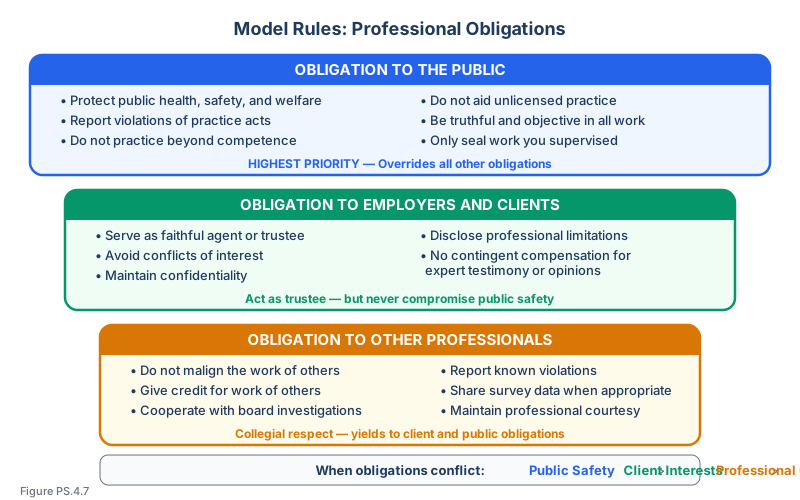
The Model Rules provide detailed guidance on professional conduct. They address:
Rules of Professional Conduct:
- Licensee's Obligation to the Public
- Licensee's Obligation to Employers and Clients
- Licensee's Obligation to Other Licensees
Obligations to the Public
Paramount Duty
The surveyor's paramount duty is to protect the health, safety, and welfare of the public. This obligation supersedes obligations to clients, employers, or the profession:
- A surveyor who discovers a condition that threatens public safety must take appropriate action, even if the client objects
- A surveyor must not participate in activities that endanger the public
- A surveyor must report violations of the licensing law to the appropriate authority
Competence
A surveyor shall undertake only those assignments for which the surveyor is qualified by education, training, and experience:
| Principle | Application |
|---|---|
| Accept only qualified work | Do not accept projects outside your area of competence |
| Disclose limitations | Inform the client if the project approaches the limits of your expertise |
| Seek assistance | Engage specialists or consultants when the project requires expertise you lack |
| Maintain competence | Keep current with changes in technology, standards, and law |
Truthfulness
A surveyor shall be truthful and objective in all professional reports, statements, and testimony:
- Do not misrepresent qualifications, experience, or capabilities
- Do not misrepresent findings, opinions, or conclusions
- Do not falsify records, reports, or documents
- Do not suppress relevant information in professional communications
Public Statements
When making public statements on professional matters:
- Express opinions only on matters within your competence
- Distinguish between facts and opinions
- Do not make exaggerated claims about your services
- Do not disparage other professionals without factual basis
Obligations to Clients and Employers
Faithful Agency
A surveyor shall act as a faithful agent or trustee for the client or employer:
| Obligation | Application |
|---|---|
| Disclose conflicts | Inform the client of any financial, personal, or professional interest that could influence judgment |
| Maintain confidentiality | Do not disclose client information without consent (except as required by law) |
| Avoid competing interests | Do not accept compensation from more than one party on the same project without full disclosure to all parties |
| Return materials | Upon termination, return client property and project materials |
Professional Independence
Despite the obligation of faithful agency, the surveyor must maintain professional independence:
- Do not allow the client to dictate professional conclusions
- Do not certify work that does not meet professional standards, regardless of client pressure
- Do not accept instructions that would require violation of law or professional rules
- The surveyor's professional judgment must remain independent
This balance between faithfulness and independence is a common exam topic. The correct answer is always that professional obligations to the public override obligations to the client.
Common wrong path — letting client pressure override professional judgment. The most common PS ethics trap: the question describes a client asking for a specific result — "please just change this monument location," "the plat needs to show the fence as the boundary," "can you certify we've met the setback" — and offers the surveyor choices including "comply because the client hired you." That's always wrong. The surveyor's obligation of faithful agency runs to honest professional work, not to delivering whatever conclusion the client wants. Independence from client pressure is a core ethical requirement. The correct answer to any client-pressure scenario always involves the surveyor refusing to misrepresent, withdrawing from the engagement if necessary, and documenting the situation. Clients hire your professional judgment; they do not purchase the right to override it.
Quick retrieval check — try before reading on.
▶Your client, a developer, insists that the ALTA survey show that there are no encroachments on the property. During fieldwork you clearly observe that the neighboring property's garage crosses the boundary by 2.4 ft. The client threatens to withhold payment and to never hire you again if the encroachment appears on the plat. What is the correct professional response?
Show the encroachment on the plat. There is no choice here. Facts observed in the field must be reported accurately; hiding the encroachment would be falsification — a violation of the truthfulness requirement and grounds for disciplinary action. The surveyor's obligation to the public (accurate documentation of property conditions) and to subsequent relying parties (the lender, the title insurer, the buyer) overrides any client pressure. Professional response: (1) inform the client that the encroachment must be shown, (2) explain the legal and professional reasons, (3) if the client persists or refuses payment, document the demand in writing and withdraw from the engagement if necessary, (4) consider whether to report the incident to the licensing board if the client attempts to pressure another surveyor. Losing the client is an acceptable outcome; losing your license is not.
Fee-Related Ethics
- Do not accept contingent fees when the surveyor's judgment may be compromised (for example, a fee that depends on the survey reaching a particular conclusion)
- Do not undercut competitors by offering to perform work below the standard of care
- Disclose the basis of compensation to the client
- Do not pay or accept kickbacks, commissions, or referral fees that create conflicts of interest
Obligations to Other Professionals
Professional Courtesy
| Obligation | Application |
|---|---|
| Give credit | Acknowledge the work of others; do not take credit for work you did not perform |
| Avoid disparagement | Do not make false or malicious statements about other professionals |
| Cooperate | Share information necessary for the proper conduct of surveying services |
| Report violations | Report known violations of the licensing law to the board |
| Respect boundaries | Do not attempt to supplant another surveyor on a project through unfair means |
Reviewing Another Surveyor's Work
When engaged to review or evaluate another surveyor's work:
- Notify the other surveyor that their work is being reviewed (when practical and not contrary to the client's interests)
- Base the review on objective professional standards, not personal differences of opinion
- Recognize that reasonable professionals may reach different conclusions on some matters
- Distinguish between errors (violations of standards) and differences of professional judgment
Conflicts of Interest
Types of Conflicts
| Conflict Type | Example |
|---|---|
| Financial | Surveyor owns property adjacent to client's property being surveyed |
| Relational | Surveyor's family member is a party in a boundary dispute |
| Multiple clients | Surveyor engaged by both buyer and seller of the same property |
| Business | Surveyor recommends a contractor in whom the surveyor has a financial interest |
| Prior involvement | Surveyor previously worked on the same property for an adverse party |
Required Response to Conflicts
- Identify the conflict before accepting the engagement
- Disclose the conflict fully to all affected parties
- Obtain consent from all affected parties to proceed (documented in writing)
- Withdraw if the conflict cannot be adequately managed or if consent is not obtained
When Withdrawal Is Required
Some conflicts are too severe to manage through disclosure:
- The surveyor's financial interest is directly affected by the survey outcome
- The surveyor cannot exercise independent professional judgment
- The conflict creates an appearance of impropriety that disclosure cannot cure
- Any party withholds consent to the surveyor's continued involvement
Seal and Signature Requirements
The Professional Seal
The seal (or stamp) of a licensed surveyor is a legal instrument that:
- Identifies the responsible professional
- Certifies that the document was prepared under the surveyor's responsible charge
- Indicates that the surveyor has reviewed and approved the document
- Creates legal accountability for the content
When the Seal Is Required
| Document | Seal Required |
|---|---|
| Survey plats and maps | Yes -- when filed as public record or furnished to the client |
| Legal descriptions | Yes -- when prepared by the surveyor |
| Survey reports | Yes -- when issued as a professional document |
| Calculations | Varies by jurisdiction -- typically not required unless furnished as deliverable |
| Preliminary/draft documents | No -- but must be clearly marked as preliminary |
| Internal work papers | No |
Responsible Charge
"Responsible charge" means the individual control and direction of surveying work. The licensee who seals a document must have:
- Personally directed the work, or
- Reviewed the work sufficiently to have personal knowledge of its adequacy
Sealing work performed by others without adequate review is a violation of professional conduct rules and may constitute fraud.
Signature Requirements
Most jurisdictions require that sealed documents also bear the surveyor's signature and date:
- The signature must be the personal signature of the licensee (not a stamp or reproduction)
- The date indicates when the surveyor signed, not necessarily when the work was completed
- Digital or electronic signatures are accepted in many jurisdictions, subject to specific requirements
- The signature confirms the surveyor's personal responsibility for the document
Protecting the Seal
| Action | Required |
|---|---|
| Secure storage | Keep seal secure to prevent unauthorized use |
| Report loss | Notify the board if the seal is lost or stolen |
| Retire upon expiration | Do not use the seal after license expires or lapses |
| Do not lend | Never allow another person to use your seal |
| Seal only your work | Only seal documents prepared under your responsible charge |
Continuing Education
Purpose
Continuing education (CE) requirements ensure that licensed professionals maintain competency throughout their careers. Justifications include:
- Technology evolves rapidly (GNSS, LiDAR, UAS)
- Laws and regulations change
- Standards are periodically updated (ALTA/NSPS, state minimum standards)
- New methods and best practices emerge
- Public protection requires current knowledge
Model Law Provisions
The Model Law recommends that each state require continuing professional competency as a condition of license renewal. Specific requirements vary by state, but common elements include:
| Element | Typical Requirement |
|---|---|
| Hours per renewal period | 15-30 professional development hours (PDH) per two-year cycle |
| Qualifying activities | Courses, seminars, conferences, self-study, teaching, publishing |
| Approved providers | registered providers, professional associations, universities |
| Record keeping | Licensee must maintain records for audit |
| Ethics requirement | Some states require a minimum number of hours in professional ethics |
| Carryover | Some states allow excess hours to carry forward to the next period |
Professional Development Activities
| Activity | Typical PDH Credit |
|---|---|
| Attending a course or seminar | 1 PDH per contact hour |
| Teaching a course (first time) | 2 PDH per contact hour |
| Publishing a paper | Up to 10 PDH |
| Active participation in professional society | Varies |
| Self-study (approved programs) | Varies by jurisdiction |
| Patent obtained | Up to 10 PDH |
Disciplinary Process
Grounds for Discipline
Common grounds for disciplinary action include:
- Practicing beyond the scope of competence
- Fraud, deceit, or misrepresentation
- Negligence or incompetence in professional practice
- Conviction of a felony or crime related to professional practice
- Violation of rules of professional conduct
- Allowing unauthorized use of the seal
- Aiding unlicensed practice
- Failure to comply with continuing education requirements
- Failure to report as required (e.g., settlements, convictions)
Disciplinary Actions
| Action | Severity | Effect |
|---|---|---|
| Letter of concern | Least severe | Warning without formal discipline |
| Reprimand | Moderate | Formal censure, placed in record |
| Probation | Moderate | License retained with conditions |
| Fine | Moderate | Monetary penalty |
| Suspension | Severe | Cannot practice for specified period |
| Revocation | Most severe | License permanently removed (may allow reapplication) |
Due Process
Licensees facing discipline are entitled to:
- Notice of the charges
- Opportunity to respond
- Hearing before the board (or hearing officer)
- Legal representation
- Appeal of adverse decisions
- Access to evidence
Ethical Decision-Making Framework
When facing an ethical dilemma, apply this framework:
- Identify the issue -- What ethical principle or rule is at stake?
- Identify the stakeholders -- Who is affected (public, client, other professionals)?
- Consider the obligations -- What do the rules of conduct require?
- Prioritize obligations -- Public safety supersedes client interests; professional standards supersede client instructions
- Evaluate options -- What actions are available, and what are their consequences?
- Choose the principled action -- Select the option that best fulfills professional obligations
- Document the decision -- Record the rationale for the chosen course of action
Exam Tips
- The public welfare obligation always takes priority -- if a question pits client interests against public safety, public safety wins
- Know the three categories of obligations: to the public, to clients/employers, and to other professionals
- Conflicts of interest questions test whether you can identify conflicts and apply the disclosure-consent-withdrawal framework
- Seal and signature questions test responsible charge -- you cannot seal work you did not direct or adequately review
- Understand that professional independence must be maintained even when acting as a faithful agent for the client
- Continuing education questions are straightforward -- know the general framework and typical requirements
- When in doubt, the most conservative ethical answer is usually correct on the PS exam
Related Test Topics
- Risk Management (Topic 4.6)
- Client Communication and Interdisciplinary Coordination (Topic 4.8)
- Costs, Budgets, and Contracts (Topic 4.2)
- Quality Assurance and Quality Control Methods (Topic 4.5)
Further Reading
Authoritative sources for deeper study
NCEES Model Rules of Professional Conduct (Aug 2025) — Model ethics, competence, and licensure rules adopted by most state boards.
Brown's Boundary Control and Legal Principles (7th Ed., Robillard & Wilson) — Standard textbook on boundary law, evidence hierarchy, and retracement.
Last updated: 2026-04-17