PS Exam Preparation
Comprehensive preparation for the NCEES Principles and Practice of Surveying (PS) exam. 5 modules covering all 5 exam domains with 50 in-depth topics.
Module 1: Legal Principles
Module 2: Professional Survey Practices
Module 3: Standards & Specifications
Module 4: Business Practices
Module 5: Areas of Practice
Risk Management & Insurance
Learning Objectives
After completing this topic, you should be able to:
- Identify major categories of risk in surveying practice
- Explain the purpose and structure of professional liability (E&O) insurance
- Evaluate risk allocation provisions in contracts
- Draft and interpret indemnification and limitation of liability clauses
- Apply risk management strategies to reduce exposure
- Understand the relationship between insurance, contracts, and professional practice
Overview
Risk management is the systematic process of identifying, assessing, and mitigating threats to a surveying practice. Every project carries risk -- the risk of errors, the risk of client disputes, the risk of physical harm, and the risk of financial loss. Professional surveyors do not eliminate risk; they manage it through insurance, contract provisions, quality procedures, and sound professional judgment.
The PS exam tests your understanding of how these risk management tools work together. A surveyor who delivers technically excellent work but ignores contractual risk allocation may find that a single claim exceeds the firm's ability to survive.
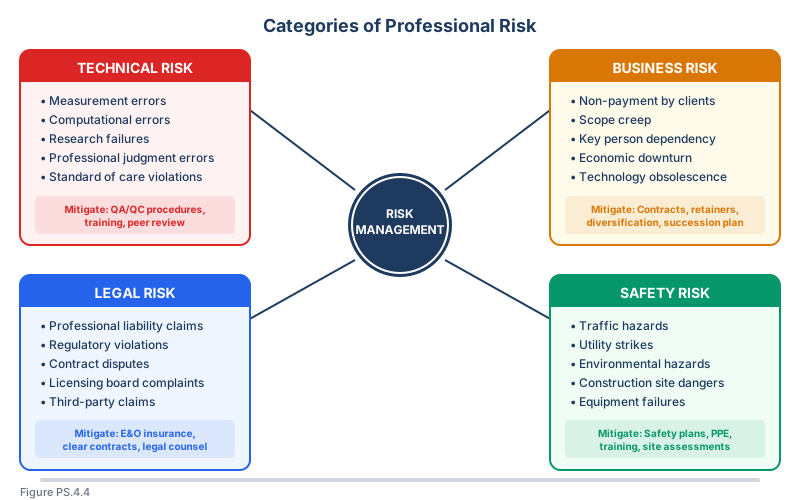
Categories of Risk
Technical Risk
Errors and omissions in the technical work product:
| Risk | Example | Consequence |
|---|---|---|
| Measurement error | Systematic EDM error due to uncalibrated instrument | Incorrect boundary positions |
| Computational error | Transposed coordinates in staking layout | Structure built in wrong location |
| Research failure | Missing a recorded easement | Encroachment on easement |
| Judgment error | Incorrect application of boundary law principles | Boundary set at wrong location |
| Standard of care violation | Failure to meet ALTA/NSPS requirements | Survey rejected by title company |
Business Risk
Risks arising from business operations:
| Risk | Example | Consequence |
|---|---|---|
| Non-payment | Client refuses to pay for completed work | Revenue loss, collection costs |
| Scope creep | Work performed without authorization | Uncompensated labor |
| Key person dependency | Licensed surveyor leaves the firm | Cannot seal work, lose clients |
| Economic downturn | Construction market contracts | Revenue decline, excess capacity |
| Technology obsolescence | Equipment becomes outdated | Loss of competitive advantage |
Legal Risk
Risks from legal claims and regulatory actions:
| Risk | Example | Consequence |
|---|---|---|
| Professional liability claim | Client sues for negligent survey | Defense costs, damages, reputation |
| Board complaint | Complaint filed with state licensing board | Investigation, discipline, license risk |
| Contractual dispute | Disagreement over scope or deliverables | Litigation, arbitration costs |
| Third-party claim | Non-client relies on survey and suffers harm | Extended liability exposure |
| Regulatory violation | Failure to file required survey records | Fines, discipline |
Physical Risk
Risks of bodily harm or property damage:
| Risk | Example | Consequence |
|---|---|---|
| Vehicle accident | Crew vehicle in collision | Injury, vehicle damage, liability |
| Struck by vehicle | Worker hit in traffic work zone | Injury or fatality |
| Fall | Worker falls from embankment | Injury |
| Environmental exposure | Heat illness, snake bite | Injury, medical costs |
| Equipment damage | Instrument dropped or stolen | Repair/replacement cost |
Professional Liability Insurance
Errors and Omissions (E&O) Insurance
Professional liability insurance, commonly called E&O insurance, is the primary financial protection against claims of professional negligence:
What E&O Covers:
- Defense costs (attorney fees, expert witnesses, court costs)
- Damages awarded by judgment or agreed in settlement
- Some policies cover regulatory defense costs
What E&O Does NOT Cover:
- Intentional misconduct or fraud
- Criminal fines or penalties
- Bodily injury or property damage (covered by general liability)
- Breach of contract (some policies exclude, some cover)
- Punitive damages (excluded in most jurisdictions)
- Work performed outside the policy period (unless tail coverage purchased)
- Guaranteed or warranted outcomes
Policy Structure
| Term | Definition |
|---|---|
| Claims-made | Covers claims made during the policy period, regardless of when the error occurred (most E&O policies) |
| Occurrence | Covers events that occur during the policy period, regardless of when the claim is made (rare for E&O) |
| Per-claim limit | Maximum payout for a single claim |
| Aggregate limit | Maximum total payout during the policy period |
| Deductible / Self-insured retention (SIR) | Amount the insured must pay before coverage begins |
| Retroactive date | The earliest date of service covered by the policy |
| Extended reporting period (tail) | Optional extension to report claims after the policy expires |
Claims-Made vs. Occurrence
The claims-made structure has significant implications:
- Gap risk: If the policy is not renewed and no tail coverage is purchased, claims arising from past work may be uninsured
- Prior acts coverage: Coverage for errors that occurred before the policy inception but are claimed during the policy period (depends on retroactive date)
- Tail coverage: Essential when changing carriers or retiring -- allows claims to be reported after the policy expires
Common wrong path — letting E&O lapse without tail coverage. Professional liability policies are almost universally claims-made: coverage applies to claims reported during the policy period, not to work done during that period. A surveyor who closes their practice and stops paying premiums is instantly uninsured for every survey they ever performed — because there is no active policy to accept a future claim. The same is true when switching carriers if the new policy's retroactive date is later than the old policy's. The remedy is tail coverage (extended reporting period): a one-time premium that lets you continue reporting claims against your past work for a specified period (often 1–5 years, sometimes indefinitely). Exam questions plant this trap by describing a surveyor who "retires and cancels insurance" — the answer is "they are exposed unless they purchased tail coverage." Retirement without tail is a catastrophic oversight.
Quick retrieval check — try before reading on.
▶A surveyor performs a boundary survey in 2019 on a claims-made policy. In 2021 they switch insurers; the new policy has a retroactive date of 2021-01-01 (no prior acts coverage). In 2024 a claim is filed alleging negligence in the 2019 survey. Is the claim covered?
No, under either policy as described. The 2019 policy is no longer in force when the 2024 claim is made, so it cannot accept the claim (claims-made policies only accept claims during the policy period). The 2021 policy has a retroactive date of 2021-01-01, meaning it only covers work performed on or after that date — the 2019 survey falls before the retroactive date and is excluded. The surveyor is personally exposed for the entire defense cost and any damages. This gap is preventable by either (a) purchasing tail coverage when leaving the first policy, or (b) negotiating a retroactive date on the new policy that reaches back to cover the prior work. Both options cost money; the failure to arrange either costs far more if a claim arrives.
Factors Affecting Premiums
| Factor | Impact on Premium |
|---|---|
| Revenue | Higher revenue = higher premium |
| Types of services | Boundary and ALTA surveys carry more risk than topographic surveys |
| Claims history | Past claims increase premiums significantly |
| Deductible selected | Higher deductible = lower premium |
| Geographic area | Litigious areas cost more |
| Firm size | More employees = more exposure |
| Quality management | Documented QA/QC programs may reduce premiums |
Other Insurance Types
| Insurance | Coverage | Applicability |
|---|---|---|
| General liability (CGL) | Bodily injury, property damage to third parties | Required for most contracts |
| Workers compensation | Employee injuries on the job | Required by law in most states |
| Commercial auto | Vehicle accidents | Required for all firm vehicles |
| Umbrella/excess | Additional limits above primary policies | Large projects, high-value contracts |
| Inland marine | Equipment damage and theft | Protects expensive survey equipment |
| Cyber liability | Data breach, ransomware | Increasing relevance for digital records |
Contractual Risk Management
Limitation of Liability Clauses
A limitation of liability clause caps the surveyor's total liability for a project:
Typical provision: "Surveyor's total liability for all claims arising from this project shall not exceed the greater of $50,000 or the total fee paid for services."
Key considerations:
- Must be negotiated before work begins (courts generally will not enforce limits imposed after a dispute arises)
- Some jurisdictions limit enforceability for certain types of claims
- The cap should be reasonable and proportional to the fee
- Does not limit liability for intentional misconduct
- Some clients (particularly public agencies) will not accept limitation clauses
Indemnification Provisions
Indemnification clauses allocate responsibility for losses between parties:
Types of indemnification:
| Type | Surveyor Indemnifies For | Risk Level |
|---|---|---|
| Limited (recommended) | Claims arising from the surveyor's own negligence | Fair allocation |
| Intermediate | Claims arising from the surveyor's negligence, including defense costs | Moderate risk |
| Broad form (avoid) | All claims arising from the project, regardless of fault | Extreme risk -- may not be insurable |
Recommended language: "Surveyor shall indemnify and hold harmless Client from claims, damages, and losses to the extent caused by the negligent acts, errors, or omissions of the Surveyor in the performance of services."
The phrase "to the extent caused by" ensures the surveyor is only responsible for its proportionate share of liability.
Language to avoid: "Surveyor shall indemnify and hold harmless Client from any and all claims arising out of or related to the services." This imposes liability for claims that may not be the surveyor's fault.
Dispute Resolution
Contracts should specify how disputes will be resolved:
| Method | Characteristics |
|---|---|
| Negotiation | Direct discussion between parties; no cost, no binding outcome |
| Mediation | Neutral third party facilitates agreement; non-binding |
| Arbitration | Neutral third party renders a decision; binding |
| Litigation | Court proceedings; most expensive, most formal |
Many surveying contracts specify a stepped process: negotiation first, then mediation, then arbitration or litigation. This approach resolves many disputes before they become costly.
Contractual Risk Transfer
Contracts can transfer risk through various mechanisms:
| Mechanism | Purpose |
|---|---|
| Insurance requirements | Require the other party to carry specified insurance |
| Additional insured endorsement | Add the client to the surveyor's CGL policy (common request) |
| Waiver of subrogation | Prevent one party's insurer from pursuing the other party |
| Hold harmless | One party agrees to bear losses that would otherwise fall on the other |
Risk Assessment and Mitigation
Project Risk Assessment
Before accepting a project, evaluate risk factors:
| Factor | Low Risk | High Risk |
|---|---|---|
| Client | Established relationship, sophisticated client | New client, unrealistic expectations, litigious history |
| Scope | Well-defined, familiar project type | Ambiguous scope, unfamiliar project type |
| Property | Clear title, no disputes | Contested boundaries, multiple claimants |
| Fee | Adequate for scope and quality | Compressed fee, competitive pressure to cut corners |
| Schedule | Reasonable timeline | Unrealistic deadline, pressure to skip steps |
| Third-party reliance | Limited to client | Title companies, lenders, buyers will rely on survey |
| Value | Modest property value | High-value commercial or development property |
Risk Response Strategies
| Strategy | Description | Example |
|---|---|---|
| Avoid | Do not accept the risk | Decline the project |
| Transfer | Shift risk to another party | Insurance, indemnification clauses |
| Mitigate | Reduce the likelihood or impact | QA/QC procedures, clear scope, documentation |
| Accept | Acknowledge and manage the risk | Accept a well-defined project with adequate insurance |
Documentation as Risk Management
Thorough documentation is the surveyor's best defense against claims:
Document these items for every project:
- All research conducted and sources reviewed
- Field conditions and evidence found (and not found)
- Professional judgment decisions and their basis
- Client communications and instructions
- Scope changes and authorizations
- QA/QC activities performed
- Deviations from standard procedures and their justification
Statutes of Limitation and Repose
Statutes of Limitation
A statute of limitation sets the time within which a legal claim must be filed after the injury is discovered (or should have been discovered):
| Claim Type | Typical Limitation Period |
|---|---|
| Breach of written contract | 3-6 years (varies by state) |
| Breach of oral contract | 2-4 years (varies by state) |
| Professional negligence | 2-4 years from discovery |
| Fraud | 3-6 years from discovery |
Statutes of Repose
A statute of repose sets an absolute outer limit on claims regardless of when the injury was discovered. Many states have statutes of repose for design professionals (including surveyors) that range from 6 to 15 years from completion of services.
Key distinction: A statute of limitation begins when the injury is discovered; a statute of repose begins when the services are completed. The statute of repose provides an absolute cutoff that the statute of limitation cannot extend beyond.
Exam Tips
- Understand the difference between claims-made and occurrence policies -- nearly all E&O policies are claims-made
- Know what E&O insurance does and does not cover
- Limitation of liability and indemnification questions are common -- know the difference between limited, intermediate, and broad form indemnification
- The "standard of care" is reasonable professional care, not perfection -- contracts should not guarantee error-free results
- Understand the stepped dispute resolution process (negotiation, mediation, arbitration, litigation)
- Know the difference between statutes of limitation (from discovery) and statutes of repose (from completion)
- Risk assessment questions may present a project scenario and ask you to identify the highest-risk elements
Related Test Topics
- Costs, Budgets, and Contracts (Topic 4.2)
- Safety Procedures (Topic 4.4)
- Quality Assurance and Quality Control Methods (Topic 4.5)
- Professional Conduct and Ethics (Topic 4.7)
Further Reading
Authoritative sources for deeper study
NCEES Model Rules of Professional Conduct (Aug 2025) — Model ethics, competence, and licensure rules adopted by most state boards.
Brown's Boundary Control and Legal Principles (7th Ed., Robillard & Wilson) — Standard textbook on boundary law, evidence hierarchy, and retracement.
Clark, A Treatise on the Law of Surveying and Boundaries — Long-standing legal reference on boundary disputes and surveyor liability.
Last updated: 2026-04-17