PS Exam Preparation
Comprehensive preparation for the NCEES Principles and Practice of Surveying (PS) exam. 5 modules covering all 5 exam domains with 50 in-depth topics.
Module 1: Legal Principles
Module 2: Professional Survey Practices
Module 3: Standards & Specifications
Module 4: Business Practices
Module 5: Areas of Practice
Parol Evidence
Learning Objectives
After completing this topic, you should be able to:
- Define parol evidence and explain its role in boundary surveying
- State the parol evidence rule and identify its exceptions
- Distinguish between latent and patent ambiguity
- Explain when parol evidence is admissible to clarify deed language
- Identify situations where oral testimony can override written documents
- Apply the parol evidence rule to exam-style boundary scenarios
Overview
Parol evidence is any evidence that exists outside the four corners of a written instrument. The term "parol" comes from the French word for "word" or "speech," and while it most commonly refers to oral testimony, it encompasses any extrinsic evidence -- including other writings, physical evidence, and surrounding circumstances -- that is not contained in the document itself.
The parol evidence rule is one of the most important and frequently tested legal principles on the PS exam. It governs when extrinsic evidence may be used to interpret, supplement, or contradict the terms of a written deed or other conveyance. Understanding this rule is essential because surveyors routinely encounter situations where the deed language alone does not resolve the boundary location.
Key Concepts
What Constitutes Parol Evidence
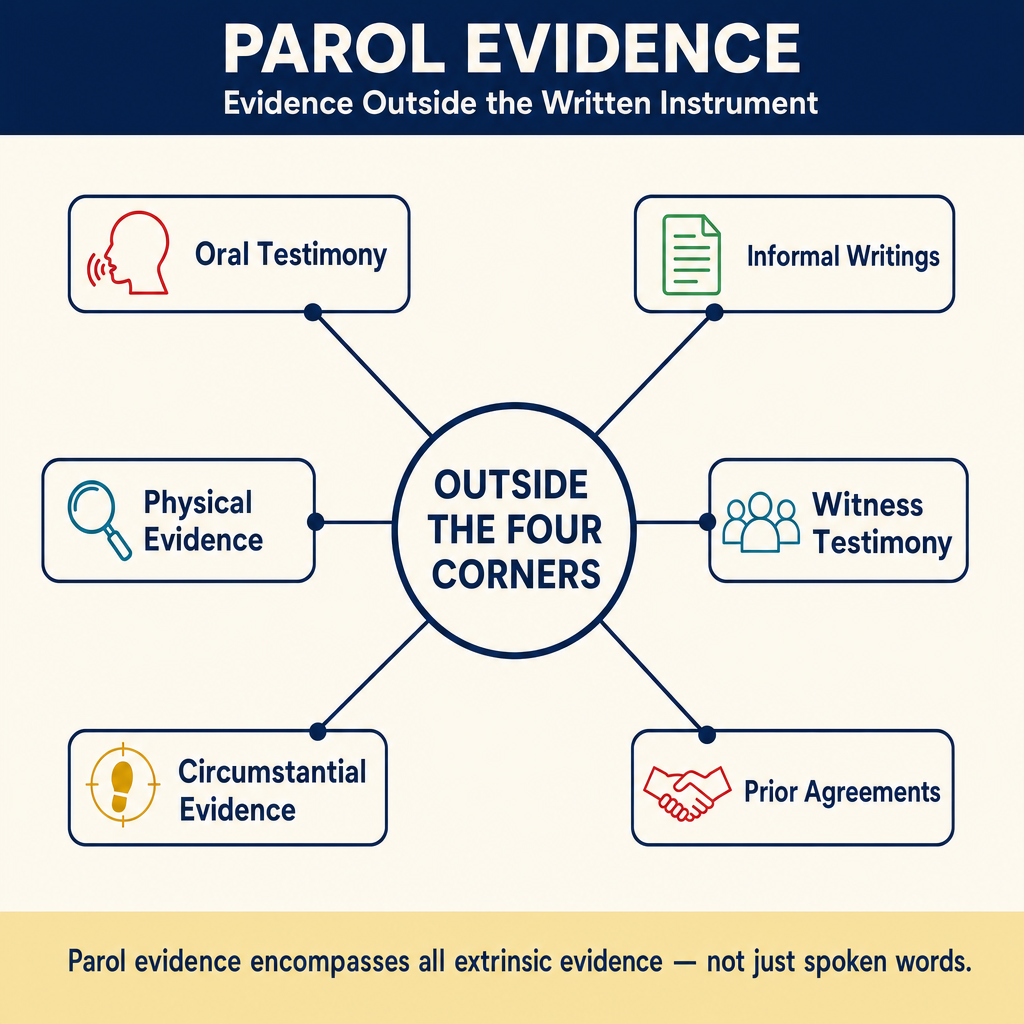
Parol evidence includes any evidence outside the written instrument:
| Type | Examples |
|---|---|
| Oral testimony | Statements by grantors, grantees, neighbors, prior surveyors |
| Written documents not under seal | Letters, notes, informal agreements, prior drafts |
| Physical evidence | Location of fences, occupation lines, improvements |
| Witness testimony | People who observed monument placement or boundary agreements |
| Circumstantial evidence | Surrounding facts, customs, local practices |
| Prior or contemporaneous agreements | Earlier oral or written agreements between the parties |
The Parol Evidence Rule
The parol evidence rule states:
When parties have reduced their agreement to a final written instrument, parol evidence of prior or contemporaneous agreements or negotiations is not admissible to vary, contradict, or add to the terms of the writing.
In simpler terms: if you signed a deed, you generally cannot introduce outside evidence to change what the deed says. The written document is presumed to contain the parties' complete and final agreement.
However, the rule has critical exceptions that are directly relevant to surveying practice:
Exceptions to the Parol Evidence Rule
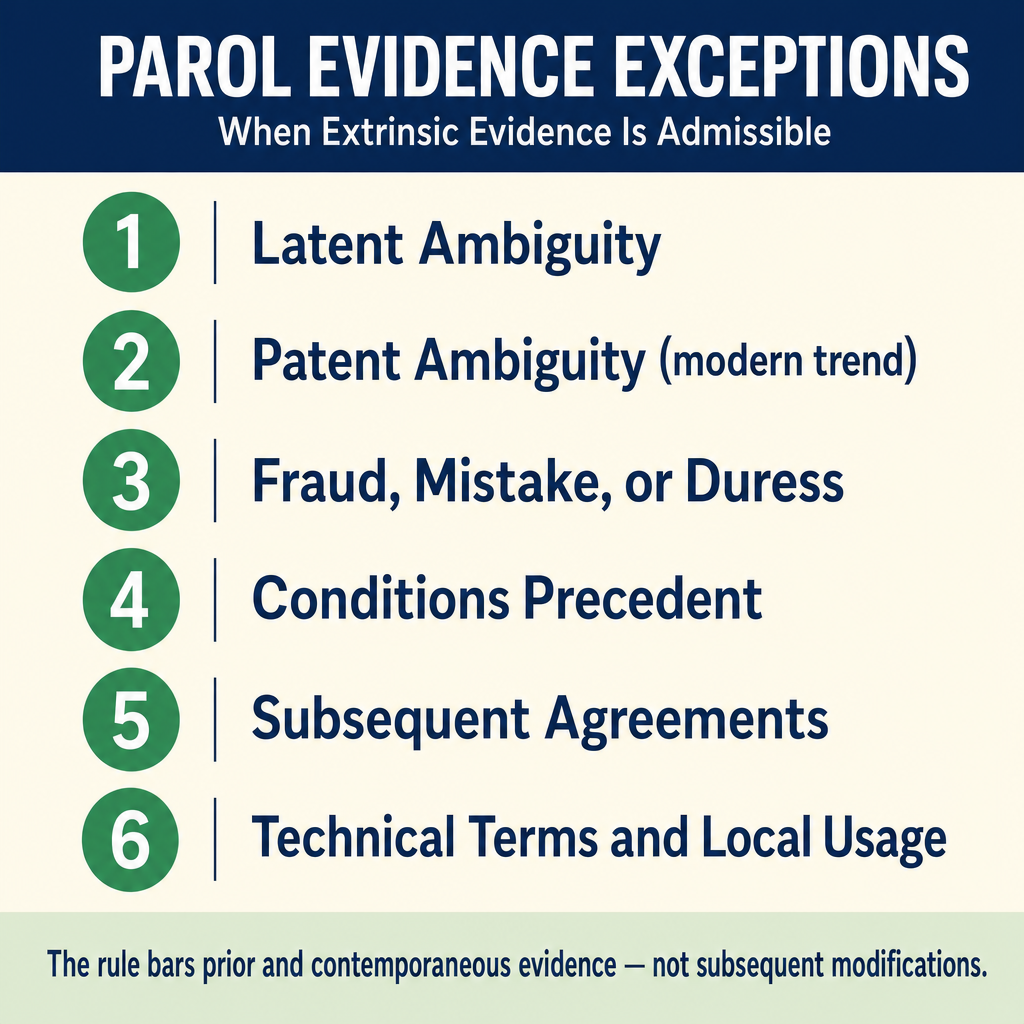
1. Latent Ambiguity
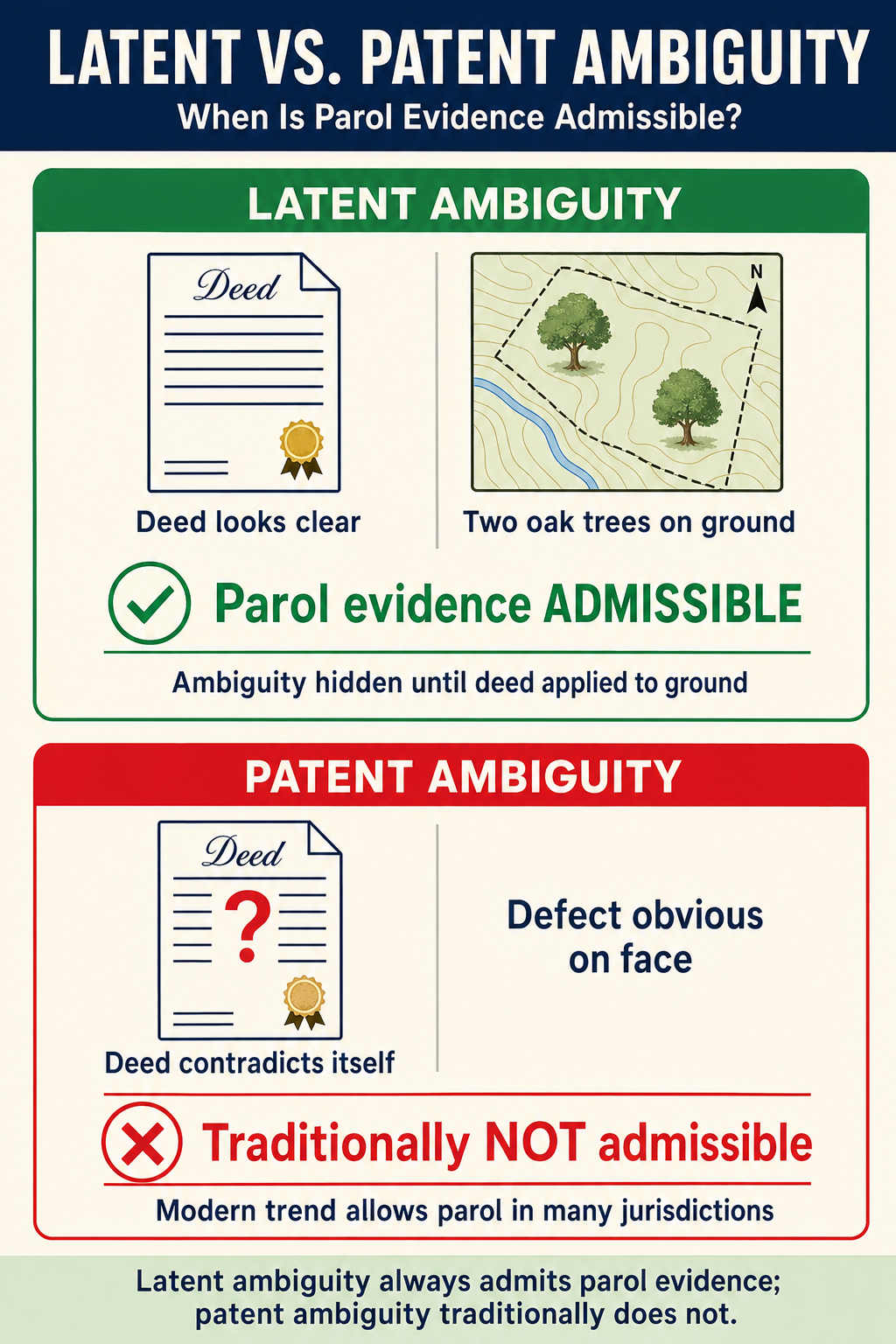
Parol evidence is admissible to resolve a latent ambiguity. A latent ambiguity exists when:
- The language of the instrument appears clear and unambiguous on its face
- The ambiguity only becomes apparent when the description is applied to the ground
- The language fits two or more possible locations or interpretations when applied to actual conditions
Classic example: A deed calls for "the large oak tree at the northeast corner." The description seems perfectly clear. But when the surveyor goes to the ground, there are two large oak trees near the northeast area. The ambiguity is latent -- hidden until the deed is applied to reality. Parol evidence (testimony from the grantor, neighbors, or the surveyor who prepared the description) is admissible to determine which oak tree was intended.
Additional examples of latent ambiguity:
- A deed references "John Smith's property" and there are two John Smiths in the area
- A description calls for a monument that has been destroyed, and the location is disputed
- Courses and distances do not close, and adjacent calls are ambiguous
- A call for a natural feature that has shifted position since the deed was written
2. Patent Ambiguity
A patent ambiguity is an ambiguity that is apparent on the face of the instrument itself. The document is clearly defective or contradictory without needing to look beyond its four corners.
Examples of patent ambiguity:
- A deed describes a parcel by metes and bounds but the description does not close
- The deed grants "the north half" but also describes a parcel that is clearly not the north half
- Conflicting bearings and distances within the same description
- A deed that grants land to "A or B" without clarifying which party receives title
Important distinction for the exam: Courts have historically been divided on whether parol evidence is admissible to resolve patent ambiguity. The traditional rule held that parol evidence was not admissible for patent ambiguity because the defect was the drafter's fault and should not be fixed by outside evidence. The modern trend, however, allows parol evidence to resolve patent ambiguity in many jurisdictions.
| Type | Appears on Face? | Parol Evidence Admissible? |
|---|---|---|
| Latent ambiguity | No -- clear until applied to the ground | Yes -- universally accepted |
| Patent ambiguity | Yes -- obvious defect in the document | Traditionally no; modern trend yes |
Common wrong path — admitting parol evidence when the deed is clear. The parol evidence rule has real teeth: when a deed's language is unambiguous and applies cleanly to the ground, extrinsic evidence cannot be used to contradict it — not even testimony from the grantor about what they "really meant." Students routinely miss this on exam questions that describe a clear deed ("thence N 45° E, 200.00 ft to an iron pipe"), a monument found exactly where described, and a grantor claiming the actual intent was different. Parol evidence is inadmissible here because there is no ambiguity to resolve. The classic trigger for admitting parol evidence is latent ambiguity — the deed is clear on paper but produces two or more plausible positions on the ground (two oak trees, two John Smiths). Without that trigger, the four-corners rule controls.
Quick retrieval check — try before reading on.
▶A 1958 deed calls for "the south line of the Anderson Ranch." When you retrace, you find that two separate Anderson family ranches bordered the property — a north Anderson Ranch operated by one family branch and a south Anderson Ranch operated by another. The grantor is deceased, but their adult child testifies the grantor intended the north Anderson Ranch. Is the child's testimony admissible?
Yes — this is a classic latent ambiguity. The deed language ("the Anderson Ranch") appears unambiguous on its face; the ambiguity emerges only when applied to the ground and two candidate parcels exist. Parol evidence — including the child's testimony about the grantor's intent — is admissible to resolve which Anderson Ranch was meant. The child's testimony should be weighed against other corroborating evidence: prior deeds in the chain, historical maps, assessor records, physical evidence of which boundary has been respected by the parties since 1958. If everything points consistently to the north Anderson Ranch, that testimony plus corroborating evidence resolves the latent ambiguity. Note: if only one Anderson Ranch bordered the property, there would be no latent ambiguity and the child's testimony would be inadmissible.
3. Fraud, Mistake, or Duress
Parol evidence is always admissible to show that a deed was obtained by fraud, was the result of a mutual mistake, or was executed under duress. These go to the validity of the instrument itself, not merely its interpretation.
4. Conditions Precedent
Parol evidence may be introduced to show that the written agreement was subject to a condition that had to be fulfilled before the agreement became effective.
5. Subsequent Agreements
The parol evidence rule only bars evidence of prior or contemporaneous agreements. Evidence of agreements made after the written instrument was executed is admissible to show modification.
6. Explaining Technical Terms
Parol evidence is admissible to explain the meaning of technical terms, local usage, or trade customs that give special meaning to words in the instrument. For example, testimony about the local meaning of "to the river" (whether it means to the bank, to the thread, or to the water's edge) is admissible.
Parol Evidence in Surveying Practice
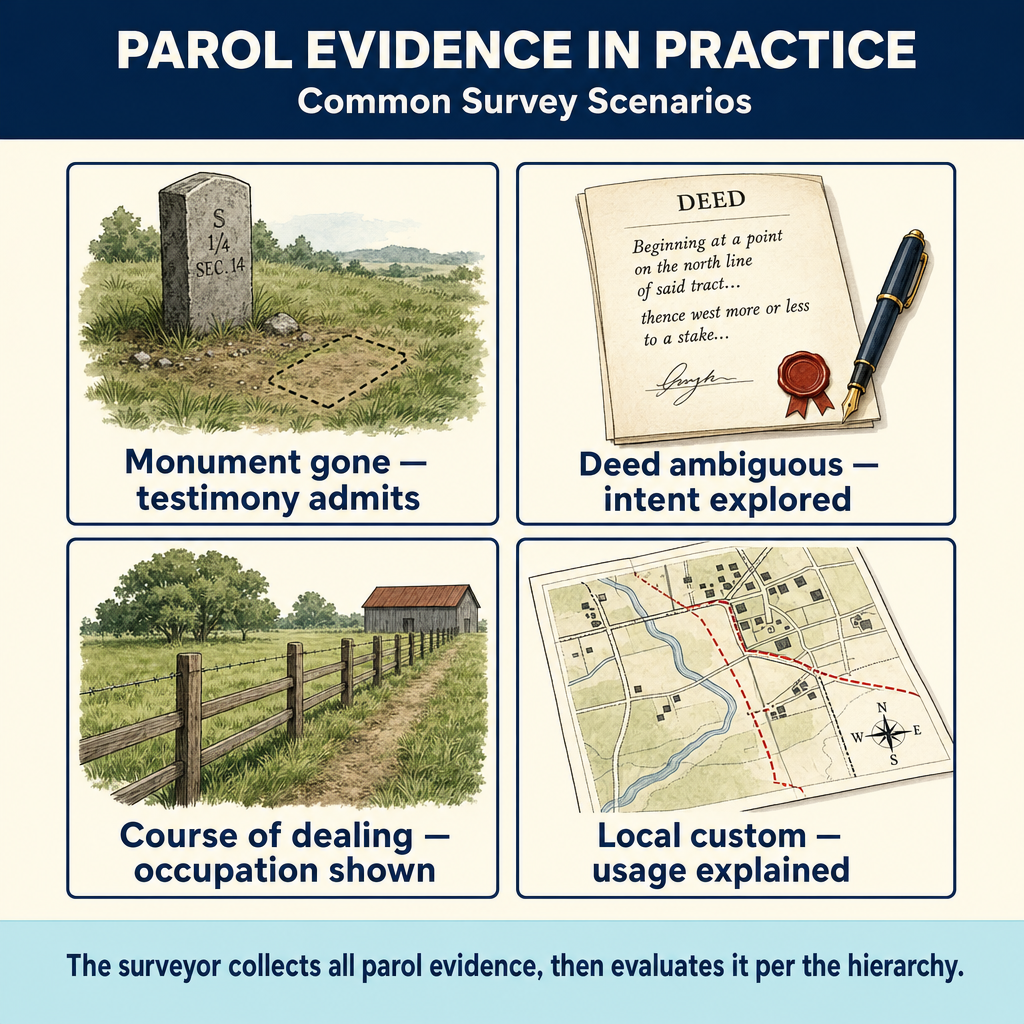
The surveyor encounters parol evidence issues in several common scenarios:
Monument identification: When a deed calls for a monument that is no longer extant, parol evidence (testimony from people who saw the monument, photographs, prior survey records) is admissible to establish its former location.
Intent of the parties: When the deed language is ambiguous, testimony about what the grantor and grantee intended may be admissible. However, the surveyor should be cautious -- the intent must be determined from the deed language itself if the language is clear.
Course of dealing: Evidence of how the parties actually treated the boundary after the conveyance may be admissible, particularly in establishing acquiescence or practical location.
Custom and usage: Local customs regarding boundary location (such as the tradition that fences are placed on the owner's side of the line, or that a call for "the road" means the centerline) may be explained through parol evidence.
The Surveyor's Role with Parol Evidence
While the surveyor is not a judge and does not make legal rulings on the admissibility of evidence, the surveyor must:
- Collect all available evidence, including parol evidence, during the investigation phase
- Evaluate the evidence according to established legal principles
- Document the evidence thoroughly in field notes and survey reports
- Apply the evidence to the boundary determination according to the hierarchy of controlling elements
- Note unresolvable conflicts and recommend legal counsel when appropriate
The surveyor should never ignore parol evidence simply because it is oral rather than written. In many retracement surveys, the testimony of long-time residents about the location of destroyed monuments or the history of fence lines is the most valuable evidence available.
Practical Application: Evaluating Oral Testimony
When evaluating oral testimony, the surveyor should consider:
- Age of the witness at the time of the event: Was the witness old enough to understand and remember what they observed?
- Relationship to the parties: Is the witness disinterested, or do they have a stake in the outcome?
- Specificity of the testimony: Does the witness provide specific, detailed information, or vague generalizations?
- Consistency: Is the testimony consistent with other evidence? Does the witness contradict themselves?
- Time elapsed: How long ago did the event occur? Memory degrades significantly over time.
- Corroboration: Is the testimony supported by other independent evidence?
The Best Evidence Rule
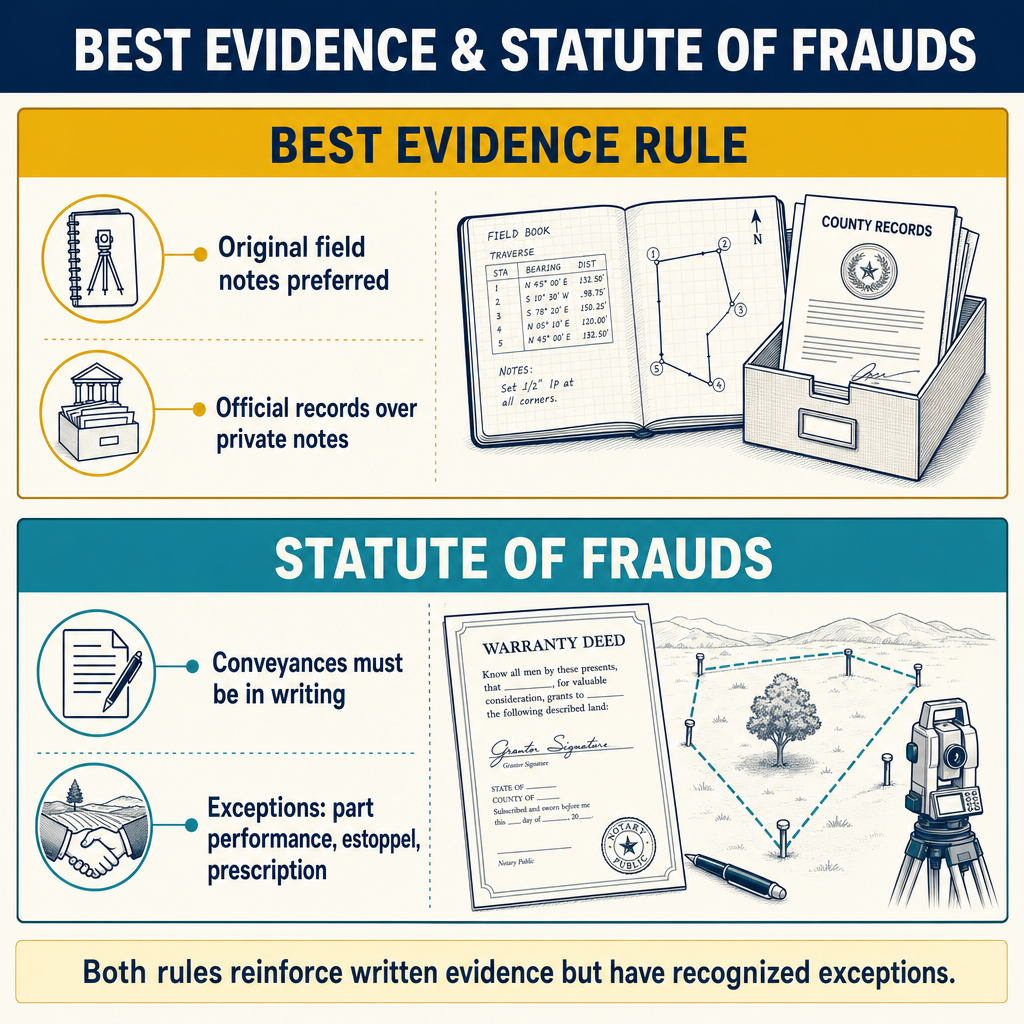
Related to the parol evidence rule is the best evidence rule, which requires that the best available evidence be produced. If an original document exists, a copy is generally not admissible (with modern exceptions for authenticated copies). For surveyors, this means:
- Original field notes are preferred over copies
- Recorded plats are preferred over unrecorded sketches
- Official records are preferred over private notes
- The original monument is preferred over testimony about the monument
The Statute of Frauds
The Statute of Frauds requires that conveyances of interests in real property be in writing and signed by the party to be charged. This statute reinforces the parol evidence rule by establishing that:
- Deeds must be in writing to be enforceable
- Easements generally must be in writing (with exceptions for implied and prescriptive easements)
- Boundary agreements that effectively transfer land should be in writing
- Oral promises to convey land are generally unenforceable
However, the Statute of Frauds has recognized exceptions:
- Part performance: When a party has substantially performed based on an oral agreement (entered possession, made improvements, paid consideration), courts may enforce the agreement despite the lack of writing
- Estoppel: When one party would be unjustly harmed by strict application of the statute
- Prescriptive rights: These arise by operation of law, not by agreement, so the Statute of Frauds does not apply
Key Court Decisions on Parol Evidence
Several landmark cases illustrate the application of parol evidence principles in boundary disputes:
Rivers v. Lozeau (Florida, 1989): Though primarily a landmark case on the retracement survey doctrine, Rivers v. Lozeau also illustrates how courts evaluate evidence beyond the written deed. The court held that a retracing surveyor must "track the footsteps of the original surveyor" and cannot establish new corners or correct original errors -- the surveyor "is only [the boundary's] discoverer, not its creator." The case underscores that extrinsic evidence (original monuments, field notes, physical evidence on the ground) is essential to locating boundaries described in deeds.
General principle from boundary case law: Courts have consistently held that when a deed calls for a natural monument that has changed position, parol evidence is admissible to show the monument's location at the time of the conveyance.
General principle from case law: Courts consistently hold that parol evidence is more readily admitted in boundary disputes than in contract disputes because the purpose of a boundary description is to locate specific land on the ground, and external evidence is often essential to that task.
Integration Clause
An integration clause (also called a merger clause) is a provision in a written agreement stating that the writing represents the complete and final agreement of the parties. When present:
- It strengthens the parol evidence rule
- It makes it harder to introduce extrinsic evidence of prior agreements
- It does NOT prevent the introduction of evidence to show fraud, mistake, or latent ambiguity
- It does NOT bar subsequent modifications
Deeds rarely contain integration clauses, but the concept is relevant because deeds are generally treated as integrated documents -- the legal description in the deed is presumed to be the parties' final expression of what land is being conveyed.
Exam Tips
- Latent vs. patent ambiguity is a high-frequency exam topic -- know the difference cold
- Parol evidence is always admissible to explain latent ambiguity
- The parol evidence rule bars prior and contemporaneous evidence, not subsequent agreements
- Remember that "parol" includes more than just oral testimony -- it encompasses all extrinsic evidence
- When a deed description is clear and unambiguous on its face, parol evidence generally cannot contradict it
- The most common exam scenario: a deed calls for a monument, the monument is gone, and you must determine whether testimony about its location is admissible (answer: yes, this is a latent ambiguity)
- Parol evidence can explain what a grantor meant by a term but cannot change a clear grant into something different
Related Test Topics
- Searching and Evaluating Evidence (Topic 1.1)
- Controlling Elements (Topic 1.5)
- Acquiescence and Boundary Agreement (Topic 1.4)
- Legal Descriptions (Topic 1.9)
- Sequential and Simultaneous Conveyances (Topic 1.8)
Further Reading
Authoritative sources for deeper study
Brown's Boundary Control and Legal Principles (7th Ed.), chapters on evidence hierarchy and weighing of conflicting calls.
Evidence and Procedures for Boundary Location (Robillard, Wilson, & Brown, 7th Ed.) — Practical treatise on collecting, weighing, and applying boundary evidence.
Clark, A Treatise on the Law of Surveying and Boundaries — Long-standing legal reference on boundary disputes and surveyor liability.
Last updated: 2026-04-17