PS Exam Preparation
Comprehensive preparation for the NCEES Principles and Practice of Surveying (PS) exam. 5 modules covering all 5 exam domains with 50 in-depth topics.
Module 1: Legal Principles
Module 2: Professional Survey Practices
Module 3: Standards & Specifications
Module 4: Business Practices
Module 5: Areas of Practice
Prescriptive Rights & Adverse Possession
Learning Objectives
After completing this topic, you should be able to:
- Define prescription and distinguish it from adverse possession
- List and explain the elements of adverse possession (ECHOS + ACTUAL)
- Identify the statutory period requirements in various jurisdictions
- Explain the concept of tacking and when it applies
- Distinguish between color of title and claim of right
- Recognize how prescriptive rights affect boundary surveys
- Apply adverse possession analysis to exam-style scenarios
Overview
Prescription and adverse possession are doctrines of unwritten title that allow a person to acquire rights in land through long, continuous, and hostile use or possession. These doctrines exist because the law favors productive use of land and penalizes those who sleep on their rights. For the surveyor, understanding these doctrines is critical because they can establish boundary lines that differ from the written record.
As Brown emphasizes in Boundary Control and Legal Principles: unwritten title lines are local in character and cannot be used to establish the lines of a written deed. They operate independently of the written conveyance system. A boundary established by adverse possession or prescription is a real boundary, but it exists because of what happened on the ground -- not because of what any deed says.
Key Concepts
Prescription vs. Adverse Possession
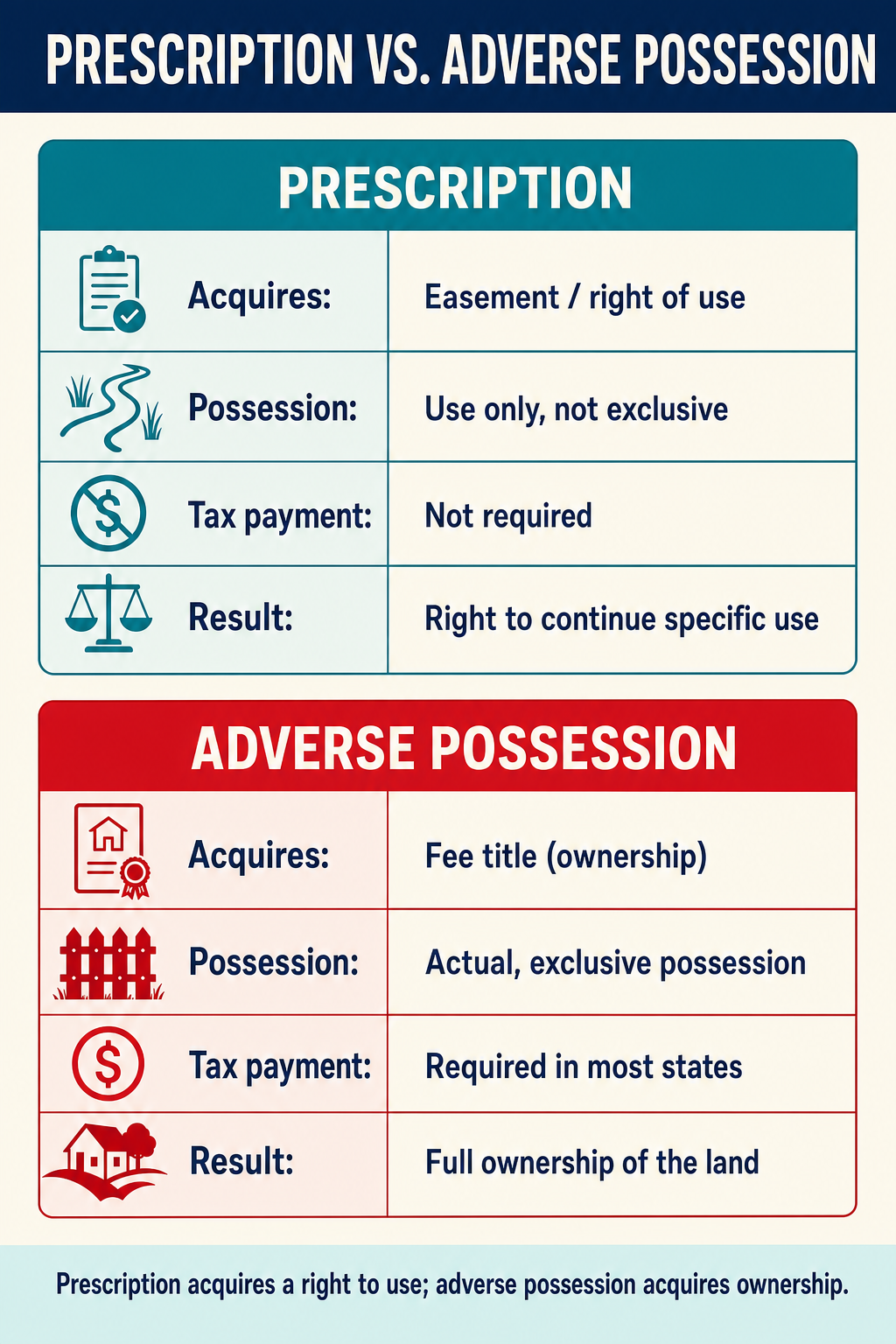
While these terms are often used interchangeably in casual conversation, they have distinct legal meanings:
| Feature | Prescription | Adverse Possession |
|---|---|---|
| What is acquired | An easement or right of use | Fee title (ownership) |
| Possession required | Use only (not exclusive possession) | Actual, exclusive possession |
| Result | Right to continue specific use | Full ownership of the land |
| Tax payment | Generally not required | Required in most states |
| Example | Right to cross neighbor's land | Owning a strip of neighbor's land |
Prescription is the acquisition of a right (typically an easement) by long, continuous, hostile, open, and notorious use. The prescriptive claimant does not acquire ownership -- only the right to continue the specific use.
Adverse possession is the acquisition of actual ownership (fee title) by long, continuous, hostile, open, notorious, exclusive, and actual possession under certain conditions.
Elements of Adverse Possession: ECHOS + ACTUAL
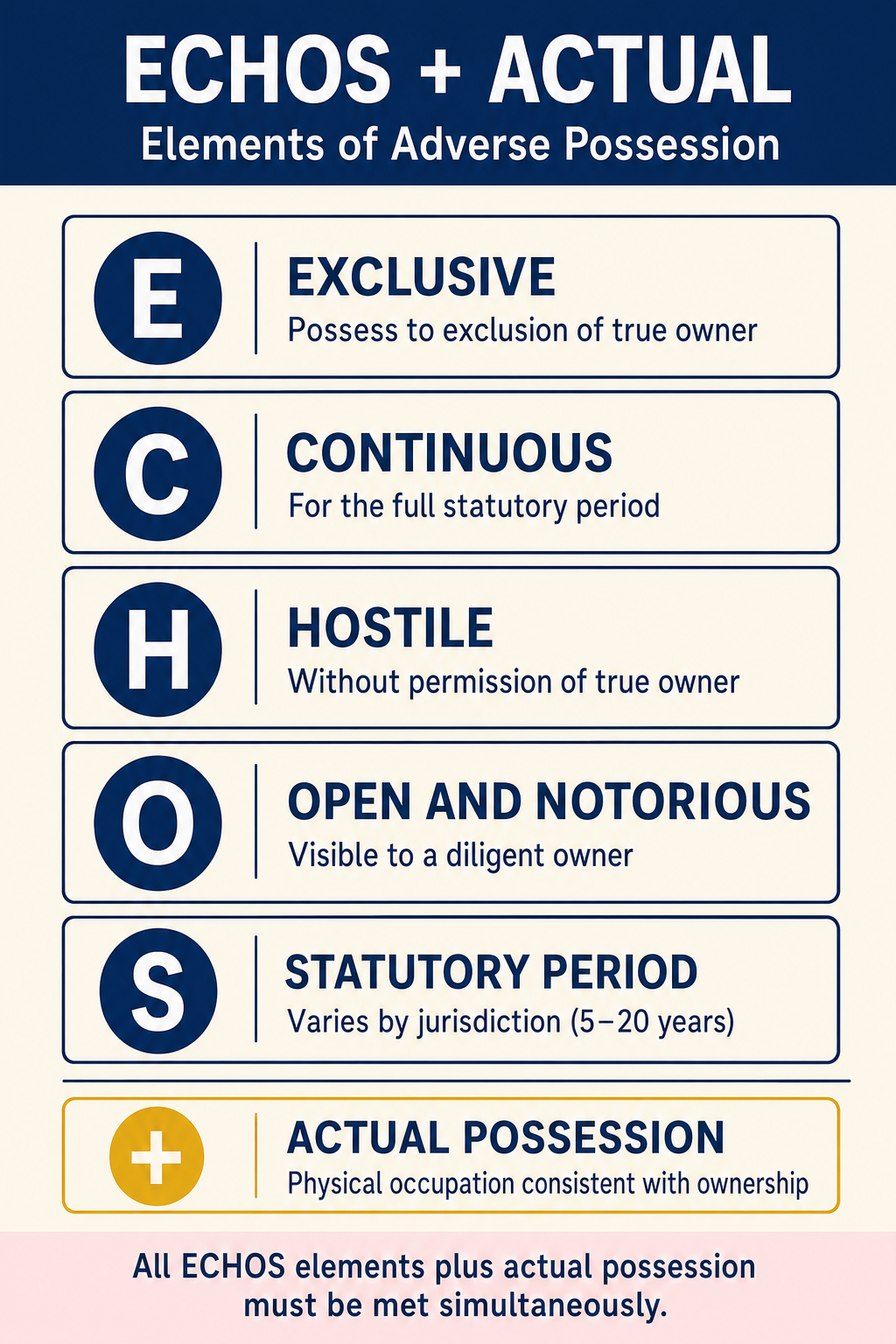
The elements of adverse possession are commonly remembered by the mnemonic ECHOS, with the additional requirement of ACTUAL possession:
E -- Exclusive
The possession must be exclusive -- the claimant must possess the land to the exclusion of the true owner and the general public. This does not mean the claimant must be the only person on the land (family members and tenants are permitted), but the true owner must be effectively excluded from possession.
- Shared use with the true owner typically defeats exclusivity
- The claimant must exercise dominion as an owner would
- Using land in common with the public is not exclusive possession
C -- Continuous
The possession must be continuous for the entire statutory period. This does not require constant physical presence but rather the type of continuous use that a typical owner would exercise for that type of property.
- Seasonal use of a cabin may be continuous if that is how such property is typically used
- Abandonment during the statutory period breaks continuity
- Temporary absences do not necessarily break continuity if the claimant maintains control
- The nature of the property determines what "continuous" means -- farmland only needs seasonal cultivation
H -- Hostile
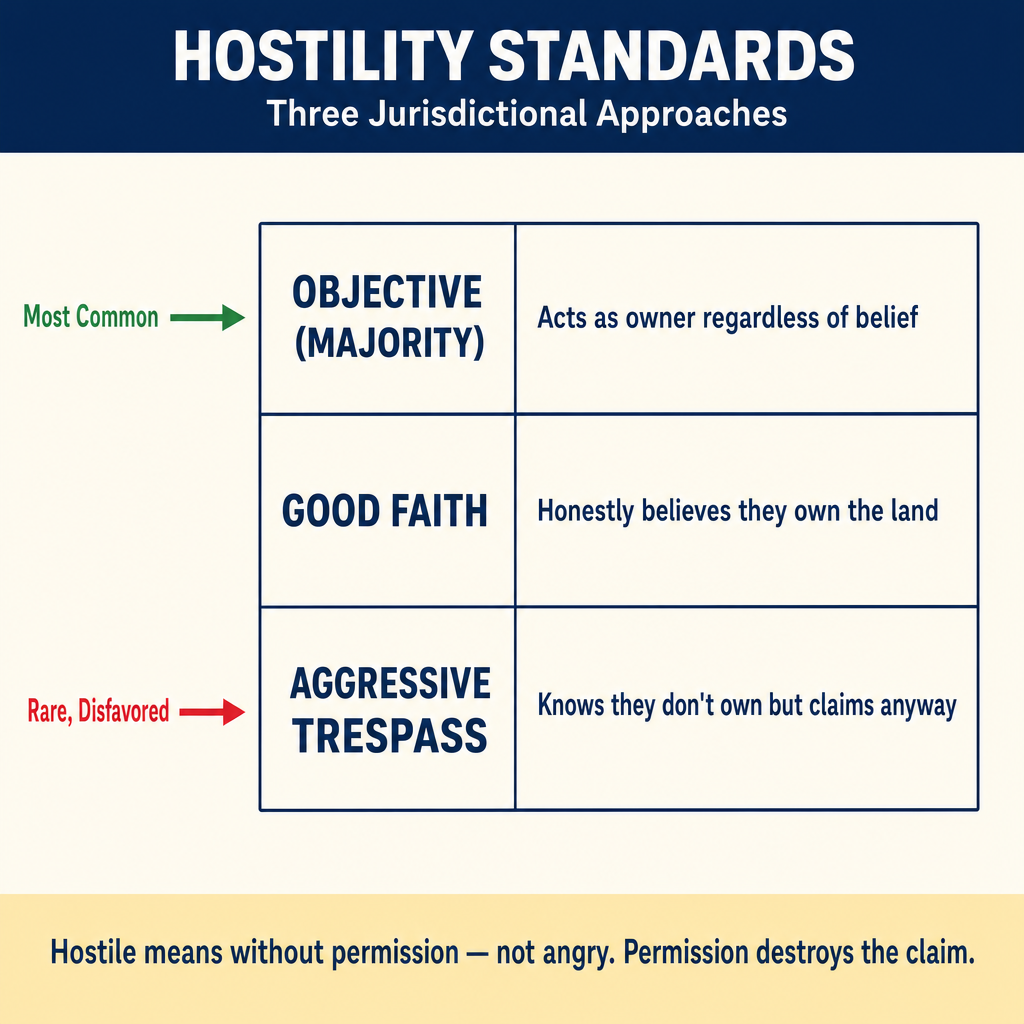
The possession must be hostile to the rights of the true owner. This is the most commonly misunderstood element. "Hostile" does not mean angry or aggressive -- it means the possession is without permission and is inconsistent with the true owner's rights.
Three standards of hostility exist across jurisdictions:
| Standard | Requirement | Notes |
|---|---|---|
| Objective (majority) | Claimant acts as owner regardless of subjective belief | Most common standard |
| Good faith | Claimant honestly believes they own the land | Used in some states |
| Aggressive trespass | Claimant knows they don't own it but claims it anyway | Rare, disfavored |
Critical point: If the true owner gives permission to use the land, the use becomes permissive and can never ripen into adverse possession, no matter how long it continues. Permission destroys hostility.
O -- Open and Notorious
The possession must be open and notorious -- visible and obvious enough that a reasonably diligent owner inspecting the property would discover it. The claimant cannot acquire title by secret or hidden occupation.
- Fencing the land is classic open and notorious possession
- Cultivating, building structures, or paving are open and notorious acts
- Underground encroachments (such as building foundations) may not satisfy this element
- The standard is what a reasonable owner would discover, not what the actual owner knew
S -- Statutory Period
The possession must continue for the full statutory period prescribed by the jurisdiction. This period varies significantly:
| Jurisdiction | Standard Period | With Color of Title |
|---|---|---|
| Some western states | 5 years | 5 years |
| Texas | 10 years | 3, 5, or 10 years |
| New York | 10 years | 10 years |
| Florida | 7 years | 7 years |
| Federal (PLSS lands) | Cannot adversely possess federal land | N/A |
Note: Federal and state government lands generally cannot be acquired by adverse possession. This is a critical distinction for the PS exam.
ACTUAL Possession
In addition to the ECHOS elements, most jurisdictions require actual possession -- the claimant must physically occupy and use the land in a manner consistent with ownership. This can include:
- Enclosing the land with a fence or wall
- Cultivating or farming the land
- Building and maintaining structures
- Grading, paving, or landscaping
- Regular maintenance and upkeep
The acts of possession must be commensurate with the type of land. What constitutes actual possession of urban land (building, fencing) differs from what constitutes actual possession of wild, rural land (logging, grazing).
Additional Requirements
Payment of Taxes
Many states require the adverse possessor to pay property taxes on the land for the statutory period. This requirement:
- Applies to adverse possession claims seeking fee title
- Generally does not apply to prescriptive easement claims
- Must be documented with tax records
- The taxes must be paid under a claim of right or color of title
Color of Title
Color of title exists when the claimant possesses a written instrument (such as a deed) that purports to convey title but is defective in some way. Color of title:
- May shorten the statutory period in some jurisdictions
- May allow constructive possession of the entire parcel described (not just the portion actually occupied)
- Distinguishes the claimant's basis for the claim from a mere "squatter"
Claim of Right
Claim of right means the claimant possesses the land as if they own it, asserting ownership rather than acknowledging another's title. It is the mental component that accompanies the physical acts of possession.
Tacking
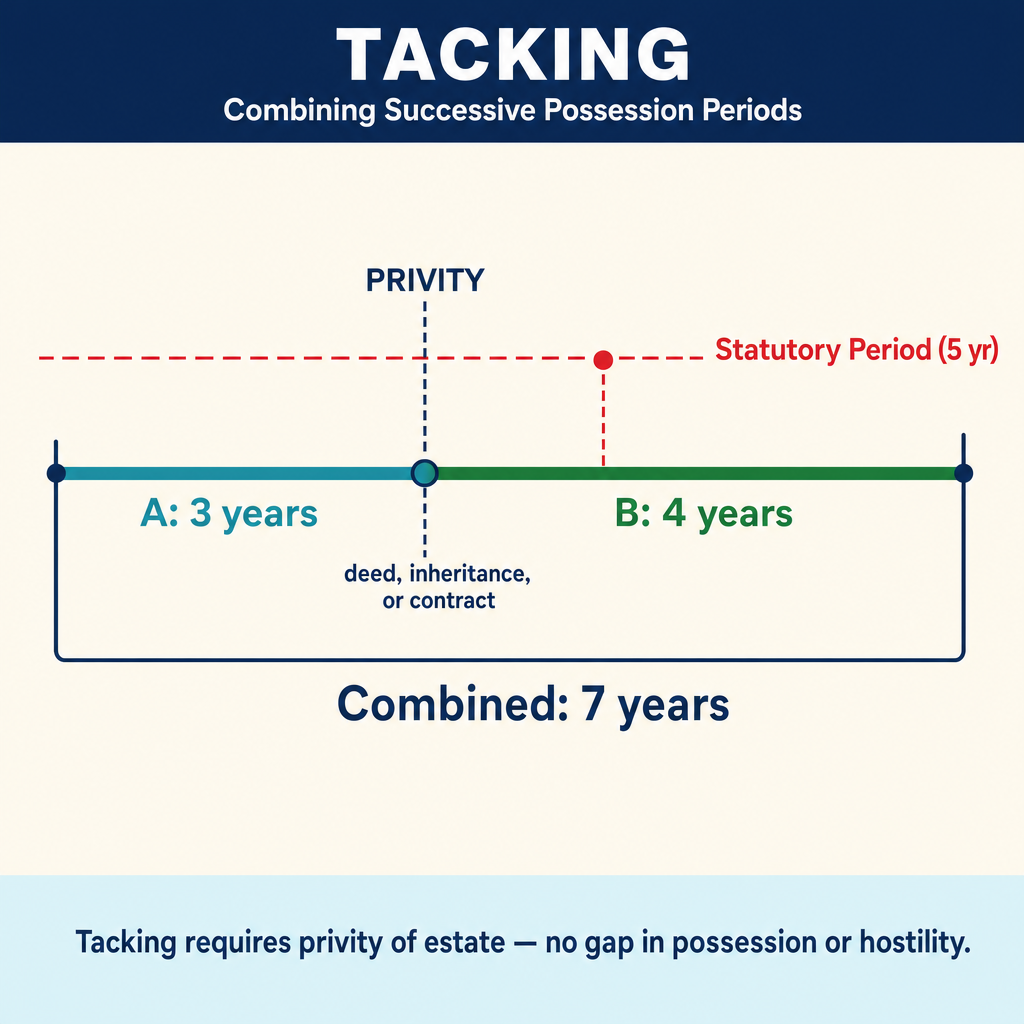
Tacking allows successive adverse possessors to combine their periods of possession to satisfy the statutory requirement, provided there is privity of estate (a legal connection such as a deed, inheritance, or contract) between the successive possessors.
Example: Owner A adversely possesses a strip of land for 3 years, then sells to B, who continues to possess the strip for 4 years. If the statutory period is 5 years, B can "tack" A's 3 years to B's 4 years to reach the 7-year total, which exceeds the statutory period.
Requirements for tacking:
- Privity of estate between successive claimants
- No gap or abandonment between successive periods
- The same land must be claimed throughout
- Each successive possessor must meet all the ECHOS elements
Interruption of the Statutory Period
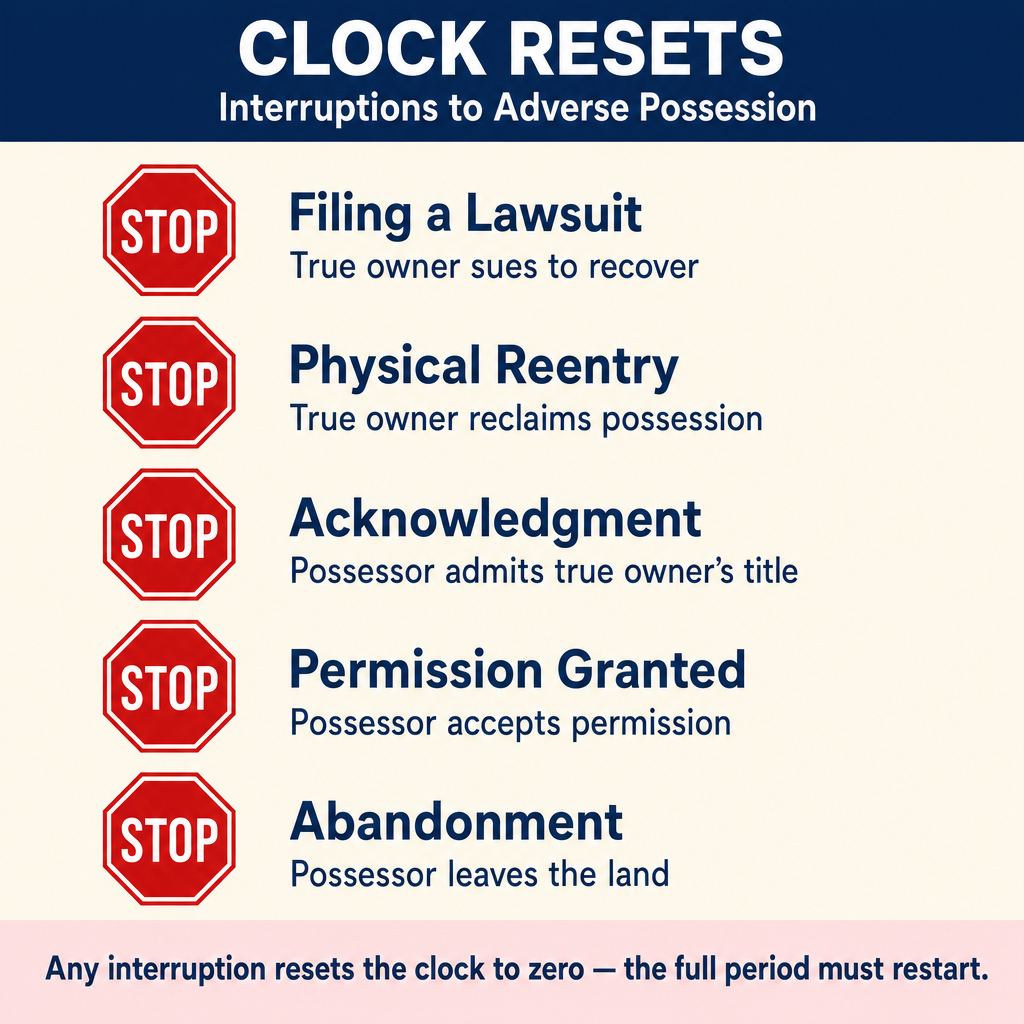
The statutory period can be interrupted (the clock resets) by:
- Filing a lawsuit: The true owner files an action to recover possession
- Physical reentry: The true owner physically reenters and reclaims possession
- Acknowledgment: The adverse possessor acknowledges the true owner's title
- Permission: The adverse possessor accepts permission from the true owner
- Abandonment: The adverse possessor abandons the land
Prescriptive Easements
A prescriptive easement is acquired through use that meets most of the same elements as adverse possession but does not require exclusive possession or tax payment. The elements are:
- Open and notorious use
- Hostile (without permission)
- Continuous for the statutory period
- Under claim of right
Common prescriptive easements include:
- Access roads used across another's land
- Drainage paths
- Utility crossings
- Paths and trails
Impact on Boundary Surveys
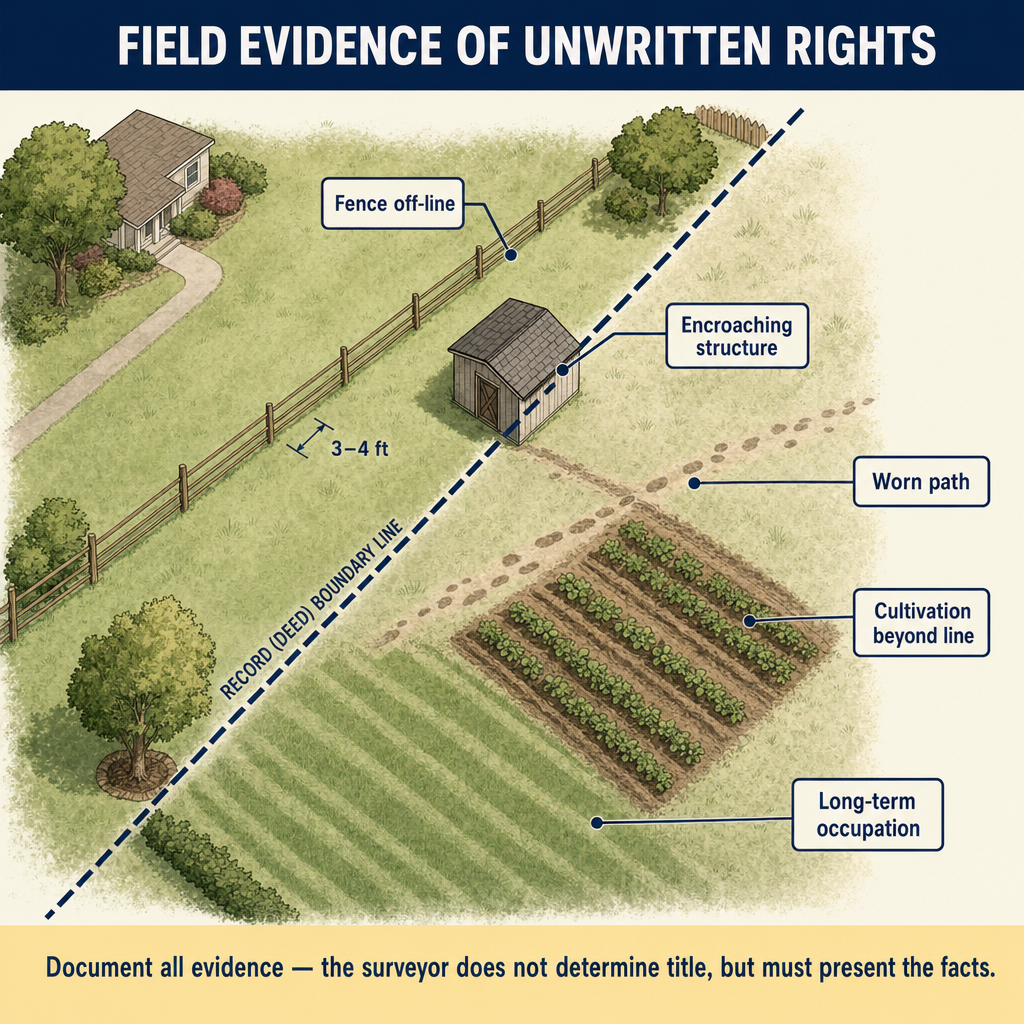
The surveyor must be alert to potential unwritten rights during every boundary survey. Indicators include:
- Fences not on the property line -- may indicate adverse possession or acquiescence
- Structures or improvements encroaching across boundary lines
- Well-worn paths or driveways crossing adjacent parcels
- Cultivation or landscaping extending beyond property boundaries
- Long-term occupation patterns that differ from the deed description
When the surveyor encounters evidence of potential adverse possession or prescriptive use, the surveyor should:
- Document all physical evidence thoroughly
- Note the apparent duration and character of the use
- Inform the client of the potential unwritten rights issue
- Recommend legal counsel for determination of title
- Show both the record boundary and the occupation line on the survey
The surveyor does not determine title -- that is a judicial function. But the surveyor must recognize the evidence and present it clearly.
Common wrong path — conflating permission with hostility. The single biggest adverse-possession trap on the exam is the permission question. If the true owner ever grants permission — even verbally, even informally, even years ago — the hostility element evaporates and the clock resets to zero. A claimant who occupied land for 20 years but got permission from the true owner in year 10 has zero toward any statutory period: only the years after permission was withdrawn (and withdrawal was explicit and known to the claimant) would count. Exam questions plant this trap by mentioning "the neighbor told them they could use it" or "the prior owner said it was fine" — those phrases are fatal to the adverse-possession claim. The opposite is equally true: a claimant need not be hostile in a personal or emotional sense; mere occupation without permission is enough.
Quick retrieval check — try before reading on.
▶A landowner allowed their neighbor's livestock to graze a 40-ft strip of pasture from 2005 to 2015. In 2015, the original landowner died and the heirs took title. The neighbor continued grazing the strip without interacting with the new heirs. The statutory period in this jurisdiction is 10 years. In 2028, can the neighbor establish adverse possession of the strip?
Probably not, based on the facts as stated. From 2005–2015 the use was permissive (the original owner "allowed" it). Permissive use is not hostile and does not count toward the statutory period. In 2015, when the heirs took title, the permission arguably ended — but permission implicitly carries forward unless affirmatively withdrawn, and the neighbor's continued grazing without any contact with the heirs is ambiguous. The cleanest argument is that the neighbor's claim could only start running in 2015 (at best), giving 13 years by 2028 — exceeding the 10-year statutory period. But the hostility element is weak because the neighbor's use continued in the same pattern established under the original permission. The answer depends on whether a court would find that permission lapsed with the change of ownership; in most jurisdictions, permission does not automatically transfer to heirs, but the adverse-possession clock only starts when the claimant's use is clearly adverse to the new owner's rights. A surveyor should show the grazing occupation line and recommend legal counsel — the analysis is fact-intensive and title-level.
Exam Tips
- Know the ECHOS + ACTUAL elements cold -- this is heavily tested
- Hostile does not mean angry -- it means without permission
- Government land cannot be adversely possessed in most jurisdictions
- Tacking requires privity of estate -- mere successive occupation is not enough
- Some states require payment of taxes for adverse possession; many states do not
- Prescriptive easements acquire use rights only, not fee title
- If the true owner gives permission at any point, the hostile element is destroyed and the clock resets
- Color of title may extend the claim to the full parcel described in the defective instrument
- The statutory period varies by state -- know the general ranges and that federal land is immune
- Continuous possession means possession consistent with the character of the land, not necessarily 24/7 physical presence
Related Test Topics
- Acquiescence and Boundary Agreement (Topic 1.4)
- Controlling Elements (Topic 1.5)
- Easement Rights (Topic 1.6)
- Searching and Evaluating Evidence (Topic 1.1)
- Sequential and Simultaneous Conveyances (Topic 1.8)
Further Reading
Authoritative sources for deeper study
Brown's Boundary Control and Legal Principles (7th Ed.), chapters on evidence hierarchy and weighing of conflicting calls.
Evidence and Procedures for Boundary Location (Robillard, Wilson, & Brown, 7th Ed.) — Practical treatise on collecting, weighing, and applying boundary evidence.
Clark, A Treatise on the Law of Surveying and Boundaries — Long-standing legal reference on boundary disputes and surveyor liability.
Last updated: 2026-04-17