PS Exam Preparation
Comprehensive preparation for the NCEES Principles and Practice of Surveying (PS) exam. 5 modules covering all 5 exam domains with 50 in-depth topics.
Module 1: Legal Principles
Module 2: Professional Survey Practices
Module 3: Standards & Specifications
Module 4: Business Practices
Module 5: Areas of Practice
State Statutes & ALTA/NSPS Surveys
Learning Objectives
After completing this topic, you should be able to:
- Explain the relationship between ALTA/NSPS national standards and state survey statutes
- Identify common state statutory requirements that supplement the ALTA/NSPS standards
- Describe typical state recording and filing requirements for boundary surveys
- Understand monument standards imposed by state law
- Recognize when state law imposes requirements beyond the ALTA/NSPS minimum
- Apply the "more stringent standard prevails" principle
Overview
The ALTA/NSPS standards establish a national minimum for land title surveys, but they do not exist in a vacuum. Every state has its own statutes, regulations, and administrative codes governing boundary surveys, monuments, recording, and professional practice. When a surveyor prepares an ALTA/NSPS survey, the surveyor must comply with both the national standards and all applicable state requirements.
The 2021 ALTA/NSPS standards explicitly acknowledge this dual obligation. Section 3(D) states that the surveyor must comply with the applicable jurisdictional requirements. Where state law imposes a more stringent requirement than the ALTA/NSPS standards, the state law controls. Where the ALTA/NSPS standards are more stringent than state law, the ALTA/NSPS standards control. The more demanding standard always prevails.
Key Concepts
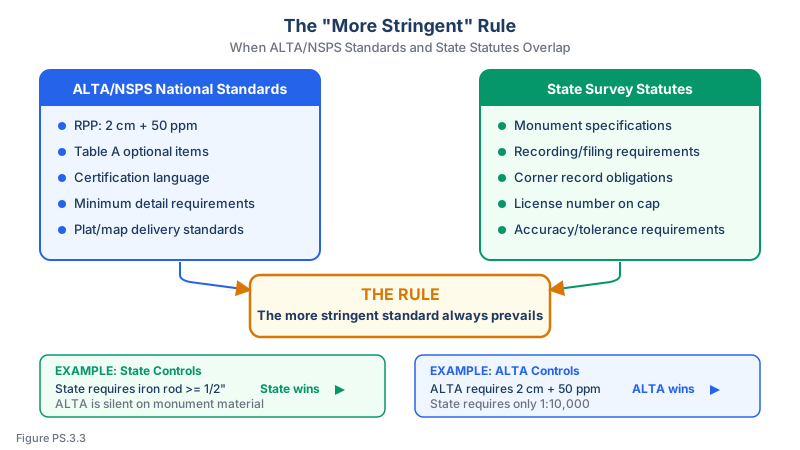
The "More Stringent" Rule
This principle is fundamental:
When preparing an ALTA/NSPS survey, the surveyor must meet whichever standard is more stringent -- the ALTA/NSPS minimum or the applicable state requirement.
Example: If a state requires that all survey monuments be capped with a licensed land surveyor's registration number but the ALTA/NSPS standards do not specify cap requirements, the state requirement applies. Conversely, if the ALTA/NSPS RPP requirement of 2 cm + 50 ppm is tighter than a state's general survey accuracy standard, the ALTA/NSPS RPP controls.
This dual-obligation framework means the surveyor must know both standards and apply the more demanding of the two in every instance.
Common State Statutory Requirements
While specific statutes vary by jurisdiction, most states address the following categories. The PS exam tests general principles rather than individual state codes (except for state-specific exams like the CA PLS).
Monument Standards:
Most states have statutory requirements for survey monuments. Common provisions include:
- Material specifications: Durable materials such as iron pipes, iron rods, brass or aluminum caps, or concrete monuments
- Minimum dimensions: Typical requirements include iron rods of at least 1/2-inch diameter and 18-24 inches in length
- Identification: Monument must bear the surveyor's license number, name, or both
- Setting requirements: Set flush with or above the ground surface, with witness markers where the monument cannot be seen
- When required: Most states require monuments at all boundary corners established or reestablished by a licensed surveyor
Recording and Filing Requirements:
States impose varying requirements for recording survey documents:
| Requirement | Typical Provisions |
|---|---|
| Record of Survey / Map of Survey | Many states require filing when new monuments are set, discrepancies are found, or boundaries are established |
| Filing deadline | Commonly 30-90 days after survey completion |
| Filing location | County recorder, county surveyor, or state board of licensure |
| Plat format | Minimum sheet size, margins, scale requirements, required elements |
| Corner Record | Some states require separate corner records for each monument set or found |
Triggers for Recording:
Common statutory triggers that require a survey to be recorded:
- Setting new monuments or resetting disturbed monuments
- Discovering a discrepancy with the record that exceeds statutory tolerances
- Establishing or reestablishing boundary lines
- Subdividing or partitioning land
- Client request
Not every boundary survey triggers a recording requirement. The surveyor must know the specific triggers in the jurisdiction where the survey is performed.
State Requirements That Supplement ALTA/NSPS
Several categories of state requirements go beyond or supplement the ALTA/NSPS standards:
Corner Records:
Some states require the surveyor to file a separate corner record document for each boundary corner set or found. This record typically includes:
- Corner description (type, size, material, markings)
- Method of determination (found, reset, calculated, proportioned)
- Reference ties to nearby permanent features
- Geodetic position (if required by the state)
- Date of establishment and surveyor identification
Corner records serve as a public repository of monument information for future surveyors. They are separate from the survey plat and filed with the county surveyor or recorder.
Minimum Survey Content:
State statutes may require elements not listed in the ALTA/NSPS standards:
- Geodetic coordinates on at least two monuments (tied to a state coordinate system)
- Reference to the state plane coordinate system zone
- Basis of bearings referenced to a specific datum
- Flood zone designation (some states require this on all surveys, not just ALTA)
- Soil or geologic hazard notations
- Archaeological or historic preservation notations
Professional Practice Requirements:
States regulate how the survey is certified and by whom:
- Original wet signature and seal (some jurisdictions do not accept digital signatures for recorded documents)
- Surveyor must be licensed in the state where the property is located
- Some states require a separate "surveyor's report" narrative in addition to the plat
- Continuing education requirements may include state-specific standards training
Relationship Between ALTA Certification and State Requirements
When preparing an ALTA/NSPS survey, the surveyor's certification addresses compliance with the national standards. However, the surveyor must also comply with all applicable state requirements. This creates a layered obligation:
- ALTA/NSPS certification -- Certifies compliance with the 2021 Minimum Standard Detail Requirements
- State recording requirements -- The surveyor must meet all statutory requirements for the survey document to be accepted for recording
- State practice act -- The surveyor must practice within the scope authorized by the state licensing board
If a state requires a Record of Survey to be filed when new monuments are set, the ALTA/NSPS survey may trigger that filing requirement even though the ALTA/NSPS standards themselves do not address recording.
Boundary by State Statute
Some states have statutes that directly affect how boundary surveys are conducted:
Agreed Boundary Statutes: Some states codify the common-law doctrine of boundary by agreement, specifying requirements such as minimum duration of acquiescence, whether a dispute is required, and what constitutes sufficient evidence.
Adverse Possession Statutes: State statutes define the elements and duration of adverse possession. These affect the surveyor's obligation to note evidence of adverse use when conducting an ALTA/NSPS survey. If the surveyor observes evidence of possession or use inconsistent with the title during an ALTA survey, the standards require it to be shown -- but the legal significance depends on state law.
Statute of Limitations for Survey Errors: States vary in how long a client has to bring a claim against a surveyor. This affects the surveyor's record-keeping obligations and professional liability exposure.
Common wrong path — ALTA/NSPS is the "maximum" standard you need to meet. Students sometimes treat the ALTA/NSPS standards as the ceiling — "if I meet ALTA, I've done everything." Wrong. The ALTA/NSPS standards are a national minimum; state law can and frequently does impose additional requirements (monument capping, Record of Survey filings, Corner Records, wet signature on recorded documents, specific coordinate system tie-ins, archaeological notations). When state law is more stringent, state law controls — full compliance with ALTA/NSPS does not excuse the surveyor from the state-specific additions. On the exam, a question that asks "what must the surveyor do" when state law adds a requirement beyond ALTA/NSPS: the answer is always "comply with both." The ALTA certification covers only what ALTA addresses; state-law compliance is a separate obligation.
Quick retrieval check — try before reading on.
▶You are preparing an ALTA/NSPS Land Title Survey in a state that requires (a) all monuments to be capped with the surveyor's license number, (b) a Record of Survey filed within 90 days when new monuments are set, and (c) the survey to show at least one tie to the state plane coordinate system. Are these obligations part of the ALTA/NSPS survey, or additional?
Both — they are additional obligations that must be met in parallel with ALTA/NSPS compliance. The 2021 ALTA/NSPS standards do not require monument capping, Record of Survey filing, or state plane coordinate ties (though coordinate ties may be elected as a Table A item). These three requirements come from state law, and because state law is more stringent than the ALTA/NSPS minimum in these areas, state law controls.
In practice, the surveyor:
- Completes the ALTA/NSPS survey meeting all minimum standards and selected Table A items
- Caps the set monuments per state law
- Prepares and files a Record of Survey within the state's 90-day deadline
- Includes the state plane coordinate tie on the plat (either as part of the ALTA plat or on the Record of Survey)
The ALTA/NSPS certification on the plat covers only the ALTA/NSPS standards; the state requirements are satisfied through separate compliance documented on the plat, in the Record of Survey, and through the filing. A surveyor who delivers an ALTA-compliant plat but skips the Record of Survey filing has not "completed the survey" — they have violated state law, even though the ALTA portion is technically correct.
Practical Application
When a surveyor receives a request for an ALTA/NSPS survey in any state, the workflow should include:
- Review the ALTA/NSPS standards for baseline requirements
- Review state statutes and administrative code for survey requirements
- Check local (county/city) requirements for any additional filing or content rules
- Apply the more stringent standard in every case of overlap
- Document compliance with both the national and state standards
- File all required documents within statutory deadlines
Exam Tips
- The PS exam tests the principle that the more stringent standard always prevails -- this applies to precision, content, filing, and monument requirements
- Know that ALTA/NSPS standards do not override state law; they establish a national floor that states can exceed
- State-required corner records and records of survey are separate obligations from the ALTA/NSPS survey plat
- If an exam question describes a scenario where state law requires something not in the ALTA/NSPS standards, the surveyor must comply with state law
- Recording triggers vary by state but commonly include setting monuments and finding discrepancies
- The certification on an ALTA/NSPS survey addresses the national standards; state requirements are met through additional compliance, not modification of the ALTA certification language
- Monument identification requirements (license number on cap) are almost always state-imposed, not ALTA-imposed
- The PS exam may present scenarios where the surveyor must determine whether a state requirement or the ALTA/NSPS standard is more stringent -- always choose the tighter standard
Related Test Topics
- ALTA/NSPS Land Title Survey Standards (Topic 3.2)
- Professional licensing and regulatory compliance (Module 2)
- Legal descriptions and recording (Module 1, Topic 1.9)
- Evidence of adverse possession and unwritten rights (Module 1, Topics 1.3-1.4)
- Professional liability and standard of care (Module 2)
Further Reading
Authoritative sources for deeper study
2021 ALTA/NSPS Land Title Survey Standards — Current minimum standard detail requirements for ALTA/NSPS land title surveys.
NCEES Model Rules of Professional Conduct (Aug 2025) — Model ethics, competence, and licensure rules adopted by most state boards.
Brown's Boundary Control and Legal Principles (7th Ed., Robillard & Wilson) — Standard textbook on boundary law, evidence hierarchy, and retracement.
Last updated: 2026-04-17