PS Exam Preparation
Comprehensive preparation for the NCEES Principles and Practice of Surveying (PS) exam. 5 modules covering all 5 exam domains with 50 in-depth topics.
Module 1: Legal Principles
Module 2: Professional Survey Practices
Module 3: Standards & Specifications
Module 4: Business Practices
Module 5: Areas of Practice
Safety Procedures
Learning Objectives
After completing this topic, you should be able to:
- Identify OSHA requirements applicable to surveying operations
- Develop site-specific safety plans and hazard assessments
- Apply traffic control principles for roadway work zones
- Explain the 811 utility locating process and legal requirements
- Specify appropriate personal protective equipment (PPE) for various field conditions
- Recognize environmental, biological, and site-specific hazards
- Understand employer and employee safety responsibilities
Overview
Field surveying is inherently hazardous work. Surveyors operate in active construction zones, along busy roadways, in remote terrain, and near underground and overhead utilities. OSHA statistics consistently rank construction-related activities among the most dangerous occupations. The PS exam tests your knowledge of safety regulations, hazard assessment, and risk mitigation procedures -- not as a secondary concern, but as a core professional competency.
A surveyor who cannot manage field safety risks is not qualified to manage a survey project.
OSHA Regulatory Framework
Federal OSHA
The Occupational Safety and Health Administration (OSHA) sets minimum safety standards for all workplaces. Key regulations affecting surveying:
| Standard | Citation | Application |
|---|---|---|
| General Duty Clause | Section 5(a)(1) | Employers must provide a workplace free from recognized hazards |
| Construction Standards | 29 CFR 1926 | Applies when surveying on construction sites |
| General Industry Standards | 29 CFR 1910 | Applies to office operations and non-construction field work |
| Excavation Standard | 29 CFR 1926 Subpart P | Trenching and excavation safety |
| Fall Protection | 29 CFR 1926 Subpart M | Protection from falls over 6 feet |
| Electrical Safety | 29 CFR 1926 Subpart K | Working near energized conductors |
| Hazard Communication | 29 CFR 1910.1200 | Chemical exposure information |
State OSHA Programs
Twenty-two states and territories operate their own OSHA-approved programs. These must be at least as stringent as federal OSHA and may impose additional requirements. Surveyors must comply with whichever standard is more protective.
Employer Responsibilities
Under OSHA, employers must:
- Provide a safe workplace free from recognized hazards
- Comply with all applicable OSHA standards
- Provide safety training appropriate to job hazards
- Provide required PPE at no cost to employees
- Maintain records of work-related injuries and illnesses (OSHA 300 Log)
- Post required OSHA notices in the workplace
- Report fatalities within 8 hours and hospitalizations within 24 hours
Employee Responsibilities
Employees must:
- Comply with all applicable safety rules and regulations
- Use provided PPE properly
- Report hazardous conditions to the employer
- Report work-related injuries and illnesses
- Not tamper with safety devices or equipment
Hazard Assessment
Job Hazard Analysis (JHA)
A Job Hazard Analysis is a systematic process for identifying and mitigating worksite hazards before work begins:
| Step | Action | Example |
|---|---|---|
| 1. Identify tasks | List the tasks to be performed | Monument search in roadway median |
| 2. Identify hazards | For each task, identify potential hazards | Traffic, overhead lines, underground utilities |
| 3. Assess risk | Rate likelihood and severity | High-speed traffic = high likelihood, severe consequence |
| 4. Determine controls | Identify measures to eliminate or reduce risk | Traffic control plan, lane closure, high-visibility apparel |
| 5. Document | Record the JHA and communicate to all crew members | Written JHA reviewed at tailgate meeting |
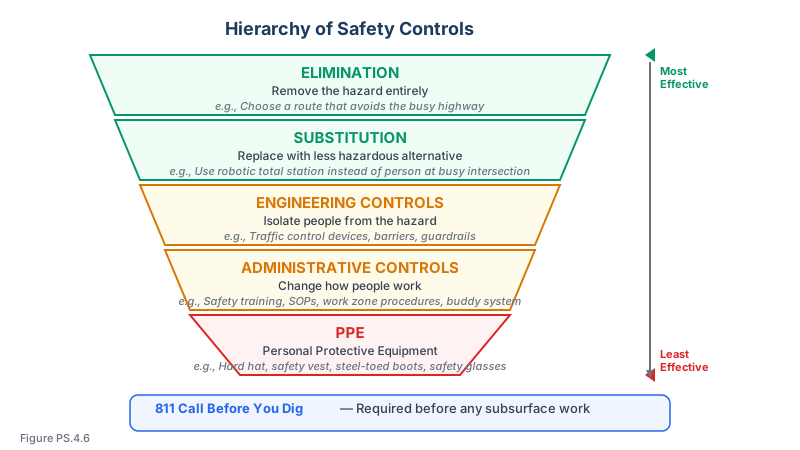
Hierarchy of Controls
OSHA's hierarchy of controls, from most effective to least effective:
| Level | Control Type | Surveying Example |
|---|---|---|
| 1. Elimination | Remove the hazard entirely | Schedule work when roadway is closed |
| 2. Substitution | Replace with a less hazardous alternative | Use GNSS instead of total station to reduce time in traffic |
| 3. Engineering controls | Isolate workers from the hazard | Traffic barriers, delineators, temporary barriers |
| 4. Administrative controls | Change work practices | Limit time in hazard zone, buddy system, training |
| 5. PPE | Protect the individual worker | High-visibility vest, hard hat, safety glasses |
PPE is the last resort, not the first. Effective safety programs address hazards at the highest feasible level.
Tailgate Safety Meetings
Before each day of field work, the party chief should conduct a brief safety meeting covering:
- Specific hazards at the day's work site
- Traffic control plan (if applicable)
- PPE requirements
- Emergency procedures and contact numbers
- Communication protocols
- Weather conditions and precautions
- Any changes from previous days
Traffic Control
Work Zone Components
Per the Manual on Uniform Traffic Control Devices (MUTCD), work zones consist of four areas:
| Zone | Purpose | Elements |
|---|---|---|
| Advance Warning Area | Alert approaching motorists | Warning signs at prescribed spacing |
| Transition Area | Guide traffic around the work area | Tapers using cones, barrels, or delineators |
| Activity Area | Protect workers and equipment | Buffer space plus work space |
| Termination Area | Return traffic to normal patterns | End construction signs, taper |
Taper Lengths
Taper length depends on posted speed and lane width:
| Speed Limit | Minimum Taper Length (per lane) |
|---|---|
| 25 mph | 75 feet |
| 35 mph | 175 feet |
| 45 mph | 360 feet |
| 55 mph | 540 feet |
| 65 mph | 720 feet |
Actual taper lengths should be calculated using the MUTCD formula: L = (speed squared) / 60 for speeds above 40 mph, or L = width x speed / 2 for speeds at or below 40 mph.
Surveyor-Specific Traffic Control
Surveying operations present unique traffic control challenges:
- Mobile operations -- Surveyors frequently move along roadways, making fixed work zones impractical
- Short-duration occupancy -- A few minutes at each setup does not justify full lane closure
- Shoulder work -- Often the only practical location for control points and boundary monuments
Minimum protection for mobile operations:
- Vehicle-mounted warning signs or arrow boards
- Vehicle emergency flashers
- High-visibility apparel (Class 2 minimum; Class 3 for high-speed roads)
- Shadow vehicle positioned upstream of work area
- Rotating beacon or strobe lights on survey vehicles
Flagger Operations
When flaggers are required:
- Must be trained and certified (in most jurisdictions)
- Must wear Class 3 high-visibility apparel
- Must use STOP/SLOW paddle (minimum 18 inches)
- Must be positioned with adequate sight distance
- Must have an escape route
Underground Utility Locating
The 811 System
The national 811 "Call Before You Dig" system is the primary mechanism for preventing underground utility damage:
| Step | Action | Timing |
|---|---|---|
| 1. Call 811 | Contact the one-call center | At least 2-3 business days before excavation (varies by state) |
| 2. Provide information | Location, type of work, extent of excavation | At time of call |
| 3. Receive ticket | Confirmation number for tracking | Immediately |
| 4. Wait for marks | Utility owners mark their facilities | Within the notification period |
| 5. Respect marks | Hand dig within the tolerance zone | During excavation |
Utility Marking Standards (APWA Uniform Color Code)
| Color | Utility Type |
|---|---|
| Red | Electric power lines, conduit, cables |
| Yellow | Gas, oil, steam, petroleum |
| Orange | Communications, alarm, signal lines, cable TV |
| Blue | Potable water |
| Green | Sewer and storm drain |
| Purple | Reclaimed water, irrigation |
| Pink | Temporary survey markings |
| White | Proposed excavation outline |
Surveyor Applicability
Surveyors must call 811 when:
- Setting monuments that require excavation below the surface
- Driving posts or pipes deeper than typical stake depth
- Core drilling or augering for monument installation
- Any subsurface disturbance that could contact utilities
Tolerance Zone
The tolerance zone is the area around a marked utility within which hand digging (or other careful methods) is required. Typical tolerance zones are 18-24 inches on either side of the mark, but this varies by state.
Personal Protective Equipment (PPE)
Minimum PPE by Work Environment
| Environment | Required PPE |
|---|---|
| Active construction site | Hard hat, safety glasses, high-visibility vest, safety-toe boots |
| Roadway work zone | High-visibility apparel (Class 2 or 3), safety glasses |
| General field work | Appropriate footwear, sun protection, seasonal clothing |
| Near water | Personal flotation device (PFD) when working from boats or near deep water |
| Near heavy equipment | Hard hat, hearing protection, high-visibility apparel |
| Confined spaces | Atmospheric monitoring, retrieval harness, attendant |
High-Visibility Apparel Classes
| Class | Minimum Background Material | Minimum Retroreflective Material | Application |
|---|---|---|---|
| 1 | 217 sq in | 155 sq in | Low-traffic areas, parking lots |
| 2 | 775 sq in | 201 sq in | Most survey field work |
| 3 | 1240 sq in | 310 sq in | High-speed roadways, low-visibility conditions |
Hearing Protection
Noise levels requiring hearing protection (85 dBA over 8-hour TWA):
Surveyors may encounter excessive noise near:
- Heavy construction equipment
- Pile driving operations
- Pavement sawcutting
- Demolition activities
- Generators and compressors
Environmental Hazards
Heat Illness
Heat illness is a serious risk for outdoor workers. The progression from heat stress to heat stroke can be rapid:
| Condition | Symptoms | Response |
|---|---|---|
| Heat cramps | Muscle cramps, heavy sweating | Move to shade, hydrate, rest |
| Heat exhaustion | Headache, nausea, weakness, heavy sweating, cool/clammy skin | Move to cool area, loosen clothing, hydrate, seek medical attention if symptoms worsen |
| Heat stroke | Confusion, hot/dry skin, rapid pulse, loss of consciousness | Medical emergency -- call 911, cool the person immediately |
Prevention:
- Acclimatize new workers gradually (over 7-14 days)
- Provide water (at least one quart per hour in hot conditions)
- Schedule heavy work for cooler parts of the day
- Provide shade for rest breaks
- Train all workers on heat illness recognition
Cold Stress
Cold-related hazards include:
- Hypothermia -- Core body temperature drops below 95 degrees F
- Frostbite -- Tissue freezing, especially extremities
- Trench foot -- Prolonged wet/cold exposure to feet
Prevention:
- Layer clothing (wicking base, insulating mid, waterproof outer)
- Protect extremities (insulated gloves, warm headwear)
- Take warming breaks
- Monitor each other for symptoms
- Keep dry clothing available
Biological Hazards
Common biological hazards in field surveying:
| Hazard | Risk | Prevention |
|---|---|---|
| Ticks | Lyme disease, Rocky Mountain spotted fever | Permethrin-treated clothing, daily tick checks, long pants tucked into boots |
| Venomous snakes | Envenomation | Watch where you step and reach, wear boots, carry a first aid kit |
| Poison ivy/oak/sumac | Contact dermatitis | Learn to identify, wear long sleeves, wash exposed skin promptly |
| Stinging insects | Allergic reactions, anaphylaxis | Carry epinephrine if allergic, avoid disturbing nests |
| Mosquitoes | West Nile virus, other diseases | Use repellent, wear long sleeves in infested areas |
Overhead Power Line Safety
Minimum Approach Distances
When working near overhead power lines, maintain minimum clearance:
| Voltage Range | Minimum Clearance |
|---|---|
| Up to 50 kV | 10 feet |
| 50 kV to 200 kV | 15 feet |
| 200 kV to 350 kV | 20 feet |
| 350 kV to 500 kV | 25 feet |
| 500 kV to 750 kV | 35 feet |
Surveyor-Specific Considerations:
- Prism poles and GNSS antennas extend the worker's reach -- add the height of the pole to the person's reach
- Metal range poles and leveling rods are conductive
- Guy wires on utility poles may be energized if insulation has failed
- Survey equipment on tripods near power lines increases risk
Common wrong path — forgetting pole/antenna height when judging overhead clearance. Minimum approach distances to energized overhead lines are measured from the highest point of the worker or the longest conductive object the worker is holding or carrying — not from the worker's body or feet. A surveyor holding an 8-ft range pole or a GNSS survey pole with antenna must add the pole's length to their own height when judging clearance. Students sometimes answer "10 ft" to an overhead clearance question without accounting for the equipment, producing a dangerously wrong clearance calculation. OSHA and utility operators assess approach distance from the closest conductive object the worker can extend — metal range poles, leveling rods, and GNSS antennas all count. Exam questions test this by describing a setup where the person is 6 ft tall but their pole reaches 14 ft; the approach clearance must account for the pole.
Quick retrieval check — try before reading on.
▶A 6-foot-tall surveyor is using a 14-foot prism pole on a project near a 12 kV overhead distribution line. The minimum approach distance for up to 50 kV is 10 feet. What clearance must the surveyor maintain?
The measurement is from the highest point of the surveyor or their equipment, whichever is closer to the line. In this case, the prism pole is the limiting dimension. If the surveyor holds the pole vertically above their head, the top of the pole is at approximately 6 ft (surveyor height) + 14 ft (pole length) ≈ 20 ft above the ground (accounting for where the pole is gripped).
To maintain the 10-ft minimum approach distance, every point on the pole must remain at least 10 ft from the line in any direction. If the line sags to 25 ft above ground and the pole's top reaches 20 ft, vertical clearance is only 5 ft — well inside the minimum. The surveyor must either lower the pole, move horizontally away from the line, or in high-voltage areas, contact the utility for a safety standby (temporary de-energization or observation). The safe practice: visually estimate the line height, add a generous safety margin, and when in doubt, call the utility. Metal equipment, pole-mounted antennas, and leveling rods are all conductive — the 10-ft rule is measured from the closest conductive extension, not from the worker's feet.
Exam Tips
- OSHA questions on the PS exam focus on practical application, not citation numbers -- know the concepts
- Understand the hierarchy of controls (elimination, substitution, engineering, administrative, PPE) and that PPE is the last resort
- Know the APWA utility marking color code -- this is frequently tested
- Traffic control questions test your knowledge of work zone components and when flaggers are required
- Heat illness prevention is a common exam topic -- know the progression and appropriate responses
- Understand that employer responsibilities include providing PPE at no cost and maintaining injury records
- The 811 system and its requirements are testable -- know the process and timing
Related Test Topics
- Project Planning and Management (Topic 4.1)
- Quality Assurance and Quality Control Methods (Topic 4.5)
- Risk Management (Topic 4.6)
- Professional Conduct and Ethics (Topic 4.7)
Further Reading
Authoritative sources for deeper study
OSHA 29 CFR 1926 Subpart P — Excavations — Federal trenching and excavation safety standards relevant to construction surveyors.
MUTCD 2023 Part 6 — Temporary Traffic Control — Federal standard for work-zone traffic control devices and surveyor safety.
APWA Uniform Color Code — Standard utility-marking colors used in one-call locates.
Last updated: 2026-04-17