PS Exam Preparation
Comprehensive preparation for the NCEES Principles and Practice of Surveying (PS) exam. 5 modules covering all 5 exam domains with 50 in-depth topics.
Module 1: Legal Principles
Module 2: Professional Survey Practices
Module 3: Standards & Specifications
Module 4: Business Practices
Module 5: Areas of Practice
Easement Rights
Learning Objectives
After completing this topic, you should be able to:
- Define an easement and distinguish it from other property interests
- Differentiate between appurtenant easements and easements in gross
- Identify the six methods by which easements are created
- Explain how easements are terminated or extinguished
- Describe the characteristics of prescriptive easements
- Understand the surveyor's obligations when encountering easements
- Classify easements by purpose (access, utility, drainage, conservation)
Overview
An easement is a non-possessory interest in another person's land that grants the holder a specific, limited right to use that land for a particular purpose. Unlike fee ownership, an easement does not grant possession or general control over the land -- it grants only the right to the specified use. Easements are among the most common encumbrances found on real property and directly affect the surveyor's work in boundary determination, ALTA surveys, and title examination.
Easements are rights that run with the land. The surveyor must identify, locate, and depict them because they affect both the use and value of the property (Easements Relating to Land Surveying and Title Examination, Wilson).
An encumbrance is any right or interest in land held by someone other than the fee owner that makes the land subject to a charge or liability. Easements are one type of encumbrance; others include liens, deed restrictions, and encroachments.
Key Concepts
Types of Easements
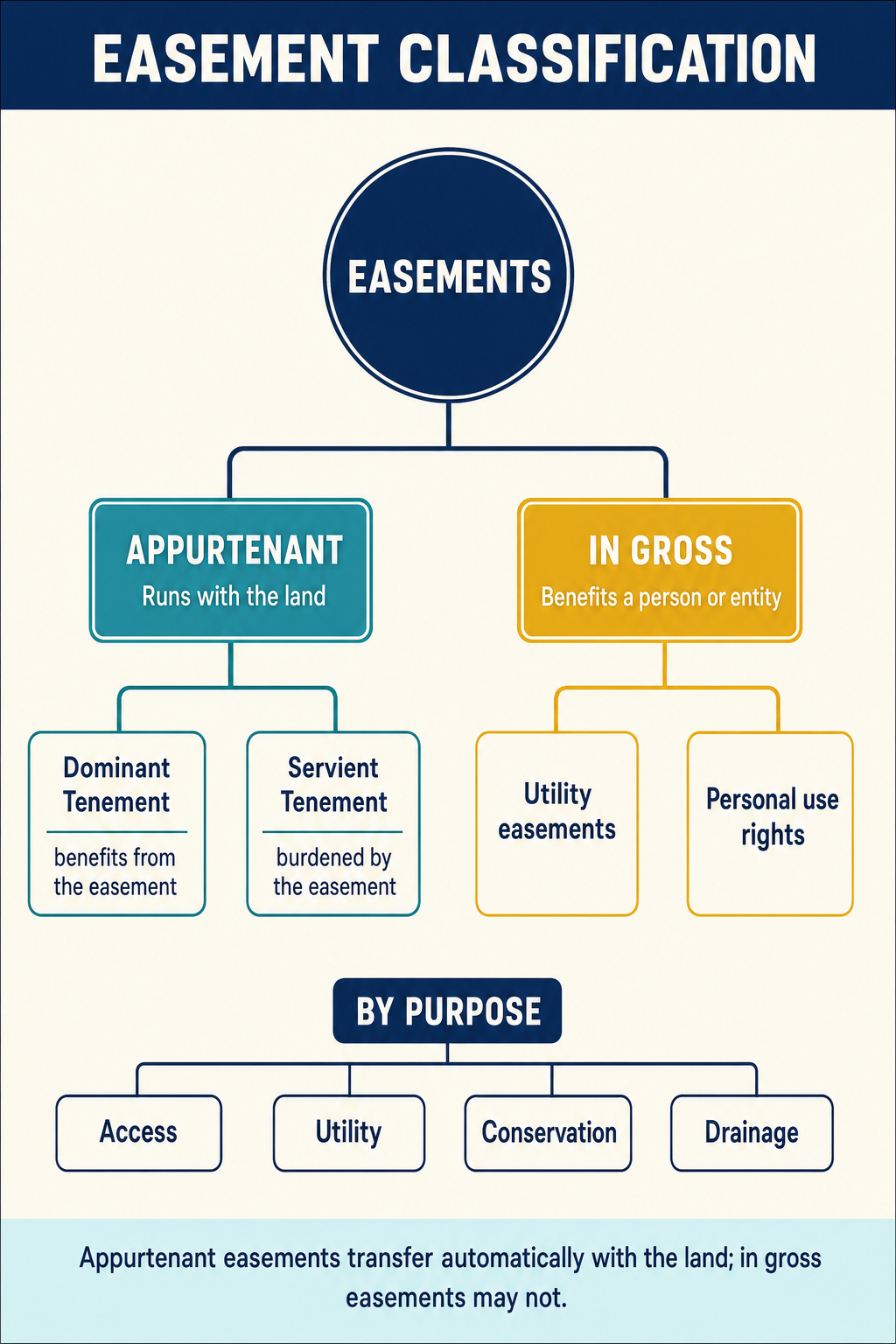
Appurtenant Easements
An easement appurtenant benefits an adjacent or nearby tract of land (the dominant tenement) and burdens another tract (the servient tenement). The easement "runs with the land" -- it transfers automatically with the dominant and servient parcels when they are sold.
Key characteristics:
- Requires two parcels: dominant (benefited) and servient (burdened)
- Transfers with the land regardless of whether the deed mentions it
- Cannot be separated from the dominant tenement
- Benefits the land itself, not just the current owner
Example: Parcel A has no road access except through Parcel B. An easement appurtenant allows Parcel A's owner to cross Parcel B. When Parcel A is sold, the new owner automatically receives the easement. When Parcel B is sold, the new owner takes it subject to the easement.
Easements in Gross
An easement in gross benefits a specific person or entity rather than a parcel of land. There is a servient tenement but no dominant tenement.
Key characteristics:
- Benefits a person or entity, not a parcel
- May or may not be transferable (commercial easements in gross are generally transferable; personal easements in gross often are not)
- Terminates upon the death of the holder (if personal) or dissolution of the entity
- Does not run with any particular parcel
Examples:
- A utility company's right to maintain power lines across your property
- A personal right to fish in a neighbor's pond
- A billboard company's right to maintain a sign on your land
- Railroad rights-of-way (historically treated as easements in gross)
Comparison
| Feature | Appurtenant | In Gross |
|---|---|---|
| Dominant tenement | Yes | No |
| Servient tenement | Yes | Yes |
| Runs with the land | Yes (both parcels) | Only the servient parcel |
| Transferable | Always (with the dominant parcel) | Depends on type |
| Benefits | The land | A person or entity |
| Typical examples | Access roads, drainage, shared driveways | Utilities, personal use rights |
Licenses vs. Easements
A license is "permission to do an act which, without permission, would be illegal, such as permission to trespass" (Brown's Boundary Control and Legal Principles, 7th Ed., Glossary). It is easy to confuse with an easement, but the two are fundamentally different. Unlike an easement, a license:
- Is not an interest in land — it is mere personal permission from the landowner
- Is generally revocable at the will of the person who granted it
- Does not run with the land and ordinarily cannot be assigned to another person
- Requires no writing — because it conveys no interest in land, an oral license is effective
A farmer who tells a neighbor "you're welcome to cross my field to reach the pond" has granted a license, not an easement. The neighbor's use is lawful only while the permission stands, and the farmer may withdraw it at any time.
Exam significance: when a scenario describes permissive, revocable use, the answer is a license — and because the use is permissive rather than hostile, it also cannot ripen into a prescriptive easement no matter how long it continues (see Creation of Easements below).
Easements by Purpose
| Purpose | Description | Common Features |
|---|---|---|
| Access/Ingress-Egress | Right to cross another's land to reach your property | Fixed width, defined route |
| Utility | Right to install and maintain utility infrastructure | May include aerial, surface, or subsurface rights |
| Drainage | Right to direct water flow across another's property | Natural or constructed channels |
| Conservation | Restriction on development to preserve natural features | Typically in perpetuity |
| Light and Air | Right to receive light and air across adjacent property | Common in urban areas |
| Support | Right to have your land supported by adjacent or subjacent land | Lateral and subjacent support |
| Party Wall | Shared wall straddling a property line | Each owner has an easement in the other's half |
Creation of Easements
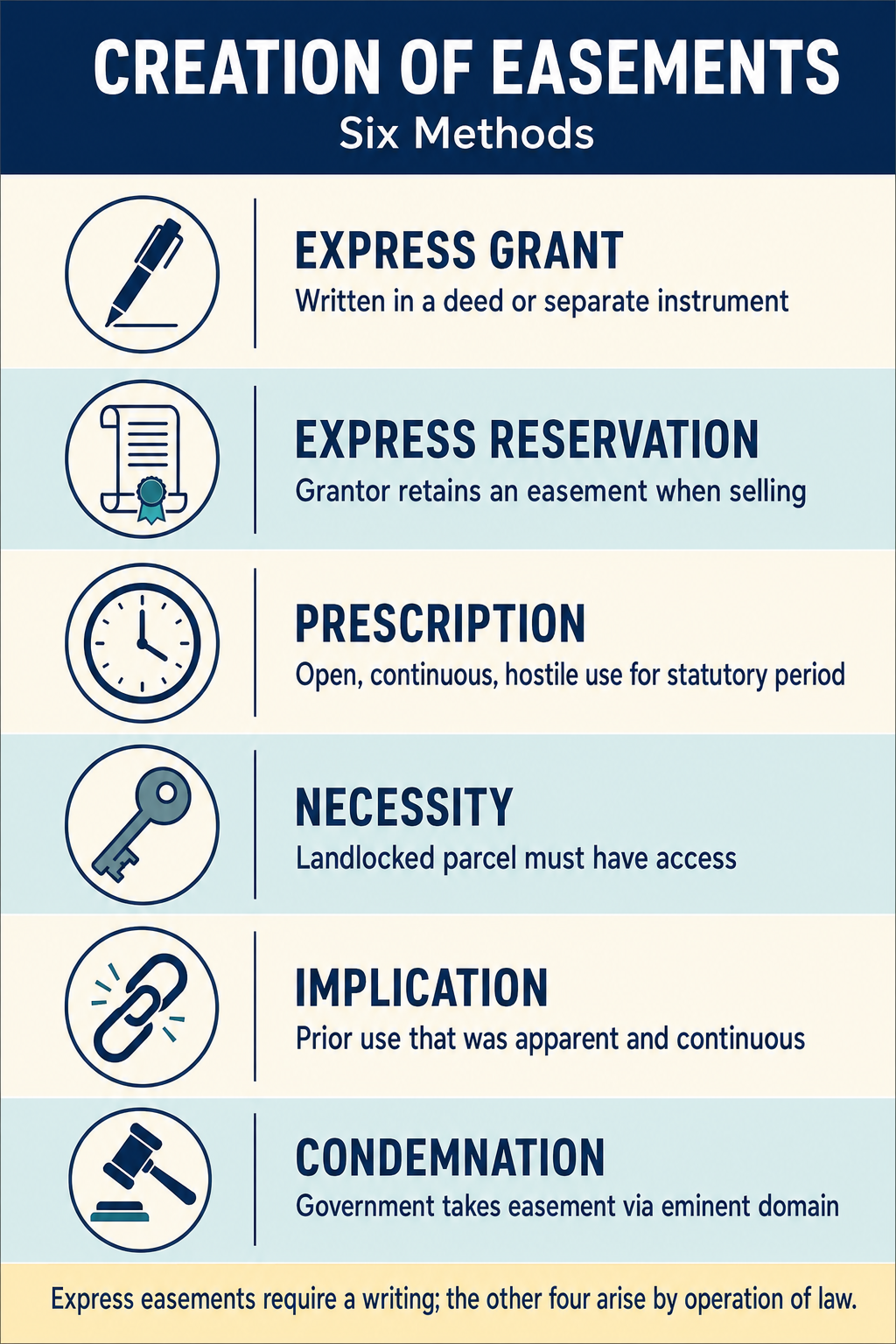
Easements can be created through six primary methods:
1. Express Grant
The most common method. The servient owner grants an easement to the dominant owner through a written instrument (deed or agreement). Requirements:
- Must be in writing (Statute of Frauds)
- Must identify the servient and dominant tenements (if appurtenant)
- Should describe the easement location, width, and purpose
- Must be signed by the grantor
- Should be recorded to provide constructive notice
2. Express Reservation
When a landowner sells a portion of their property, they may reserve an easement over the sold portion for the benefit of the retained portion. The reservation must be in the deed of conveyance.
Example: Owner sells the front portion of their lot but reserves an easement across the sold portion for access to the retained rear portion.
3. Implication (Implied Easement)
An easement may be implied when:
- A single parcel is divided into two or more parcels
- Before the division, one portion was used for the benefit of another (quasi-easement)
- The use was apparent (visible or discoverable upon reasonable inspection)
- The use was continuous (not sporadic)
- The easement is reasonably necessary for the enjoyment of the dominant parcel
Example: Owner has a single parcel with a driveway crossing the north half to reach the south half. Owner sells the north half. An implied easement for the driveway may exist because the use was apparent, continuous, and reasonably necessary before the division.
4. Necessity
An easement by necessity arises when:
- A parcel is landlocked with no legal access to a public road
- The landlocked parcel was once part of a larger tract that had access
- The division created the landlocked condition
- Access is strictly necessary (not merely convenient)
Easements by necessity are disfavored and narrowly construed. They exist only as long as the necessity exists. If alternative access becomes available, the easement by necessity may be extinguished.
5. Prescription
A prescriptive easement is acquired through long, hostile, continuous, open, and notorious use -- similar to adverse possession but acquiring only a right of use, not title. See Topic 1.3 for detailed treatment.
Key differences from adverse possession:
- Acquires use rights only, not fee title
- Does not require exclusive possession
- Generally does not require tax payment
- Must be a specific, identifiable use
6. Condemnation (Eminent Domain)
Government entities may acquire easements through condemnation (eminent domain) for public purposes such as:
- Highway and road rights-of-way
- Utility corridors
- Drainage and flood control
- Conservation and open space
Just compensation must be paid to the servient owner.
Termination of Easements
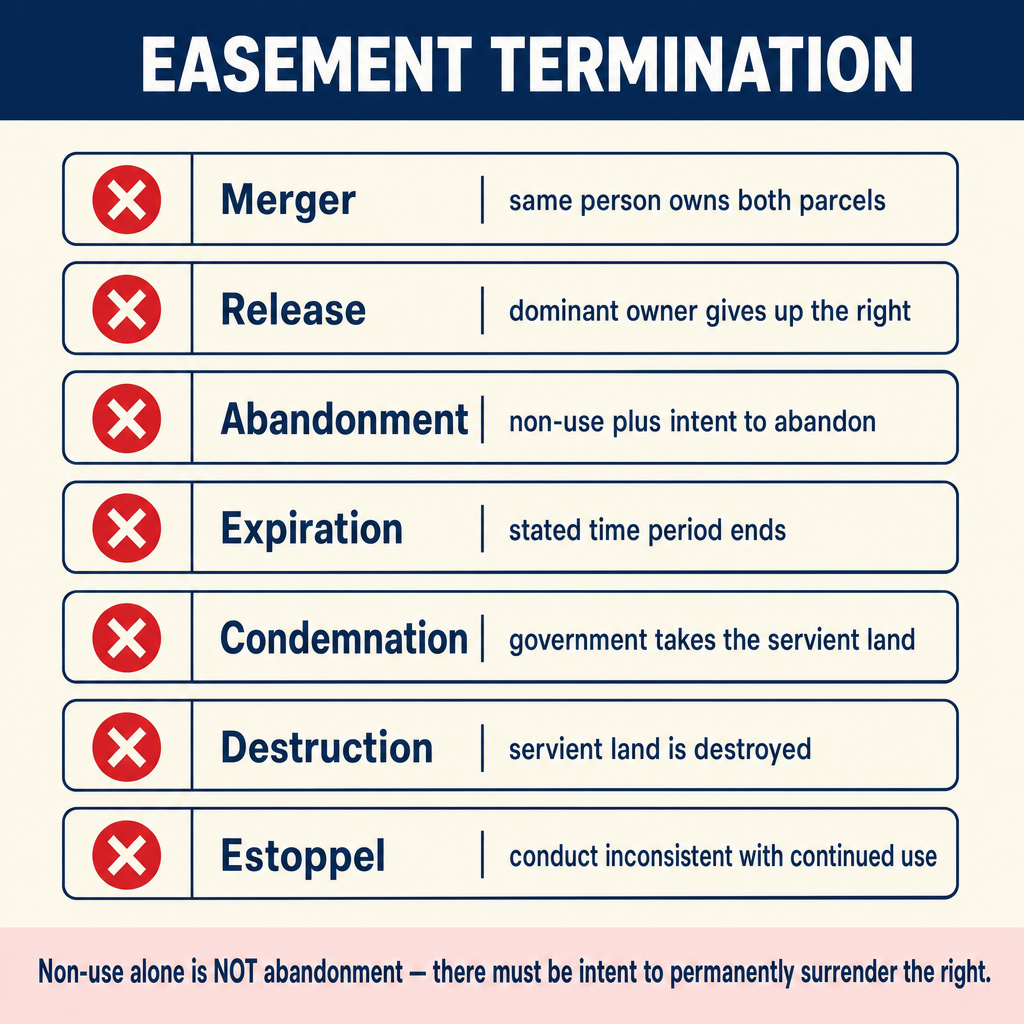
Easements can be terminated through:
| Method | Description |
|---|---|
| Release | The easement holder expressly releases the right (must be in writing) |
| Merger | The dominant and servient tenements come under common ownership |
| Abandonment | The holder demonstrates clear intent to abandon (non-use alone is insufficient) |
| Expiration | The easement was created for a specific time period that has expired |
| Destruction | The servient tenement is destroyed (rare for land easements) |
| Condemnation | Government takes the servient tenement, extinguishing the easement |
| Estoppel | The servient owner changes position in reliance on apparent abandonment |
| Prescription | The servient owner blocks the easement and meets adverse possession elements |
| End of necessity | For easements by necessity, when alternative access becomes available |
| Misuse | Extreme or persistent misuse of the easement beyond its scope |
Important: Non-use alone does not terminate an easement. The holder must demonstrate affirmative intent to abandon, typically through both non-use AND affirmative acts inconsistent with continued use.
Common wrong path — assuming long non-use extinguishes an easement. "The easement hasn't been used in 30 years — it must be gone." This reasoning is wrong. Non-use, by itself, does not terminate an easement, no matter how long. Termination requires either (a) a written release, (b) merger (dominant and servient tenements come under common ownership), (c) abandonment plus affirmative acts showing clear intent to abandon, (d) condemnation, (e) expiration of a time-limited easement, or (f) prescription running the other way (the servient owner blocks the easement and the holder does nothing for the statutory period). An easement recorded in 1920 is presumptively still valid in 2026 even if no one has used it in living memory. Exam questions bait this trap by describing long-idle rights-of-way or ancient utility corridors; the correct answer rarely involves "termination by non-use."
Quick retrieval check — try before reading on.
▶A deed easement granted a utility company a 15-ft-wide strip across your client's property in 1965 for overhead power lines. The lines were removed in 1998 and the company's records suggest the easement was "vacated." However, no written release was ever recorded. Your client wants to build a shed on the easement strip. Is the easement extinguished?
Probably not. A utility company removing physical infrastructure and internally deeming an easement "vacated" is not legal extinguishment. The easement was created by written instrument (express grant), so in most jurisdictions it can only be terminated by (a) a recorded written release, (b) merger (the utility acquiring fee title to the servient parcel), (c) a court order (e.g., quiet title with a finding of abandonment), or (d) conditions specified in the grant itself (e.g., "easement terminates upon removal of utilities"). The surveyor should: (1) flag the apparent easement on the plat with its recording reference, (2) note the absence of physical infrastructure, and (3) recommend the client obtain a formal recorded release from the utility or a quiet-title action before building on the strip. Do not opine that the easement is extinguished — that is a legal determination.
Scope and Limits of Easements
The scope of an easement is determined by:
- The language of the grant (for express easements)
- The purpose for which it was created
- The historical use (for prescriptive easements)
- Reasonable necessity (for implied and necessity easements)
The easement holder may:
- Use the easement for its intended purpose
- Make reasonable improvements necessary for the intended use
- Enter the servient tenement for maintenance
The easement holder may NOT:
- Expand the use beyond the original purpose
- Interfere with the servient owner's reasonable use of the property
- Allow the easement to serve additional parcels not contemplated in the original grant
- Materially increase the burden on the servient tenement
The servient owner may:
- Use the easement area for any purpose that does not interfere with the easement
- Build over or under the easement (in some cases) if it does not obstruct the use
- Require the dominant owner to maintain the easement area
The servient owner may NOT:
- Block or obstruct the easement
- Relocate the easement without the holder's consent (in most jurisdictions)
- Interfere with the easement holder's reasonable use
The Surveyor's Responsibilities
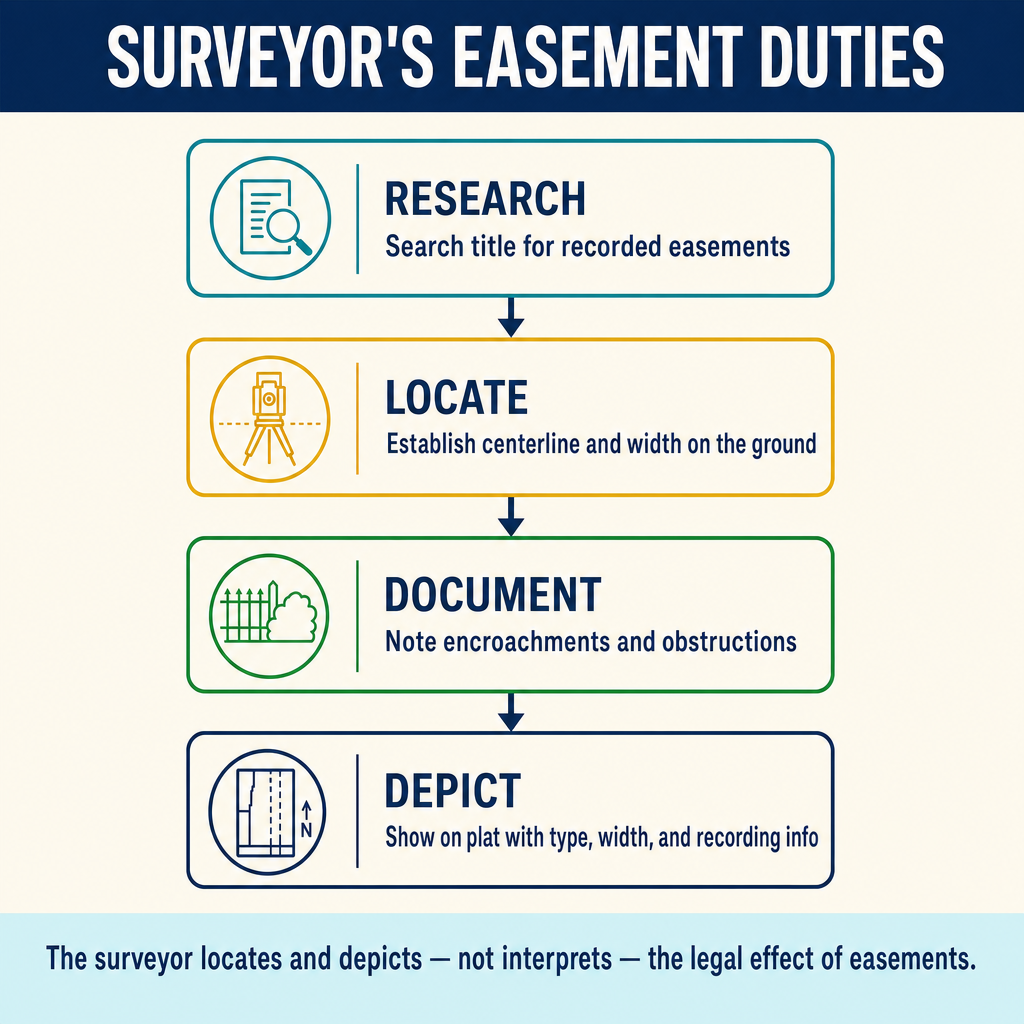
When conducting boundary or ALTA surveys, the surveyor must:
- Search for easements in the title report, recorded documents, and physical evidence
- Locate easements on the ground when possible
- Depict easements on the survey plat with appropriate notation
- Identify apparent easements not shown in the title documents (prescriptive paths, utility lines, etc.)
- Note encroachments into easement areas
- Distinguish between different types (appurtenant, in gross, prescriptive)
- Show the easement width and location with dimensions when determinable
For ALTA/NSPS Land Title Surveys, Table A items may require the surveyor to locate and depict easements, set-back lines, and other encumbrances with specific detail.
Exam Tips
- Appurtenant easements run with the land -- they transfer automatically with ownership
- Easements in gross benefit a person, not a parcel -- no dominant tenement exists
- Know all six creation methods: express grant, reservation, implication, necessity, prescription, condemnation
- Non-use alone does not terminate an easement -- affirmative intent to abandon is required
- Merger terminates an easement when dominant and servient tenements come under common ownership
- For implied easements, remember: apparent, continuous, reasonably necessary, prior common ownership
- Easements by necessity require the parcel to be strictly landlocked, not merely inconvenient to access
- Prescriptive easements acquire use rights only -- not fee title
- A prescriptive easement's scope is limited to the historical use that created it
- On ALTA surveys, the surveyor must locate and depict easements shown in the title commitment
Related Test Topics
- Prescriptive Rights and Adverse Possession (Topic 1.3)
- Acquiescence and Boundary Agreement (Topic 1.4)
- Controlling Elements (Topic 1.5)
- Riparian, Littoral, and Sovereign Rights (Topic 1.7)
- Legal Descriptions (Topic 1.9)
Further Reading
Authoritative sources for deeper study
Brown's Boundary Control and Legal Principles (7th Ed., Robillard & Wilson) — Standard textbook on boundary law, evidence hierarchy, and retracement.
Evidence and Procedures for Boundary Location (Robillard, Wilson, & Brown, 7th Ed.) — Practical treatise on collecting, weighing, and applying boundary evidence.
Clark, A Treatise on the Law of Surveying and Boundaries — Long-standing legal reference on boundary disputes and surveyor liability.
Last updated: 2026-04-17