PS Exam Preparation
Comprehensive preparation for the NCEES Principles and Practice of Surveying (PS) exam. 5 modules covering all 5 exam domains with 50 in-depth topics.
Module 1: Legal Principles
Module 2: Professional Survey Practices
Module 3: Standards & Specifications
Module 4: Business Practices
Module 5: Areas of Practice
Costs, Budgets & Contracts
Learning Objectives
After completing this topic, you should be able to:
- Estimate project costs using standard methods
- Prepare project budgets that account for direct and indirect costs
- Distinguish between contract types and their appropriate applications
- Prepare competitive bid proposals for surveying services
- Identify essential contract provisions for surveying engagements
- Recognize the financial implications of scope changes
Overview
Financial management is inseparable from project management in surveying practice. Every proposal requires a cost estimate, every project requires a budget, and every engagement requires a contract. The PS exam tests your understanding of these interconnected financial and legal instruments -- how they are prepared, what they contain, and how they protect both the surveyor and the client.
Cost Estimation
Types of Costs
Understanding cost categories is essential for accurate estimation:
| Cost Type | Description | Examples |
|---|---|---|
| Direct labor | Time spent by personnel on the project | Field crews, project surveyor, CAD technicians |
| Direct expenses | Out-of-pocket costs for the project | Subcontractors, monuments, filing fees, travel |
| Indirect labor | Support time not billed to a specific project | Office management, marketing, training |
| Overhead | General business operating costs | Rent, utilities, insurance, software licenses |
| Profit | Margin above costs | Target percentage of total revenue |
The Billing Rate Structure
A typical billing rate must recover all costs plus profit:
| Component | Example |
|---|---|
| Base salary | $35.00/hour |
| Benefits and taxes (30-40% of salary) | $12.25/hour |
| Overhead multiplier (1.5x - 2.5x of labor) | 47.25) |
| Profit (10-15% of subtotal) | $11.81/hour |
| Billing rate | 95) |
The overhead multiplier captures all indirect costs. A multiplier of 2.0 means that for every dollar of direct labor, the firm spends another dollar on overhead.
Estimation Methods
Bottom-Up Estimating
Build the estimate from individual tasks:
- List all tasks from the work breakdown structure
- Estimate hours for each task by personnel type
- Multiply hours by billing rates
- Add direct expenses
- Sum all components
This is the most accurate method but requires a well-defined scope.
Parametric Estimating
Use historical data to estimate based on project parameters:
- Cost per lot for subdivision surveys
- Cost per acre for topographic surveys
- Cost per mile for route surveys
- Cost per point for control surveys
Parametric estimates are useful for quick proposals but must be calibrated to local conditions.
Analogous Estimating
Compare to similar completed projects:
- Find a comparable project in firm records
- Adjust for differences in scope, complexity, and conditions
- Apply current rates
This method depends on having good records of past project costs.
Contingency
Every estimate should include contingency for unforeseen conditions:
| Risk Level | Contingency Range |
|---|---|
| Well-defined scope, familiar area | 5-10% |
| Moderate uncertainty | 10-20% |
| High uncertainty, new project type | 20-30% |
Contingency is not padding -- it is a rational allocation for identified risks.
Budgeting
Project Budget Components
A project budget translates the cost estimate into a spending plan:
| Budget Line | Description |
|---|---|
| Labor budget | Budgeted hours by task and personnel classification |
| Expense budget | Anticipated direct expenses |
| Contingency reserve | Funds reserved for unforeseen conditions |
| Fee | Total amount to be billed to the client |
Budget Monitoring
During project execution, the project manager compares actual expenditures against the budget:
- Weekly: Review hours charged by task
- At milestones: Compare percent complete to percent of budget consumed
- At completion: Final cost vs. budget analysis
Early detection of budget overruns allows corrective action before the project becomes unprofitable.
Profitability Analysis
After project completion, compare actual performance to the budget:
| Metric | Calculation |
|---|---|
| Gross revenue | Total amount billed |
| Direct costs | Labor + expenses actually incurred |
| Gross margin | Revenue - direct costs |
| Net margin | Gross margin - allocated overhead |
| Realization rate | Revenue / (standard billing rate x hours) |
A realization rate below 1.0 indicates the firm is not recovering its full billing rates -- a common problem when scope creep goes undocumented.
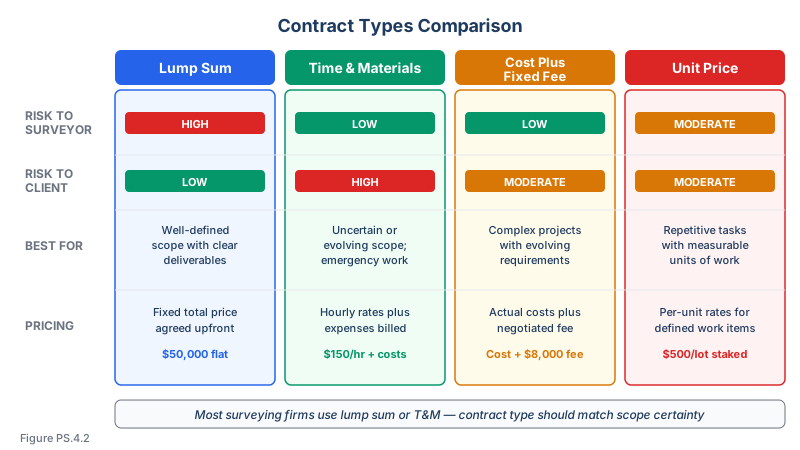
Contract Types
Fixed-Price (Lump Sum)
The surveyor agrees to complete the defined scope for a set price regardless of actual costs.
| Advantages | Disadvantages |
|---|---|
| Client knows total cost upfront | Surveyor bears all cost risk |
| Simple to administer | Must have well-defined scope |
| Incentivizes efficiency | Scope changes require amendments |
| Preferred by many clients | Underestimation leads to losses |
Best suited for: Well-defined scopes with predictable conditions (boundary surveys of simple parcels, standard ALTA surveys, lot staking).
Common wrong path — fixed-price for undefined scopes. Fixed-price contracts are attractive to clients and competitive in bid situations — but they only work when the scope is well-defined. A fixed-price proposal for a boundary survey in an area with unknown monumentation, unresolved conflicts between adjoining deeds, or potential adverse-possession issues is a recipe for losses: the surveyor has assumed all the risk of unforeseen complexity, with no mechanism to recover additional fees when the work turns out to be harder than assumed. Students sometimes answer "fixed-price" for any surveying scenario because it seems professional; the correct answer depends on scope certainty. If the scope is well-defined (routine lot, clean records), fixed-price is appropriate. If the scope involves research into conflicting deeds, litigation-adjacent work, or unknown field conditions, a T&M or NTE contract is more appropriate.
Quick retrieval check — try before reading on.
▶Two clients approach you with survey needs. Client A needs a boundary survey of a modern, clearly platted 1-acre lot in a well-documented subdivision. Client B needs a boundary retracement of a rural 40-acre parcel with a 1905 metes-and-bounds deed, conflicting adjoiner descriptions, and reports of disputed fence lines. Which contract type is appropriate for each, and why?
Client A — Fixed-price is appropriate. The scope is well-defined: modern subdivision, clean records, single well-documented parcel. The surveyor can accurately estimate hours and expenses, and any unforeseen complications are unlikely. Fixed-price gives the client cost certainty and the surveyor an incentive for efficient execution. Typical such projects have well-established benchmark pricing (cost per lot) that supports firm fee proposals.
Client B — Time-and-materials or not-to-exceed is appropriate. The scope contains multiple sources of uncertainty: 1905 deed interpretation (how many days of research?), adjoiner reconciliation (conflicts may require resurveys of neighbors), fence-line disputes (potentially involves legal consultation and court-facing documentation). A fixed-price proposal for this scenario either (a) forces the surveyor to pad heavily to cover unknowns (losing the bid) or (b) underprices and loses money. T&M gives the surveyor fair compensation for actual research time; an NTE cap gives the client a cost ceiling while preserving the T&M flexibility. If the client insists on fixed-price, either decline the engagement or scope it narrowly (fixed-price for phase 1 records research only, with phase 2 priced separately after phase 1 results are known).
Time and Materials (T&M)
The surveyor bills actual hours at agreed rates plus expenses at cost (or with markup).
| Advantages | Disadvantages |
|---|---|
| Fair compensation for actual work | Client faces cost uncertainty |
| Flexible scope | Requires detailed time tracking |
| Lower risk for surveyor | Client may question hours billed |
| Suitable for uncertain scope | No incentive for efficiency |
Best suited for: Projects with uncertain or evolving scope (expert witness work, complex boundary disputes, phased projects).
Not-to-Exceed (NTE)
A hybrid approach: T&M billing up to a maximum amount. The surveyor bills actual costs but cannot exceed the cap.
| Advantages | Disadvantages |
|---|---|
| Client has cost ceiling | Surveyor bears risk above cap |
| Fair billing for actual work | Cap must be set carefully |
| Compromise approach | May need amendment if scope changes |
Best suited for: Projects where scope is reasonably defined but some uncertainty remains.
Cost-Plus
The surveyor bills actual costs plus a percentage or fixed fee for profit.
| Advantages | Disadvantages |
|---|---|
| Full cost recovery guaranteed | No incentive to control costs |
| Transparent to client | Requires open-book accounting |
| Suitable for large/complex projects | Client must trust the surveyor |
Best suited for: Large public works projects, emergency response, or projects where the full scope cannot be defined in advance.
Unit Price
The surveyor bills at agreed rates per unit of work performed.
| Advantages | Disadvantages |
|---|---|
| Scales with actual work | Must define units precisely |
| Fair for variable quantities | Unit rates must cover all costs |
| Easy to administer | Disputes over unit definitions |
Best suited for: Repetitive work with variable quantities (staking lots in a subdivision, setting control monuments, per-acre topographic surveys).
Bid Preparation
Competitive Bidding Process
Public agencies and some private clients require competitive bids. The typical process:
- Request for Proposal (RFP) or Request for Qualifications (RFQ) issued by client
- Pre-bid meeting or site visit (sometimes mandatory)
- Proposal preparation by competing firms
- Proposal submission by deadline
- Evaluation by client (price, qualifications, or both)
- Selection and negotiation
- Contract execution
Qualifications-Based Selection (QBS)
Under the Brooks Act (federal) and many state equivalents, surveying and engineering services for public projects must be procured based on qualifications, not price:
- Firms are ranked by qualifications
- The top-ranked firm negotiates scope and fee
- If negotiations fail, the client moves to the next-ranked firm
QBS recognizes that professional services are not commodities where the lowest price ensures the best outcome.
Proposal Content
A competitive proposal typically includes:
| Section | Content |
|---|---|
| Cover letter | Introduction, key differentiators, commitment |
| Understanding of project | Demonstrates comprehension of client needs |
| Scope of services | Detailed description of proposed work |
| Approach and methodology | How the work will be performed |
| Schedule | Proposed timeline with milestones |
| Team qualifications | Relevant experience of key personnel |
| Firm qualifications | Similar project experience, references |
| Fee proposal | Cost breakdown (may be separate envelope for QBS) |
Essential Contract Provisions
Minimum Contract Elements
Every surveying contract should address:
| Provision | Purpose |
|---|---|
| Parties | Identifies the surveyor and client |
| Scope of services | Defines what work will be performed |
| Compensation | States the fee and payment terms |
| Schedule | Establishes the timeline for performance |
| Standard of care | Defines the professional standard to be met |
| Termination | Allows orderly exit by either party |
| Dispute resolution | Establishes process for resolving disagreements |
| Insurance | Specifies required insurance coverage |
| Limitation of liability | Caps the surveyor's total liability exposure |
| Indemnification | Allocates risk between parties |
| Ownership of documents | Clarifies who owns the work product |
Standard of Care Clause
The standard of care defines the level of performance expected:
"Surveyor shall perform services consistent with the degree of care and skill ordinarily exercised by members of the same profession currently practicing under similar circumstances in the same locality."
This "reasonable care" standard is the default in most jurisdictions. Contracts that impose a higher standard (such as "error-free" or "guaranteed") should be avoided because they create strict liability.
Payment Terms
Payment provisions should specify:
- When invoices will be submitted (monthly, at milestones, upon completion)
- Payment terms (net 30, net 45, etc.)
- Deposit or retainer requirements
- Late payment interest or penalties
- Right to suspend work for non-payment
- Conditions for final payment
Ownership of Documents
Instruments of service (maps, calculations, electronic files) are typically the property of the surveyor unless the contract states otherwise. The client receives a license to use the deliverables for their intended purpose. This distinction matters because:
- It prevents misuse of deliverables for purposes beyond the original scope
- It protects the surveyor from liability for unauthorized modifications
- It preserves the surveyor's intellectual property rights
Exam Tips
- Know the characteristics of each contract type and when each is appropriate
- Understand the difference between direct costs, indirect costs, and overhead
- QBS (Qualifications-Based Selection) is required for public professional services in most jurisdictions -- the PS exam tests this
- Questions may present a scenario and ask which contract type is most appropriate
- Understand that a "standard of care" clause should reference reasonable professional practice, not perfection
- Know that scope changes require written authorization and contract amendment
Related Test Topics
- Project Planning and Management (Topic 4.1)
- Survey Types and Scope of Services (Topic 4.3)
- Risk Management (Topic 4.6)
- Client Communication and Interdisciplinary Coordination (Topic 4.8)
Further Reading
Authoritative sources for deeper study
NCEES Model Rules of Professional Conduct (Aug 2025) — Model ethics, competence, and licensure rules adopted by most state boards.
2021 ALTA/NSPS Land Title Survey Standards — Current minimum standard detail requirements for ALTA/NSPS land title surveys.
Last updated: 2026-04-17