PS Exam Preparation
Comprehensive preparation for the NCEES Principles and Practice of Surveying (PS) exam. 5 modules covering all 5 exam domains with 50 in-depth topics.
Module 1: Legal Principles
Module 2: Professional Survey Practices
Module 3: Standards & Specifications
Module 4: Business Practices
Module 5: Areas of Practice
Sequential & Simultaneous Conveyances
Learning Objectives
After completing this topic, you should be able to:
- Distinguish between sequential and simultaneous conveyances
- Apply senior/junior rights to resolve overlapping descriptions
- Identify the major types of deeds and their legal implications
- Explain the doctrine of proration and when it applies
- Describe how simultaneous conveyances from a common grantor are resolved
- Understand the role of recording statutes in determining priority
- Analyze deed language to determine the grantor's intent
Overview
The manner in which land is conveyed -- whether parcels are sold one at a time (sequentially) or all at once (simultaneously) -- profoundly affects how boundaries are determined when descriptions conflict or overlap. The surveyor must understand the doctrines of senior and junior rights, the legal characteristics of different deed types, and the rules for proration that apply when a grantor conveys more or less land than they actually own.
These principles are deeply intertwined with the hierarchy of controlling elements (Topic 1.5), particularly the senior rights doctrine. The practical application of conveyance law is something the boundary surveyor encounters on virtually every retracement survey.
Key Concepts
Sequential Conveyances
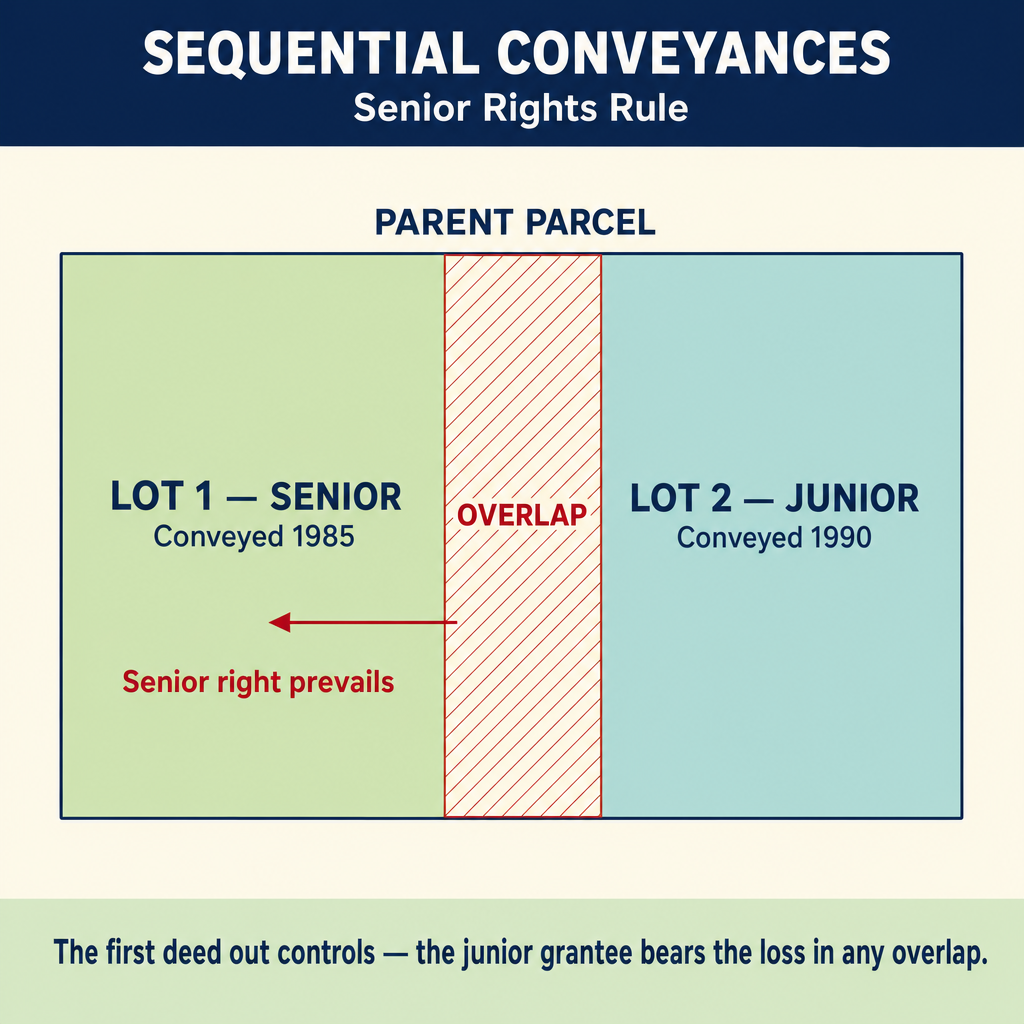
Sequential conveyances occur when a common grantor sells parcels from a larger tract one at a time, over a period of time. The first parcel sold creates the senior conveyance; subsequent sales create junior conveyances.
The Senior/Junior Doctrine
The fundamental rule: first in time, first in right (prior tempore, prior jure).
When a grantor makes sequential conveyances from the same parent tract:
| Conveyance | Status | Rights |
|---|---|---|
| First sale | Senior | Gets exactly what the deed describes (measured first) |
| Second sale | Junior | Gets what is described, but cannot take from the senior |
| Third sale | More junior | Gets the remainder after senior and second grantee |
| Last sale | Most junior | Gets whatever is left |
The senior grantee's rights are paramount. If the senior description overlaps with a junior description, the senior grantee prevails in the overlap area. The junior grantee can only receive what the grantor still had to give at the time of the junior conveyance.
Example: Grantor owns a 100-foot-wide lot.
- January: Grants the west 55 feet to A (senior)
- March: Grants the east 55 feet to B (junior)
The total exceeds 100 feet by 10 feet. A (senior) gets the full west 55 feet. B (junior) gets only 45 feet (the remainder after A's senior conveyance).
Resolving Sequential Overlap
When sequential conveyances overlap, the surveyor:
- Identifies the chronological order of conveyances
- Measures the senior conveyance first, giving it full effect
- Measures the junior conveyance from what remains
- The junior bears the excess or deficiency
This is not a matter of splitting the difference -- the senior gets exactly what was described, and the junior absorbs the discrepancy.
Simultaneous Conveyances
Simultaneous conveyances occur when a common grantor divides a tract into multiple parcels and sells (or records) them all at the same time. The most common example is a subdivision plat, where all lots are created and placed on the market simultaneously.
No Senior/Junior in Simultaneous Conveyances
When conveyances are truly simultaneous, no parcel has seniority over any other. All grantees have equal rights. This means that when descriptions conflict or the total exceeds the available land, the resolution is different from the sequential case.
Proration is the primary tool for resolving simultaneous conflicts. See below.
When Is a Conveyance "Simultaneous"?
Conveyances are generally treated as simultaneous when:
- All parcels are created on the same recorded plat or final map
- All conveyances are dated and recorded the same day
- The grantor's intent was clearly to create all parcels at once
- The plat or plan shows a comprehensive division of the parent tract
Even if individual lots from a subdivision are sold on different dates, the plat itself represents a simultaneous division. The lot lines shown on the plat are the boundaries, and all lots have equal standing relative to one another.
Proration
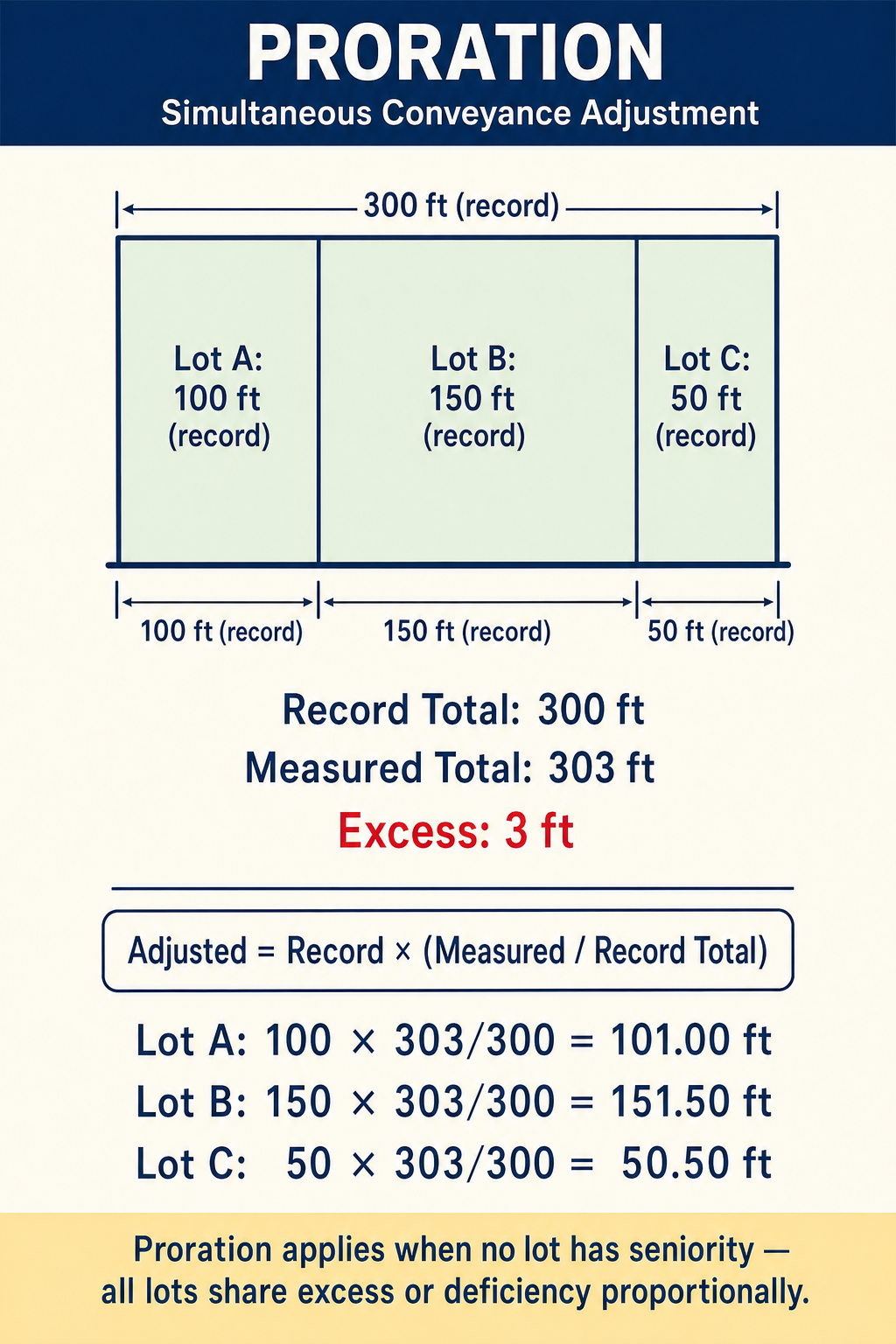
Proration is the equitable distribution of excess or deficiency among parcels when the total of all described dimensions does not match the actual available distance. It applies primarily to simultaneous conveyances.
When Proration Applies
- All parcels were created simultaneously (same plat, same grantor, same time)
- The total of the described dimensions exceeds or falls short of the measured distance
- No monuments or other higher-ranking evidence resolves the discrepancy
- The parcels are described by a common scheme (all by dimensions along a line)
How to Prorate
The basic formula distributes the excess or deficiency proportionally to each parcel based on its described dimension:
Adjusted dimension = Described dimension x (Actual total / Described total)
Example: A subdivision plat shows four lots along a block face:
- Lot 1: 50 feet
- Lot 2: 60 feet
- Lot 3: 50 feet
- Lot 4: 40 feet
- Total described: 200 feet
- Actual measured distance: 198 feet (2-foot deficiency)
Proration distributes the 2-foot deficiency proportionally:
- Lot 1: 50 x (198/200) = 49.50 feet
- Lot 2: 60 x (198/200) = 59.40 feet
- Lot 3: 50 x (198/200) = 49.50 feet
- Lot 4: 40 x (198/200) = 39.60 feet
- Total: 198.00 feet
Common wrong path — prorating sequential conveyances. The proration formula is tempting because it looks fair — everyone shares the discrepancy. But it applies only to simultaneous conveyances. In sequential conveyances, the senior grantee receives the full described dimension and the junior absorbs the entire excess or deficiency. A student who prorates a sequential conflict will deprive the senior grantee of part of what they were contractually promised — a legal error, not a numerical one. The first question on any conflict-of-dimensions problem is: were these conveyances simultaneous or sequential? Look for dates of conveyance; if the deeds are dated the same day (or reference a common plat), simultaneous. If dated different days, sequential — no proration, senior takes all.
Quick retrieval check — try before reading on.
▶Grantor X owns a 500-ft-wide parcel. On March 1, X deeds the west 300 ft to A. On June 1, X deeds "the remainder of the parcel, approximately 200 ft wide" to B. Upon retracement you find the parent parcel is actually 495 ft wide. How much does B receive?
195 ft. These are sequential conveyances (March 1 vs June 1), so senior rights apply. A takes the full 300 ft described. B, as the junior grantee, receives only what remains: 495 − 300 = 195 ft — 5 ft less than the "approximately 200 ft" the deed suggested. The word "approximately" and the "remainder" language signal that B accepted whatever was left. If the conveyances had been simultaneous (same day, same plat), you'd prorate: A = 300 × (495/500) = 297 ft; B = 200 × (495/500) = 198 ft. Different doctrine, different result.
When Proration Does NOT Apply
- Sequential conveyances: The junior absorbs the full discrepancy
- Monuments found: If lot corner monuments are found in place, they control over dimensions
- Unequal evidence: If one lot has stronger evidence (an original monument, for example) than others
- Clear intent: If the plat or deeds show that the grantor intended a specific lot to absorb the remainder
Types of Deeds
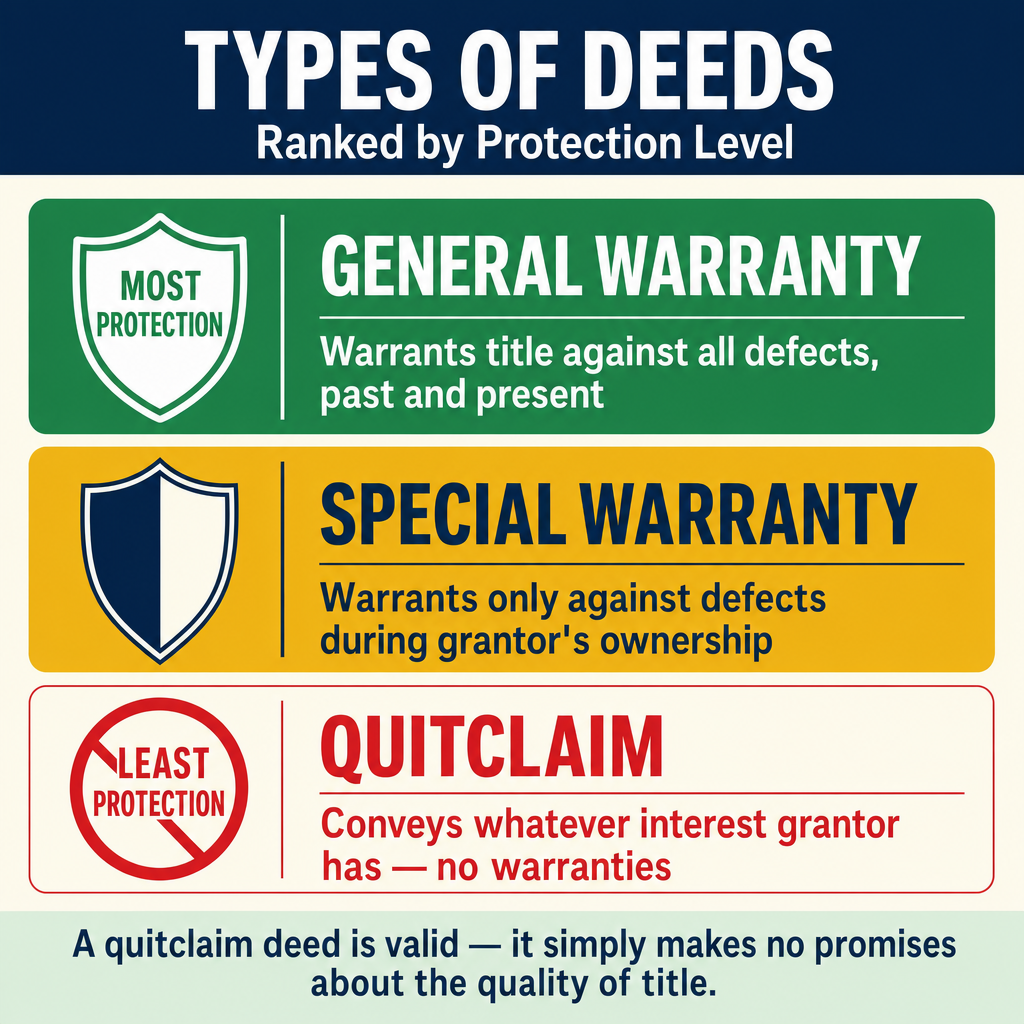
The type of deed used in a conveyance affects the grantor's liability and the grantee's protections:
Grant Deed
A grant deed (common in many western states) carries two implied warranties. Note: a bargain and sale deed is a related but distinct instrument in some jurisdictions — it implies the grantor holds title but typically makes fewer warranties than a grant deed.
- The grantor has not previously conveyed the same property to another
- The property is free from encumbrances made by the grantor (except those disclosed)
| Feature | Detail |
|---|---|
| Warranties | Not previously conveyed; free from undisclosed encumbrances |
| Grantor liability | Limited to the grantor's own actions |
| Common use | Standard residential and commercial transfers |
| After-acquired title | Passes to the grantee (in most jurisdictions) |
Warranty Deed (General Warranty Deed)
A warranty deed provides the broadest protections. The grantor warrants:
- Covenant of seisin: The grantor owns the property and has the right to convey it
- Covenant of right to convey: The grantor has legal authority to make the transfer
- Covenant against encumbrances: The property is free from liens, easements, or other encumbrances (except those stated)
- Covenant of quiet enjoyment: The grantee will not be disturbed by superior title claims
- Covenant of warranty: The grantor will defend the grantee against all title claims
- Covenant of further assurances: The grantor will execute any additional documents needed to perfect the title
Warranty deeds provide protection against defects arising from any prior owner, not just the current grantor.
Quitclaim Deed
A quitclaim deed conveys only whatever interest the grantor has at the time of the conveyance, with no warranties whatsoever.
| Feature | Detail |
|---|---|
| Warranties | None |
| What is conveyed | Whatever the grantor has, if anything |
| Grantor liability | None -- "as is" transfer |
| Common use | Clearing title clouds, transferring between family members, resolving boundary disputes |
| After-acquired title | Does NOT pass |
Critical for surveyors: A quitclaim deed does not guarantee that the grantor owns anything. If the grantor has no interest in the property, the quitclaim deed conveys nothing. However, a quitclaim deed from a prior owner can be important evidence in resolving boundary disputes.
Patent
A patent is a conveyance from the government to a private individual. It represents the original transfer of land from sovereign ownership to private ownership.
| Feature | Detail |
|---|---|
| Grantor | Federal or state government |
| Type | Original conveyance from sovereign |
| Significance | Creates the first private title; establishes the chain |
| For surveyor | The patent description and referenced survey are the foundation of the chain of title |
| PLSS connection | Federal patents reference the PLSS survey (section, township, range) |
The patent is the beginning of the chain of title. All subsequent conveyances derive their authority from the patent. The original government survey that the patent references establishes the original boundaries.
Deed of Trust
A deed of trust is a security instrument used in many states instead of a mortgage. Three parties are involved:
| Party | Role |
|---|---|
| Trustor (borrower) | Conveys legal title to the trustee as security for the loan |
| Trustee | Holds legal title in trust; reconveys upon full payment |
| Beneficiary (lender) | Holds the beneficial interest; receives payment |
A deed of trust is an encumbrance on the property, not a conveyance of ownership. The trustor retains equitable title and possession. Upon full payment of the debt, the trustee reconveys legal title to the trustor.
Recording Statutes
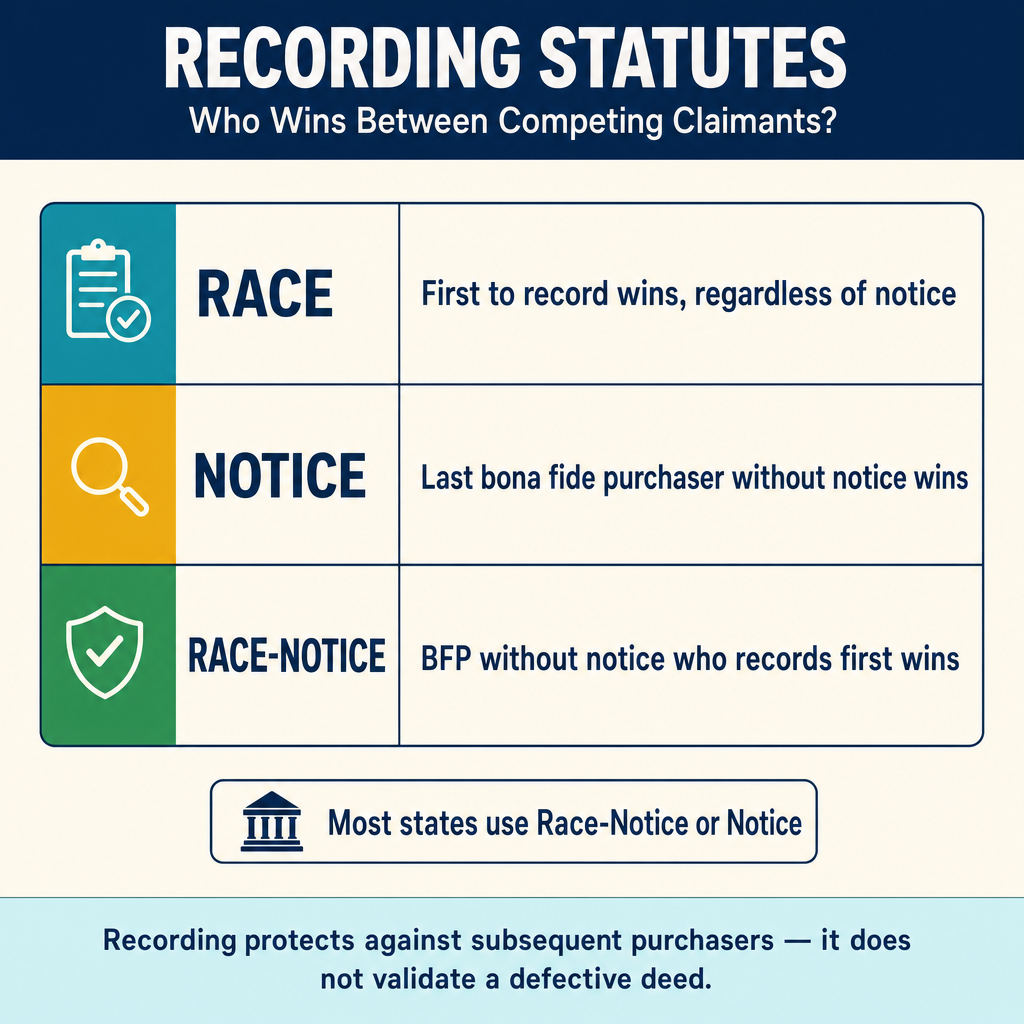
Recording statutes determine the priority of competing claims to the same property. Three types exist:
| Type | Rule | Priority |
|---|---|---|
| Race | First to record wins regardless of notice | Recording order |
| Notice | A subsequent BFP without notice prevails over an unrecorded prior conveyance | Good faith purchase without knowledge |
| Race-Notice | A subsequent BFP who records first prevails | Both must occur: no notice AND first to record |
BFP = Bona Fide Purchaser (one who pays value in good faith without notice of prior claims).
Implications for surveyors:
- The recorded chain of title is the starting point but may not tell the whole story
- Unrecorded deeds may exist and may affect boundaries
- The recording date establishes the priority for sequential conveyances
- A thorough title search is essential to identify all conveyances affecting the property
The Remainder Parcel
When a grantor sells off portions of a larger tract, the remainder (or retained parcel) is what the grantor keeps. The remainder is typically:
- Not described by a separate deed (it is what is left after all conveyances)
- Subject to all deficiencies and excesses in the described parcels
- The most junior interest (absorbs errors in the described conveyances)
- Described by reference to the parent tract minus the conveyed parcels
The surveyor must be careful when surveying remainder parcels because their boundaries are defined by the boundaries of the parcels that were carved out of them.
Exam Tips
- Sequential conveyances: senior gets full measure, junior absorbs the discrepancy
- Simultaneous conveyances: prorate the excess or deficiency proportionally
- Proration formula: Adjusted = Described x (Actual total / Described total)
- Proration does NOT apply when monuments are found -- monuments control over dimensions
- Grant deed implies not previously conveyed and free from grantor's encumbrances
- Warranty deed provides the broadest protection (six covenants)
- Quitclaim deed provides NO warranties and conveys only whatever interest the grantor has
- Patent is the original government-to-private conveyance -- the start of the chain of title
- Know the three recording statutes: race, notice, race-notice
- A remainder parcel is the most junior interest and absorbs errors
- The recording date typically determines which conveyance is senior
- When exam questions involve overlapping descriptions, first determine if the conveyances are sequential or simultaneous, then apply the appropriate doctrine
Related Test Topics
- Controlling Elements (Topic 1.5)
- Searching and Evaluating Evidence (Topic 1.1)
- Legal Descriptions (Topic 1.9)
- Prescriptive Rights and Adverse Possession (Topic 1.3)
- Acquiescence and Boundary Agreement (Topic 1.4)
Further Reading
Authoritative sources for deeper study
Brown's Boundary Control and Legal Principles (7th Ed.), chapters on evidence hierarchy and weighing of conflicting calls.
Evidence and Procedures for Boundary Location (Robillard, Wilson, & Brown, 7th Ed.) — Practical treatise on collecting, weighing, and applying boundary evidence.
Wattles, Writing Legal Descriptions (1976) — Gold-standard reference on metes-and-bounds, sectional, and combination descriptions.
Last updated: 2026-04-17