PS Exam Preparation
Comprehensive preparation for the NCEES Principles and Practice of Surveying (PS) exam. 5 modules covering all 5 exam domains with 50 in-depth topics.
Module 1: Legal Principles
Module 2: Professional Survey Practices
Module 3: Standards & Specifications
Module 4: Business Practices
Module 5: Areas of Practice
Project Planning & Management
Learning Objectives
After completing this topic, you should be able to:
- Develop a comprehensive project plan for surveying engagements
- Apply project management methodologies to survey projects
- Create and manage project schedules using standard techniques
- Identify project deliverables and milestones
- Allocate resources effectively across concurrent projects
- Recognize common causes of project failure and apply preventive measures
Overview
Project planning is the foundation of every successful surveying engagement. Before any field crew mobilizes, the project manager must define the scope, estimate resources, establish a schedule, and identify risks. Poor planning leads to cost overruns, missed deadlines, dissatisfied clients, and potential liability exposure.
The PS exam tests your ability to apply structured project management principles to real surveying scenarios -- not abstract management theory, but the practical decisions that determine whether a project succeeds or fails.
Key Concepts

The Project Life Cycle
Every survey project follows a predictable life cycle, regardless of size or complexity:
| Phase | Activities | Key Outputs |
|---|---|---|
| Initiation | Client contact, site reconnaissance, scope discussion | Proposal, contract |
| Planning | Research, scheduling, resource allocation, risk assessment | Project plan, schedule |
| Execution | Field operations, data collection, office computations | Raw data, field notes |
| Delivery | Map preparation, report writing, QA/QC review | Final deliverables |
| Closeout | Client review, file archiving, lessons learned | Archived project file |
Scope Definition
Scope definition is arguably the most important step in project planning. An ambiguous scope leads to disputes, scope creep, and unprofitable projects.
Elements of a Well-Defined Scope:
- Geographic extent -- The specific property or area to be surveyed, identified by legal description, address, or coordinates
- Survey type -- Boundary, topographic, ALTA/NSPS, construction layout, control, or other
- Standards -- Which standards apply (state minimum standards, ALTA/NSPS, local ordinances)
- Deliverables -- Maps, plats, reports, digital files, staking, monuments
- Exclusions -- Work explicitly not included (environmental assessment, title search, utility locating)
- Assumptions -- Conditions assumed to be true (access available, monuments in place, clear weather)
Defining Deliverables
Deliverables must be specific enough that both parties can agree on whether they have been provided:
| Vague Deliverable | Specific Deliverable |
|---|---|
| "A survey" | "Boundary survey plat showing all found and set monuments, bearing and distance of all boundary lines, basis of bearings, area, and adjoining owner information" |
| "Topo map" | "Topographic survey at 1-foot contour interval, showing all visible improvements, utilities, and vegetation within the property limits, delivered as AutoCAD .dwg file" |
| "Staking" | "Offset stakes at 50-foot intervals along proposed centerline with cut/fill to finish grade, plus all horizontal and vertical curve points" |
Project Scheduling
Work Breakdown Structure (WBS)
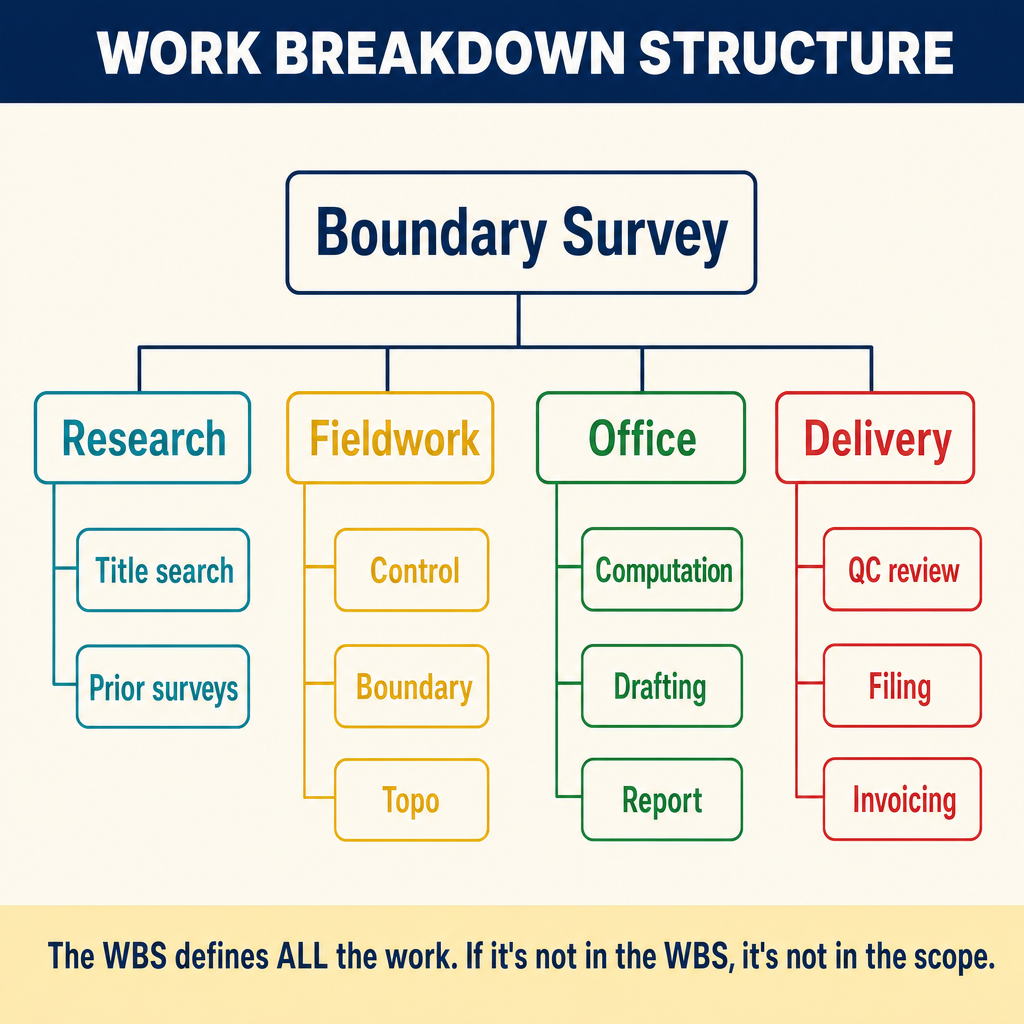
A Work Breakdown Structure decomposes the project into manageable tasks. For a typical boundary survey:
Level 1: Boundary Survey Project
Level 2 tasks:
- Research and preparation
- Field survey
- Office computations
- Map preparation
- QA/QC review
- Client delivery
Level 3 tasks (under Field Survey):
- Mobilization and site access
- Control establishment
- Monument search and recovery
- Boundary evidence collection
- Topographic data (if included)
- Demobilization
Scheduling Methods
Critical Path Method (CPM)
CPM identifies the longest sequence of dependent tasks, which determines the minimum project duration. Any delay on the critical path delays the entire project.
For a boundary survey, the critical path typically runs: Research --> Field Survey --> Computations --> Map Preparation --> Review --> Delivery
Tasks that can proceed in parallel (such as title research while field equipment is being prepared) are not on the critical path and have "float" -- they can be delayed without affecting the project completion date.
Gantt Charts
Gantt charts display tasks as horizontal bars on a timeline. They are the most common scheduling tool in surveying practice because they are intuitive and easy to update.
Key elements of an effective Gantt chart:
- Task names and durations
- Dependencies between tasks
- Milestones (contract execution, field complete, delivery date)
- Resource assignments
- Progress indicators
Estimating Task Durations
Duration estimates should be based on historical data whenever possible. Common factors affecting survey task durations:
| Factor | Impact on Duration |
|---|---|
| Terrain | Steep, heavily vegetated, or urban sites take longer |
| Access | Remote sites require mobilization time; restricted access limits work windows |
| Density | More points, more monuments, more detail means more time |
| Weather | Seasonal conditions may limit productive field days |
| Complexity | Conflicting records, disputed boundaries, and unusual geometries add research and analysis time |
| Crew experience | Less experienced crews need more time and supervision |
Resource Allocation
Personnel
Survey projects require different skill sets at different phases:
| Phase | Personnel Needed |
|---|---|
| Research | Project surveyor, research technician |
| Field | Party chief, instrument operator, rod person(s) |
| Computations | Project surveyor, CAD technician |
| Map preparation | CAD technician, drafting specialist |
| QA/QC | Senior surveyor or peer reviewer |
| Delivery | Project surveyor, licensed surveyor (for seal) |
When managing multiple concurrent projects, the project manager must balance personnel across projects to avoid bottlenecks. The licensed surveyor responsible for sealing work products is often the most constrained resource.
Equipment
Equipment allocation requires advance planning:
- Total stations and GNSS receivers -- Schedule shared equipment across crews
- Specialty equipment -- Laser scanners, hydrographic sonar, UAVs may need advance booking
- Vehicles -- Fleet management for field crews
- Software licenses -- Some software is seat-limited
Budget vs. Schedule Trade-offs
Project managers frequently face trade-offs between cost and schedule:
| Approach | Cost Impact | Schedule Impact |
|---|---|---|
| Add a second field crew | Higher labor cost | Faster field completion |
| Overtime | Premium pay rates | Moderate acceleration |
| Reduce scope | Lower cost | Shorter schedule |
| Accept delay | No additional cost | Longer schedule |
The right choice depends on contract terms, client needs, and firm capacity.
Project Monitoring and Control
Progress Tracking
Effective project managers track progress against the plan:
- Percent complete by task and overall
- Budget consumed vs. budget remaining
- Schedule variance -- ahead or behind plan
- Scope changes -- documented and approved
Earned Value Management
Earned Value Management (EVM) integrates scope, schedule, and cost data:
| Metric | Formula | Meaning |
|---|---|---|
| Planned Value (PV) | Budgeted cost of work scheduled | What you planned to spend by now |
| Earned Value (EV) | Budgeted cost of work performed | Value of work actually completed |
| Actual Cost (AC) | Actual cost of work performed | What you actually spent |
| Cost Variance (CV) | EV - AC | Positive = under budget |
| Schedule Variance (SV) | EV - PV | Positive = ahead of schedule |
| Cost Performance Index (CPI) | EV / AC | Greater than 1.0 = under budget |
| Schedule Performance Index (SPI) | EV / PV | Greater than 1.0 = ahead of schedule |
While full EVM is more common on large public projects, the underlying concepts apply to any surveying engagement.
Change Management
Scope changes are inevitable. A disciplined change management process includes:
- Identify the change and its cause
- Document the change request in writing
- Assess the impact on scope, schedule, and budget
- Approve (or reject) the change with client authorization
- Implement the change
- Update the project plan, schedule, and budget
Undocumented scope changes are a leading cause of unprofitable projects and client disputes.
Common wrong path — "scope creep is inevitable, just absorb it." When a client asks for "one more thing" during a project, it's tempting to accept the task without formal change management, especially for small additions from good clients. This is the primary path to unprofitable projects and fee disputes. Every added task takes time, and "small" additions accumulate — five "quick" add-ons may total 30 hours of uncompensated labor. The right response to every scope change, regardless of size, is: acknowledge, document in writing, assess impact, get written authorization (or rejection), then proceed. Documenting a fifteen-minute phone-call request takes five minutes; not documenting it can cost thousands in disputes months later. Exam questions test this by presenting a client request that seems minor — the correct answer is always to document and obtain authorization, not "just do it" to keep the client happy. Scope creep is not inevitable; failure to manage it is inevitable if you don't have a process.
Quick retrieval check — try before reading on.
▶During an ALTA survey, the client calls and asks you to "also locate that retaining wall along the south property line while you're out there" — it's about 300 ft long and not part of the original Table A requests. The field crew has not yet demobilized. What is your immediate response, and what must you do to address this properly?
Do not just add it to the field work. Respond with: "Sure, I can add that — let me prepare a brief change-order email confirming the additional scope, the estimated fee, and the impact on delivery date. Once you approve it in writing, we'll proceed."
Why: even a seemingly small addition (300 ft of retaining wall location) has real costs — additional field time, additional office time to depict it, potential need for additional Table A item documentation, and increased deliverable complexity. Absorbing the work without authorization violates your change management process and exposes you to (a) reduced profit on the project, (b) fee disputes at invoicing time if the client doesn't remember authorizing it, (c) ALTA certification issues if the added feature requires a Table A item that was not in scope. Document, price, obtain written authorization, then proceed. This takes 10 minutes of email work and saves hours of disputes later.
Common Causes of Project Failure
Planning Failures
- Inadequate research -- Discovering conflicting records mid-project
- Unrealistic schedule -- Promising delivery dates without considering constraints
- Poor scope definition -- Client expectations exceed what was agreed
- Insufficient site reconnaissance -- Unexpected field conditions
Execution Failures
- Resource conflicts -- Key personnel pulled to other projects
- Equipment failure -- No backup plan for critical equipment
- Weather delays -- No contingency in the schedule
- Communication breakdown -- Field crew and office not coordinated
Delivery Failures
- Inadequate QA/QC -- Errors discovered after delivery
- Missing client expectations -- Deliverables do not match client needs
- Late delivery -- Missed deadlines damage client relationships
Project Documentation
The Project File
A complete project file should contain:
| Category | Contents |
|---|---|
| Administrative | Contract, correspondence, invoices, change orders |
| Research | Title reports, recorded documents, prior surveys |
| Field | Field notes, raw data, photographs, control data |
| Computations | Adjustment reports, coordinate files, calculation sheets |
| Deliverables | Final maps, reports, legal descriptions |
| QA/QC | Review checklists, correction logs |
Retention Requirements
Project files must be retained according to:
- State board requirements (varies by jurisdiction)
- Statute of limitations for professional liability
- Client contract requirements
- Firm policy (often 10-15 years minimum)
Exam Tips
- The PS exam frequently presents scenarios where you must identify the next logical step in a project sequence -- know the project life cycle phases
- Questions about scheduling often test whether you understand task dependencies and critical path concepts
- Scope definition questions test whether you can distinguish between complete and incomplete scope statements
- Resource allocation questions may present competing priorities across multiple projects
- Change management questions test whether you follow proper documentation and approval procedures
Related Test Topics
- Costs, Budgets, and Contracts (Topic 4.2)
- Survey Types and Scope of Services (Topic 4.3)
- Quality Assurance and Quality Control Methods (Topic 4.5)
- Risk Management (Topic 4.6)
- Client Communication and Interdisciplinary Coordination (Topic 4.8)
Further Reading
Authoritative sources for deeper study
NCEES Model Rules of Professional Conduct (Aug 2025) — Model ethics, competence, and licensure rules adopted by most state boards.
Kavanagh, Surveying with Construction Applications (7th Ed.) — Combined surveying and construction-layout reference.
Last updated: 2026-04-17