FS Exam Preparation
Comprehensive preparation for the Fundamentals of Surveying (FS) exam. 7 modules covering all 7 exam domains with 60 in-depth topics.
Module 1: Surveying Processes & Methods
Module 2: Mapping Processes & Methods
Module 3: Boundary Law & Real Property
Module 4: Surveying Principles & Geodesy
Module 5: Survey Computations
Module 6: Business Concepts
Error Analysis & Propagation
Learning Objectives
After completing this topic, you should be able to:
- Classify errors as systematic, random, or blunders
- Apply the law of propagation of errors for sums, differences, products, and functions
- Compute the propagated error in a computed quantity
- Explain the difference between absolute and relative error
- Apply error propagation to common surveying computations
Overview
Error analysis identifies and classifies the sources of measurement error. Error propagation determines how measurement uncertainties combine to affect computed results. When a surveyor measures multiple quantities and combines them through calculations, the errors in the individual measurements propagate into the final result. Understanding this process is essential for designing surveys to meet accuracy specifications and for certifying that results are within tolerance.
Key Concepts
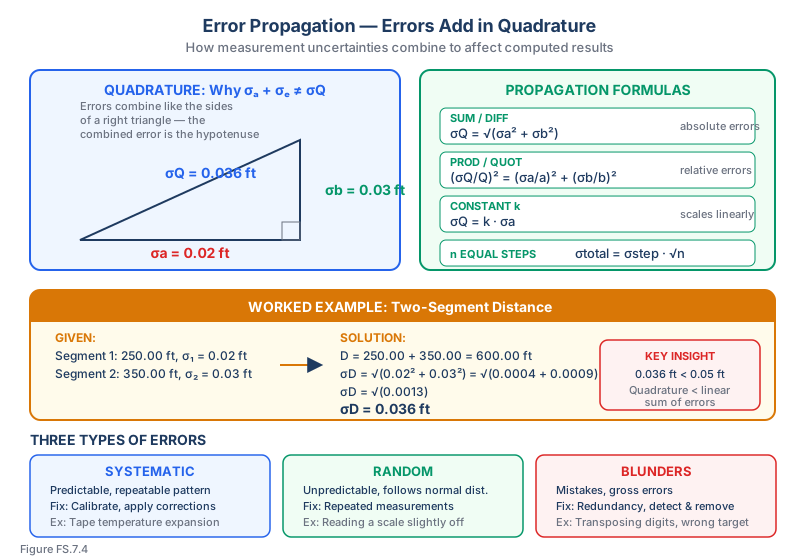
Types of Errors
| Type | Description | Example | How to Handle |
|---|---|---|---|
| Systematic | Consistent, repeatable errors that follow a pattern | Instrument calibration offset, temperature expansion of a steel tape | Identify and correct (calibrate, apply corrections) |
| Random | Unpredictable variations in measurements | Reading a scale slightly high or low each time | Cannot eliminate; reduce by repeated measurements |
| Blunders (gross errors) | Mistakes caused by human error | Reading the wrong number, transposing digits, sighting the wrong target | Detect through redundant measurements and checks; eliminate by remeasuring |
Key distinctions:
- Systematic errors have a predictable pattern and can be modeled and corrected
- Random errors are unpredictable but follow a normal distribution when a large number of measurements are made
- Blunders are neither systematic nor random -- they are mistakes that must be detected and removed
Absolute vs. Relative Error
Absolute error = |measured value - true value| (in the same units as the measurement)
Relative error = absolute error / true value (dimensionless, often expressed as a ratio or ppm)
Example: A distance measured as 500.03 ft when the true value is 500.00 ft:
- Absolute error = 0.03 ft
- Relative error = 0.03 / 500 = 1:16,667 or 60 ppm
The General Law of Error Propagation
If a quantity Q is computed from measured values x1, x2, ..., xn:
Q = f(x1, x2, ..., xn)
The variance of Q is:
sigma_Q^2 = (dQ/dx1)^2 * sigma_x1^2 + (dQ/dx2)^2 * sigma_x2^2 + ... + (dQ/dxn)^2 * sigma_xn^2
Where dQ/dxi is the partial derivative of Q with respect to xi.
This assumes the errors are independent (uncorrelated).
Common Propagation Formulas
Sum or difference: Q = a +/- b
sigma_Q = sqrt(sigma_a^2 + sigma_b^2)
Note: Errors add in quadrature whether the quantities are added or subtracted.
Product: Q = a * b
(sigma_Q / Q)^2 = (sigma_a / a)^2 + (sigma_b / b)^2
Quotient: Q = a / b
(sigma_Q / Q)^2 = (sigma_a / a)^2 + (sigma_b / b)^2
(Same formula as for products.)
Constant multiplier: Q = k * a (where k is a constant)
sigma_Q = k * sigma_a
Power: Q = a^n
sigma_Q / Q = |n| * sigma_a / a
(The relative error is always positive; the absolute value of n applies when n is negative — e.g., Q = 1/a² has the same magnitude rule as Q = a², with σ_Q / Q = 2·σ_a / a.)
Propagation in Surveying Computations
Distance from n equal tape lengths:
If each tape length has standard deviation sigma_tape:
sigma_total = sigma_tape * sqrt(n)
Example: A 100 ft tape with sigma = 0.01 ft is used 10 times to measure a distance:
sigma_total = 0.01 * sqrt(10) = 0.032 ft
Elevation difference from differential leveling:
If each setup has standard deviation sigma_setup:
sigma_total = sigma_setup * sqrt(number of setups)
Horizontal distance from slope distance and vertical angle:
HD = SD * cos(alpha)
sigma_HD = sqrt((cos(alpha) * sigma_SD)^2 + (SD * sin(alpha) * sigma_alpha)^2)
Where sigma_alpha must be in radians.
Area from coordinates:
If each coordinate has standard deviation sigma_coord, the area error depends on the specific geometry. For a rectangle with sides L and W:
sigma_Area = sqrt((W * sigma_L)^2 + (L * sigma_W)^2)
Practical Implications
- Errors accumulate as the square root of the number of measurements, not linearly
- This means doubling the number of tape lengths only increases the error by a factor of sqrt(2) = 1.414
- Errors in angles must be converted to radians before propagation (unless the formula specifically uses degrees)
- In a product, the component with the largest relative error dominates the propagated error
- In a sum, the component with the largest absolute error dominates
Worked Example
A distance is measured as the sum of two segments:
- Segment 1: 250.00 ft, sigma = 0.02 ft
- Segment 2: 350.00 ft, sigma = 0.03 ft
Total distance: D = 250.00 + 350.00 = 600.00 ft
Propagated error:
sigma_D = sqrt(0.02^2 + 0.03^2) = sqrt(0.0004 + 0.0009) = sqrt(0.0013) = 0.036 ft
Note: The propagated error (0.036 ft) is LESS than the simple sum of errors (0.05 ft) because errors are unlikely to be at their maximum values simultaneously.
Common wrong path — mixing absolute and relative error formulas. Sums and differences propagate absolute errors in quadrature (). Products and quotients propagate relative errors in quadrature (). A common exam mistake: plugging absolute errors into the product formula, or plugging relative errors into the sum formula. If the operation is + or −, keep units (feet, meters). If the operation is × or ÷, convert to ratios first (σ/a, σ/b) and apply the formula to ratios, then multiply back by Q at the end. When in doubt, fall back to partial derivatives: — that form never lies.
Quick retrieval check — try before reading on.
▶A rectangular lot measures L = 125.00 ft (σ = 0.04 ft) by W = 80.00 ft (σ = 0.03 ft). What is the propagated error in the area?
Area sq ft. Apply the product formula to relative errors:
, so sq ft.
Equivalently, using sq ft. Same answer, two routes.
Exam Tips
- Errors always add in quadrature (square root of sum of squares), never linearly
- For sums and differences, propagate absolute errors; for products and quotients, propagate relative errors
- A constant multiplier scales the error linearly: sigma_Q = k * sigma_a
- Converting angle error to linear error: linear error = distance * angle_error_in_radians
- To convert arcseconds to radians: multiply by (pi / 648000) or approximately by (1 / 206265)
- Error propagation problems are among the most commonly tested topics in the math/statistics section
- Always check that angle errors are in radians before propagating -- this is the most common mistake
- The general formula (partial derivatives) looks complex but simplifies to simple rules for common operations
Related Test Topics
- Probability and Statistics (Topic 7.3)
- Measurement Accuracy and Precision (Topic 7.5)
- Least Squares Adjustments (Topic 5.5)
- Traverse Computations and Closure (Topic 5.2)
Further Reading
Authoritative sources for deeper study
Ghilani & Wolf, Adjustment Computations (5th Ed., 2010) — Authoritative treatment of least-squares adjustment for surveying networks.
Wolf & Ghilani, Elementary Surveying — Chapter on theory of errors and error propagation.
FGDC Geospatial Positioning Accuracy Standards — National standard for positional accuracy reporting (NSSDA).
Last updated: 2026-04-17