FS Exam Preparation
Comprehensive preparation for the Fundamentals of Surveying (FS) exam. 7 modules covering all 7 exam domains with 60 in-depth topics.
Module 1: Surveying Processes & Methods
Module 2: Mapping Processes & Methods
Module 3: Boundary Law & Real Property
Module 4: Surveying Principles & Geodesy
Module 5: Survey Computations
Module 6: Business Concepts
Conveyances & Title Transfer
Learning Objectives
After completing this topic, you should be able to:
- Define a deed and identify its essential elements
- Distinguish between the types of deeds and their warranties
- Explain the concepts of delivery and acceptance
- Understand the difference between voluntary and involuntary transfers
- Describe the role of title insurance in real estate transactions
- Explain how conveyances affect boundary surveying
Overview
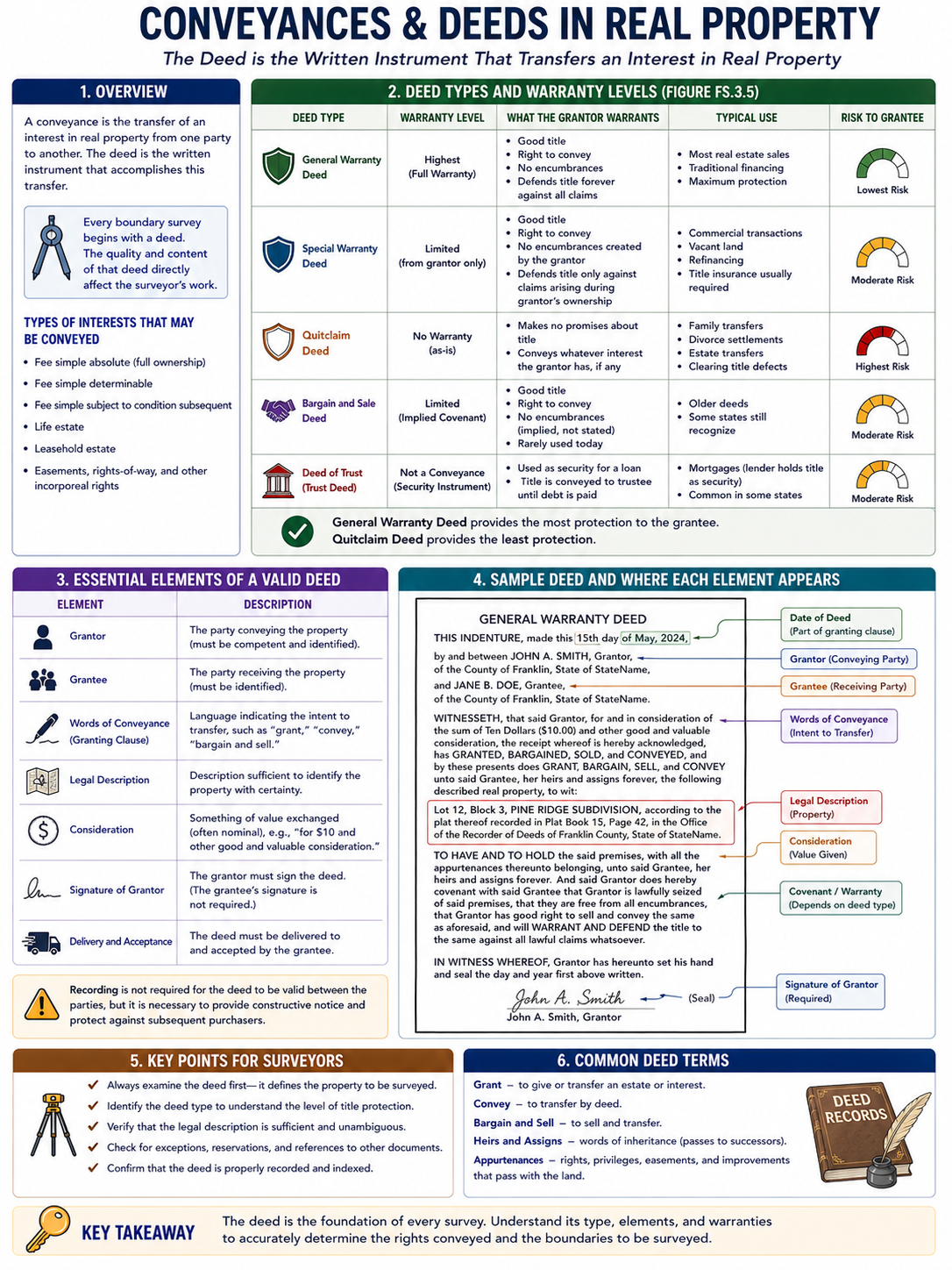
A conveyance is the transfer of an interest in real property from one party to another. The deed is the written instrument that accomplishes this transfer. Understanding how property is conveyed -- and what the different types of deeds warrant -- is essential for surveyors because every boundary survey begins with a deed, and the quality and content of that deed directly affect the surveyor's work.
Key Concepts
Essential Elements of a Valid Deed
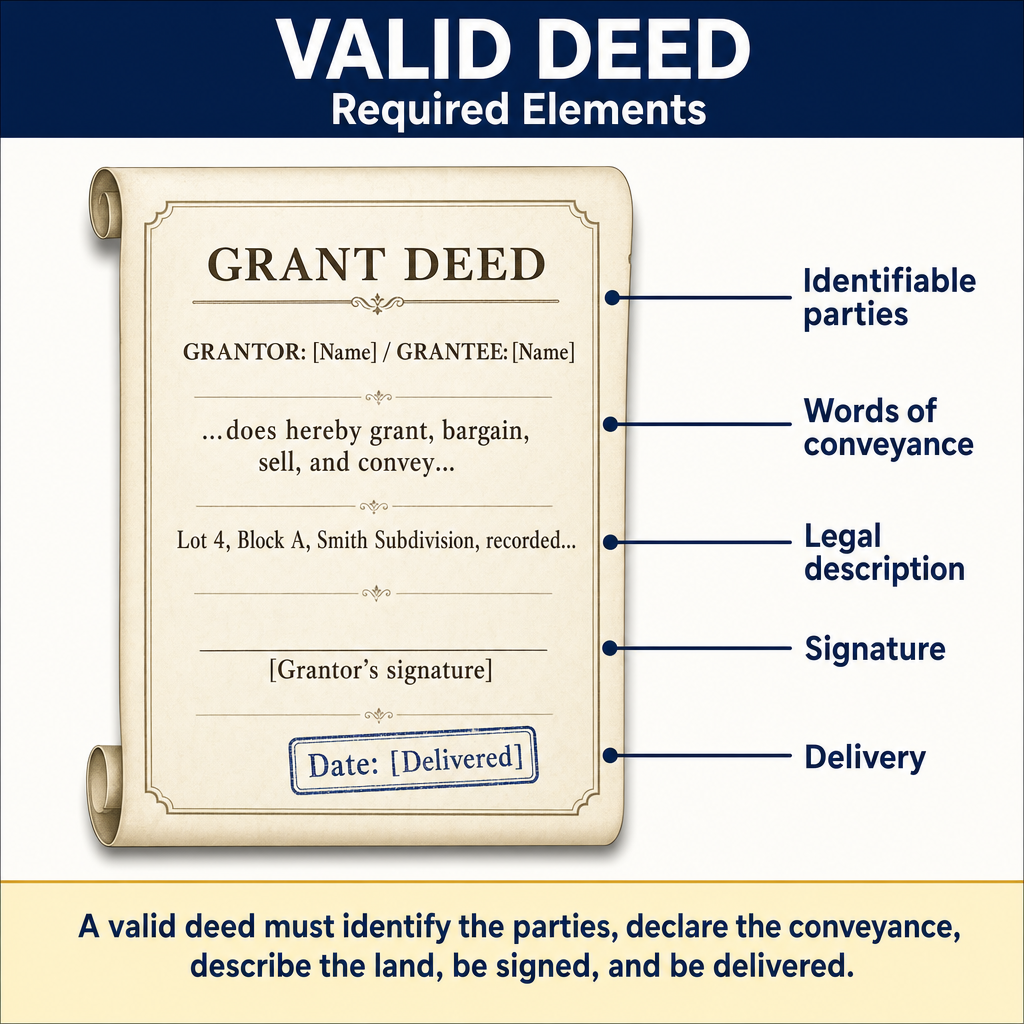
A deed must contain these elements to be legally valid:
| Element | Description |
|---|---|
| Grantor | The party conveying the property (must be competent and identified) |
| Grantee | The party receiving the property (must be identified) |
| Words of conveyance (granting clause) | Language indicating the intent to transfer ("grant," "convey," "bargain and sell") |
| Legal description | Description sufficient to identify the property with certainty |
| Consideration | Something of value exchanged (often nominal: "for $10 and other good and valuable consideration") |
| Signature of grantor | The grantor must sign the deed (the grantee's signature is not required) |
| Delivery and acceptance | The deed must be delivered to and accepted by the grantee |
Recording is not required for the deed to be valid between the parties, but it is necessary to provide constructive notice and protect against subsequent purchasers.
Types of Deeds
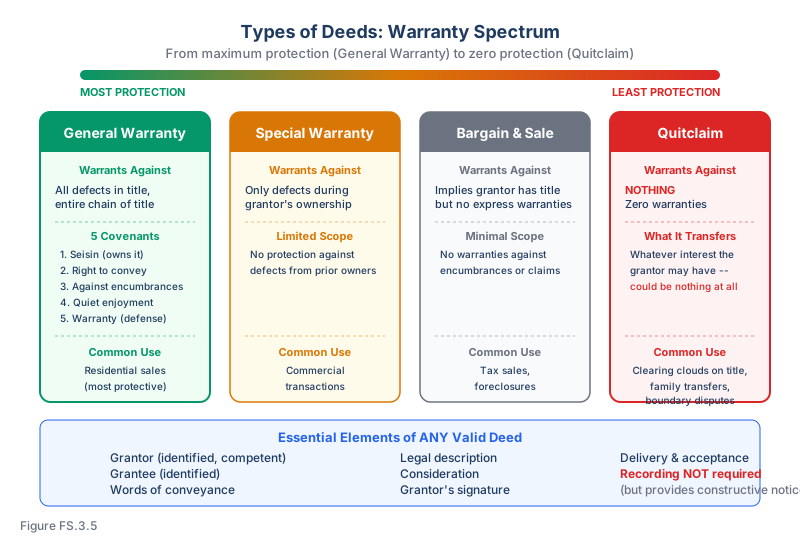
General warranty deed:
- Provides the greatest protection to the grantee
- The grantor warrants that: (1) they own the property, (2) they have the right to convey it, (3) there are no undisclosed encumbrances, (4) the grantee's enjoyment will not be disturbed, and (5) the grantor will defend the title against all claims
- These warranties extend to the entire chain of title, not just the grantor's period of ownership
Special warranty deed:
- The grantor warrants only against defects arising during their own period of ownership
- Does not warrant against defects from prior owners
- Common in commercial transactions
Quitclaim deed:
- Conveys only whatever interest the grantor may have, with no warranties whatsoever
- If the grantor has no interest, the grantee receives nothing
- Commonly used to clear clouds on title, transfer between family members, or release interests
- Often used to resolve boundary disputes or overlapping claims
Bargain and sale deed:
- Implies the grantor has title but makes no warranties against encumbrances
- Common in tax sales and foreclosure transfers
Voluntary vs. Involuntary Transfers
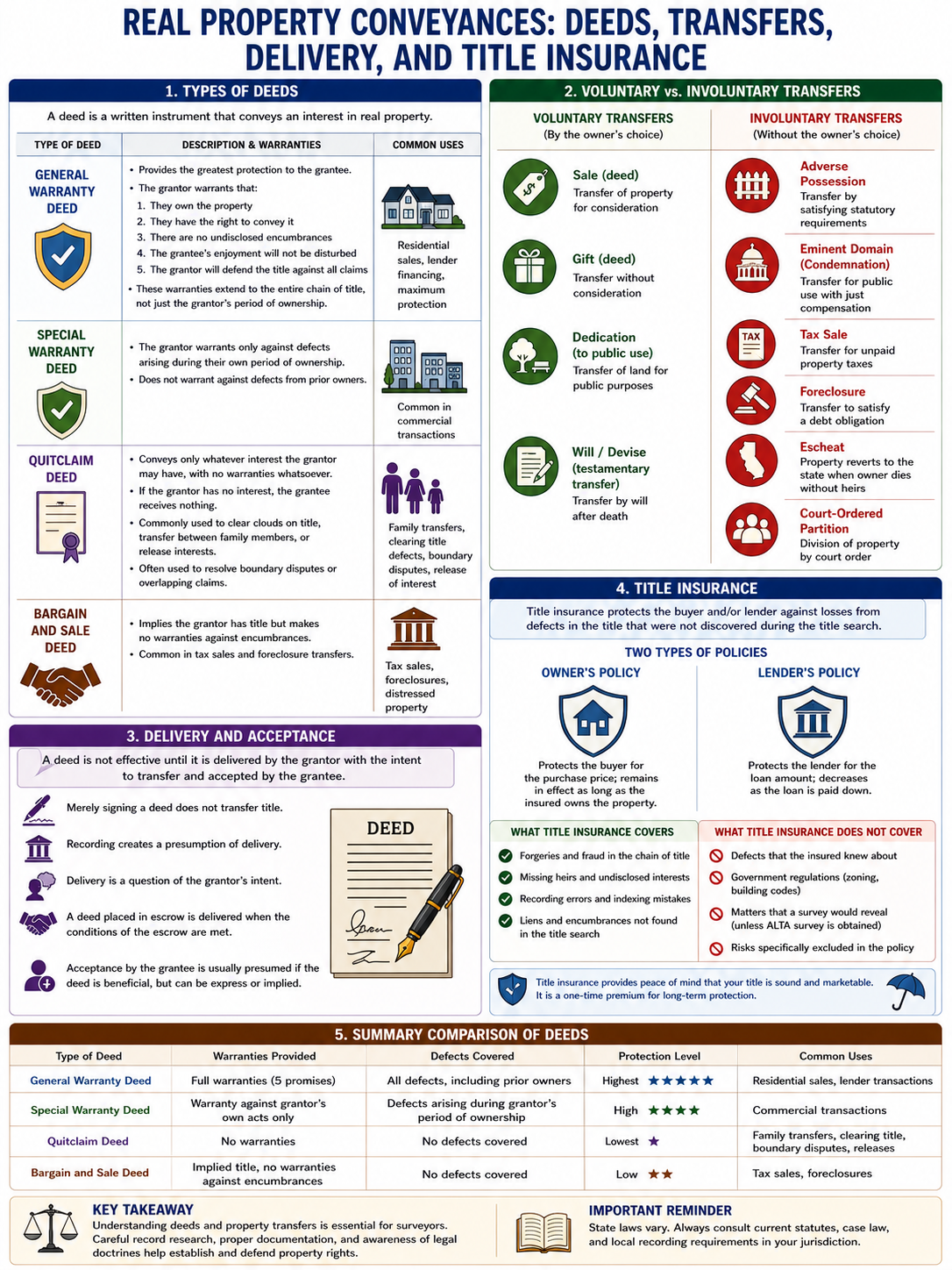
Voluntary transfers:
- Sale (deed)
- Gift (deed)
- Dedication (to public use)
- Will/devise (testamentary transfer)
Involuntary transfers:
- Adverse possession
- Eminent domain (condemnation)
- Tax sale
- Foreclosure
- Escheat (property reverts to the state when owner dies without heirs)
- Court-ordered partition
Delivery and Acceptance
A deed is not effective until it is delivered by the grantor with the intent to transfer and accepted by the grantee.
- Merely signing a deed does not transfer title
- Recording creates a presumption of delivery
- Delivery is a question of the grantor's intent
- A deed placed in escrow is delivered when the conditions of the escrow are met
Title Insurance
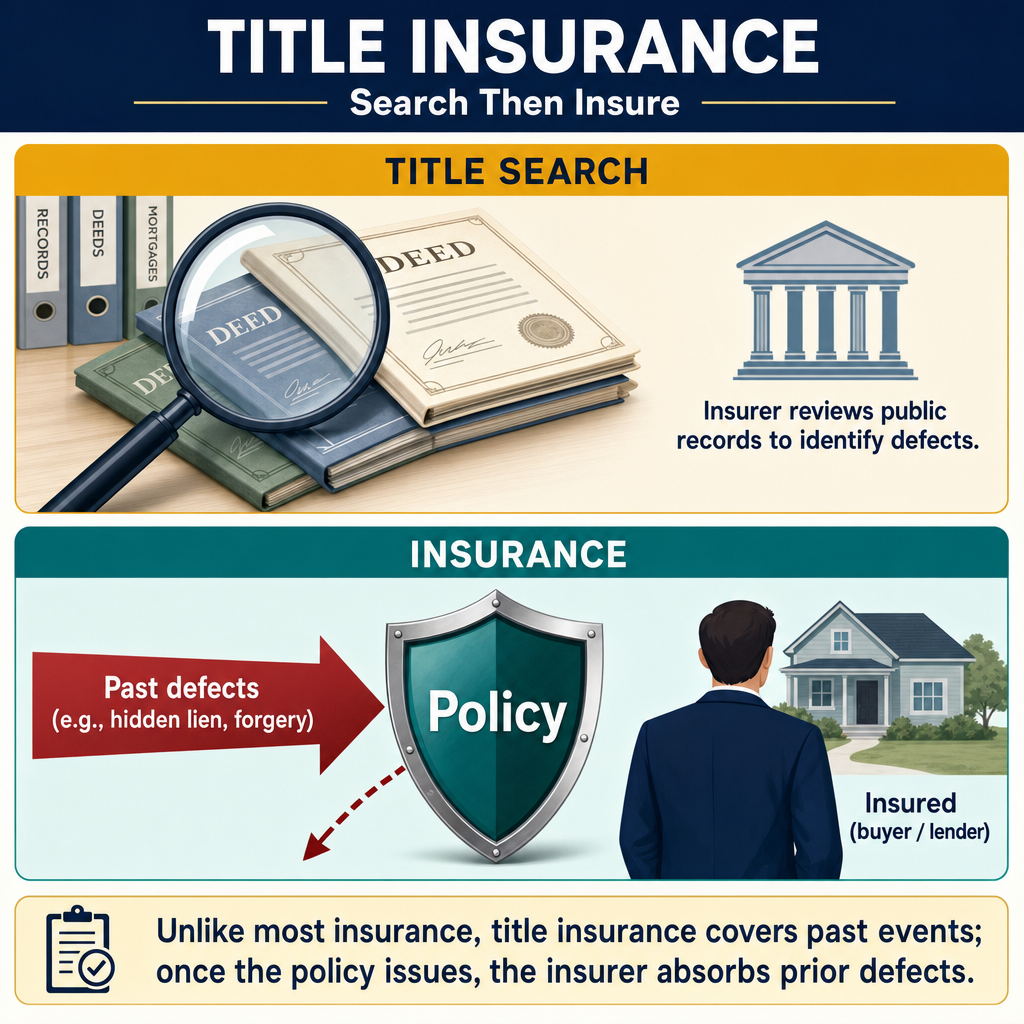
Title insurance protects the buyer and/or lender against losses from defects in the title that were not discovered during the title search.
Two types of policies:
- Owner's policy: Protects the buyer for the purchase price; remains in effect as long as the insured owns the property
- Lender's policy: Protects the lender for the loan amount; decreases as the loan is paid down
What title insurance covers:
- Forgeries and fraud in the chain of title
- Missing heirs and undisclosed interests
- Recording errors and indexing mistakes
- Liens and encumbrances not found in the title search
What title insurance does NOT cover:
- Defects that the insured knew about
- Government regulations (zoning, building codes)
- Matters that a survey would reveal (unless ALTA survey is obtained)
- Risks specifically excluded in the policy
Common wrong path — recording makes a deed valid. Recording a deed is important — it creates constructive notice to the world and protects the grantee against subsequent purchasers — but recording is NOT what makes the deed valid. A deed is valid between the grantor and grantee as soon as it is properly executed (essential elements present) and delivered with intent to transfer, whether or not it is ever recorded. Conversely, an improperly executed deed (missing consideration, defective signature, no delivery) is invalid even if recorded. Students sometimes think "only recorded deeds are real" — that's backwards. Recording is a protection mechanism for the grantee against third-party claims, not a condition of validity between the parties to the deed. Exam questions test this by describing an unrecorded deed or by asking what element is required for a deed to be effective; the answer is execution + delivery, not recording.
Quick retrieval check — try before reading on.
▶Grantor executes a valid deed to Grantee and hands it over, but Grantee never records it. Two weeks later, Grantor dies. A month after that, Grantee tries to record the deed. Is the deed valid? What potential problems does Grantee face from the delay in recording?
The deed is valid — the grantor executed it with proper elements and delivered it to the grantee with intent to transfer. Title passed from grantor to grantee at the moment of delivery, two weeks before grantor's death. Grantee is the rightful owner.
But recording delay creates problems:
- Subsequent purchasers or creditors — if grantor's estate or creditors had no notice of the conveyance, a bona fide purchaser from the estate could potentially take precedence depending on the state's recording statute (notice, race-notice, or race).
- Probate — grantor's personal representative may list the property as an estate asset, and grantee will need to prove ownership from the unrecorded deed.
- Evidentiary issues — the delay makes it harder to prove delivery occurred before death; contemporaneous corroboration (witnesses, check cashed, tax records) strengthens the grantee's position.
The lesson: record the deed promptly to avoid these complications. But the deed itself is valid from delivery, not from recording. The exam sometimes tests this by describing a recording delay and asking whether the deed is effective between the original parties — yes, it is.
How Conveyances Affect Surveying
Sequential conveyances from a common grantor create senior and junior rights:
- The first conveyance (senior) takes priority
- The second conveyance (junior) gets what remains
- This is why the chain of title research is critical for boundary work
Simultaneous conveyances (subdivision):
- When all lots are sold from the same plat, the lots are generally treated as simultaneous
- Discrepancies between lots are typically resolved by proration (distributing the excess or deficiency proportionally)
Exam Tips
- A general warranty deed provides the most protection; a quitclaim deed provides none
- A deed is valid between the parties without recording, but recording provides constructive notice
- The grantor must sign the deed; the grantee does not need to sign
- Delivery and acceptance are required for a deed to be effective -- signing alone is not enough
- A quitclaim deed transfers only whatever interest the grantor has; it does not guarantee the grantor has any interest at all
- Sequential conveyances create senior/junior rights -- first in time, first in right
- Title insurance protects against hidden defects in the chain of title
- The FS exam may test the essential elements of a deed, types of deeds, or the concept of delivery
- Escheat is the reversion of property to the state when the owner dies without heirs
Related Test Topics
- Public Records and Descriptions (Topic 3.1)
- Controlling Elements and Evidence (Topic 3.2)
- Encumbrances and Property Interests (Topic 3.10)
- Metes and Bounds Descriptions (Topic 3.6)
Further Reading
Authoritative sources for deeper study
Brown's Boundary Control and Legal Principles (7th Ed., Robillard & Wilson) — Standard textbook on boundary law, evidence hierarchy, and retracement.
Wattles, Writing Legal Descriptions (1976) — Gold-standard reference on metes-and-bounds, sectional, and combination descriptions.
Clark, A Treatise on the Law of Surveying and Boundaries — Long-standing legal reference on boundary disputes and surveyor liability.
Last updated: 2026-04-17