FS Exam Preparation
Comprehensive preparation for the Fundamentals of Surveying (FS) exam. 7 modules covering all 7 exam domains with 60 in-depth topics.
Module 1: Surveying Processes & Methods
Module 2: Mapping Processes & Methods
Module 3: Boundary Law & Real Property
Module 4: Surveying Principles & Geodesy
Module 5: Survey Computations
Module 6: Business Concepts
Traverse Adjustments
Learning Objectives
After completing this topic, you should be able to:
- Apply the compass (Bowditch) rule to adjust a traverse
- Apply the transit rule to adjust a traverse
- Explain the assumptions behind each adjustment method
- Compute adjusted coordinates from corrected latitudes and departures
- Determine when each method is most appropriate
Overview
After computing traverse closure, the misclosure must be distributed among the traverse legs to produce mathematically consistent coordinates. Traverse adjustment distributes the linear error proportionally across all legs. The two primary methods tested on the FS exam are the compass rule (Bowditch) and the transit rule. The compass rule is by far the most commonly tested.
Key Concepts
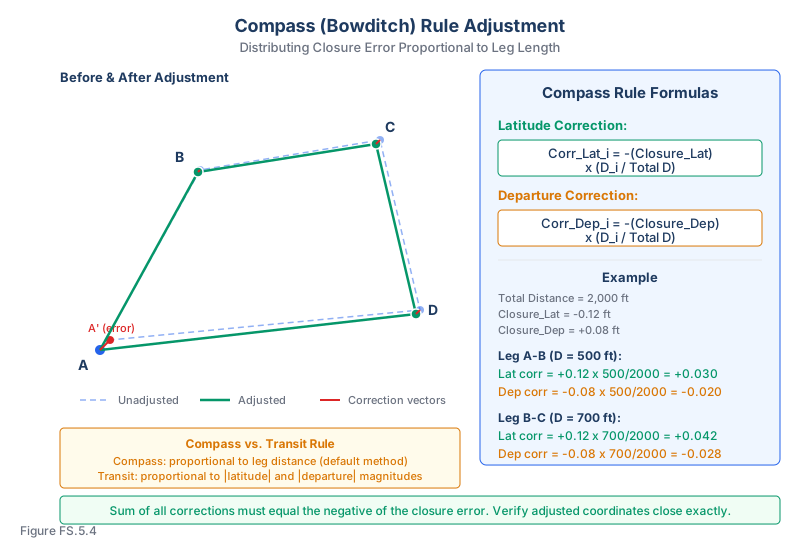
The Compass Rule (Bowditch Rule)
The compass rule assumes that errors in angles and distances are proportional to the distance of each leg. It distributes the closure error based on each leg's length relative to the total traverse length (Ghilani & Wolf, Elementary Surveying, 13th Ed., §10.7.1).
Correction to latitude for leg i:
Correction_Lat_i = -(Closure in Lat) * (D_i / Total D)
Correction to departure for leg i:
Correction_Dep_i = -(Closure in Dep) * (D_i / Total D)
Where:
- D_i = distance of leg i
- Total D = sum of all leg distances
- Closure in Lat = sum of all unadjusted latitudes
- Closure in Dep = sum of all unadjusted departures
Adjusted values:
Adjusted Lat_i = Unadjusted Lat_i + Correction_Lat_i
Adjusted Dep_i = Unadjusted Dep_i + Correction_Dep_i
The Transit Rule
The transit rule assumes that errors are proportional to the magnitude of the latitudes and departures themselves. It is used when angular measurements are significantly more precise than distance measurements.
Correction to latitude for leg i:
Correction_Lat_i = -(Closure in Lat) * (|Lat_i| / Sum of |all Lats|)
Correction to departure for leg i:
Correction_Dep_i = -(Closure in Dep) * (|Dep_i| / Sum of |all Deps|)
Comparison of Methods
| Feature | Compass Rule | Transit Rule |
|---|---|---|
| Assumption | Angles and distances equally precise | Angles more precise than distances |
| Distribution basis | Leg distance | Magnitude of lat/dep |
| Most common use | General purpose; default method | Rarely used in practice |
| FS exam frequency | Very high | Occasional |
The Crandall Method
The Crandall method adjusts only the distances while holding angles fixed. It uses a least squares approach to distribute the closure error through distance corrections only. This method is less commonly tested on the FS exam but may appear as a concept question.
Key assumption: Angles are considered error-free; all error is attributed to distances.
Computing Adjusted Coordinates
After adjusting latitudes and departures, compute coordinates sequentially:
- N_B = N_A + Adjusted Lat_AB
- E_B = E_A + Adjusted Dep_AB
- N_C = N_B + Adjusted Lat_BC
- E_C = E_B + Adjusted Dep_BC
- (continue for all points)
The final computed point should exactly match the starting point (for a loop traverse) or the known ending point (for a connecting traverse).
Adjustment Table Workflow
The safest way to work an FS traverse adjustment problem is to build the same table every time:
| Leg | Distance | Unadjusted Lat | Unadjusted Dep | Lat Correction | Dep Correction | Adjusted Lat | Adjusted Dep |
|---|---|---|---|---|---|---|---|
| AB | given | computed | computed | by rule | by rule | lat + corr | dep + corr |
Then use these checks:
- Sum of unadjusted latitudes equals the latitude closure.
- Sum of unadjusted departures equals the departure closure.
- Sum of latitude corrections equals the negative of the latitude closure.
- Sum of departure corrections equals the negative of the departure closure.
- Sum of adjusted latitudes and departures should be zero for a closed traverse.
If one correction has the same sign as the closure, stop. That is usually the sign error the exam is testing.
Choosing the Rule
Use the compass rule when angular and distance measurements are of similar quality or when the problem simply asks for a balanced traverse without specifying a special method. Use the transit rule when the problem states that angles are more reliable than distances. Use least squares when redundant observations, weights, or a network adjustment are part of the problem.
FS questions rarely ask for the Crandall method numerically. When it appears, it is usually conceptual: angles are held fixed and distance corrections carry the adjustment.
Mini Drill: Check the Corrections
A closed traverse has Sum Lat = -0.10 ft and Sum Dep = +0.04 ft. Total traverse length is 2,500 ft. A 625-ft leg receives compass-rule corrections:
- Lat correction = -(-0.10) x (625 / 2500) = +0.025 ft
- Dep correction = -(+0.04) x (625 / 2500) = -0.010 ft
The leg is one quarter of the total traverse length, so it absorbs one quarter of each total correction. Across all legs, latitude corrections must sum to +0.10 ft and departure corrections must sum to -0.04 ft. If they do not, the adjusted traverse cannot close.
Worked Example (Compass Rule)
Given traverse with total distance = 2,000 ft:
- Closure in Latitude = -0.12 ft
- Closure in Departure = +0.08 ft
For leg A-B with distance = 500 ft:
- Lat correction = -(-0.12) * (500 / 2000) = +0.030 ft
- Dep correction = -(+0.08) * (500 / 2000) = -0.020 ft
For leg B-C with distance = 700 ft:
- Lat correction = +0.12 * (700 / 2000) = +0.042 ft
- Dep correction = -0.08 * (700 / 2000) = -0.028 ft
Verify: Sum of all corrections should equal the negative of the closure error.
Common wrong path — correction sign matches closure sign. The correction is always the negative of the closure. If ΣLat closes to −0.12 ft (traverse sums short by 0.12 ft), every leg's latitude correction must be positive (to bring the sum up to zero). Students sometimes write "correction = closure × (L/P)" without the minus sign and end up doubling the error rather than eliminating it. Mnemonic: corrections cancel closure, so they must be opposite in sign. Always finish with a check: Σ corrections = −Σ closures, and Σ adjusted lats = Σ adjusted deps = 0.
Quick retrieval check — try before reading on.
▶A closed traverse totals 1,600 ft perimeter. ΣLat = +0.08 ft, ΣDep = −0.06 ft. What are the compass-rule lat and dep corrections for a leg 400 ft long?
Lat correction = ft.
Dep correction = ft.
Note the sign flip: a positive closure yields a negative correction (and vice versa). This leg is 25% of the perimeter, so it absorbs 25% of the total correction. If this leg's unadjusted lat was +288.00 ft, its adjusted lat is 288.00 − 0.020 = 287.98 ft.
Exam Tips
- The compass rule is the default -- if a problem does not specify the method, use compass rule
- Remember that corrections are subtracted from the closure error (opposite sign)
- The sum of all latitude corrections must equal the negative of the latitude closure
- The sum of all departure corrections must equal the negative of the departure closure
- Always verify that adjusted coordinates close exactly
- For the transit rule, use the absolute values of latitudes and departures, not the signed values
- Compass rule problems are very formulaic -- practice until you can solve them in under 3 minutes
Related Test Topics
- Traverse Computations and Closure (Topic 5.2)
- Least Squares Adjustments (Topic 5.5)
- Coordinate Geometry (Topic 5.1)
Further Reading
Authoritative sources for deeper study
Wolf & Ghilani, Elementary Surveying — Chapters on traverse computation, balancing, and adjustment.
Ghilani & Wolf, Adjustment Computations (5th Ed., 2010) — Authoritative treatment of least-squares adjustment for surveying networks.
Allan, Principles of Geospatial Surveying (Ethernet Edu mirror) — Survey of geospatial principles, instruments, and adjustment.
Last updated: 2026-04-17