FS Exam Preparation
Comprehensive preparation for the Fundamentals of Surveying (FS) exam. 7 modules covering all 7 exam domains with 60 in-depth topics.
Module 1: Surveying Processes & Methods
Module 2: Mapping Processes & Methods
Module 3: Boundary Law & Real Property
Module 4: Surveying Principles & Geodesy
Module 5: Survey Computations
Module 6: Business Concepts
Encumbrances & Real Property Interests
Learning Objectives
After completing this topic, you should be able to:
- Define an encumbrance and identify common types
- Distinguish between the types of property ownership (estates)
- Explain the difference between liens and non-financial encumbrances
- Describe restrictive covenants and their effect on land use
- Understand the concept of the bundle of rights
- Identify how encumbrances affect surveying practice
Overview
Real property is subject to a wide range of encumbrances -- claims, interests, and restrictions held by others that affect the property owner's rights. Surveyors must understand these interests because they often have spatial implications: easements cross the property, setback requirements limit where structures can be placed, and liens affect the ability to transfer title.
The FS exam tests your understanding of basic property interests and the types of encumbrances that surveyors commonly encounter.
Key Concepts
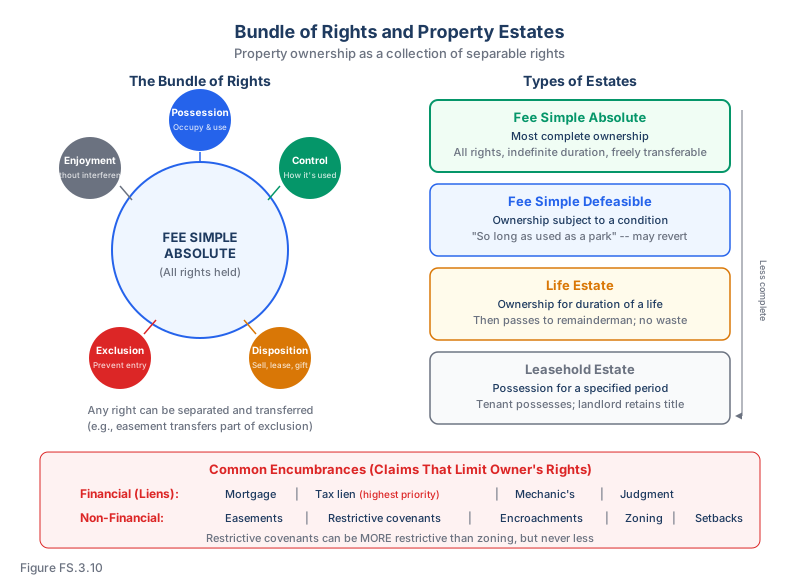
The Bundle of Rights
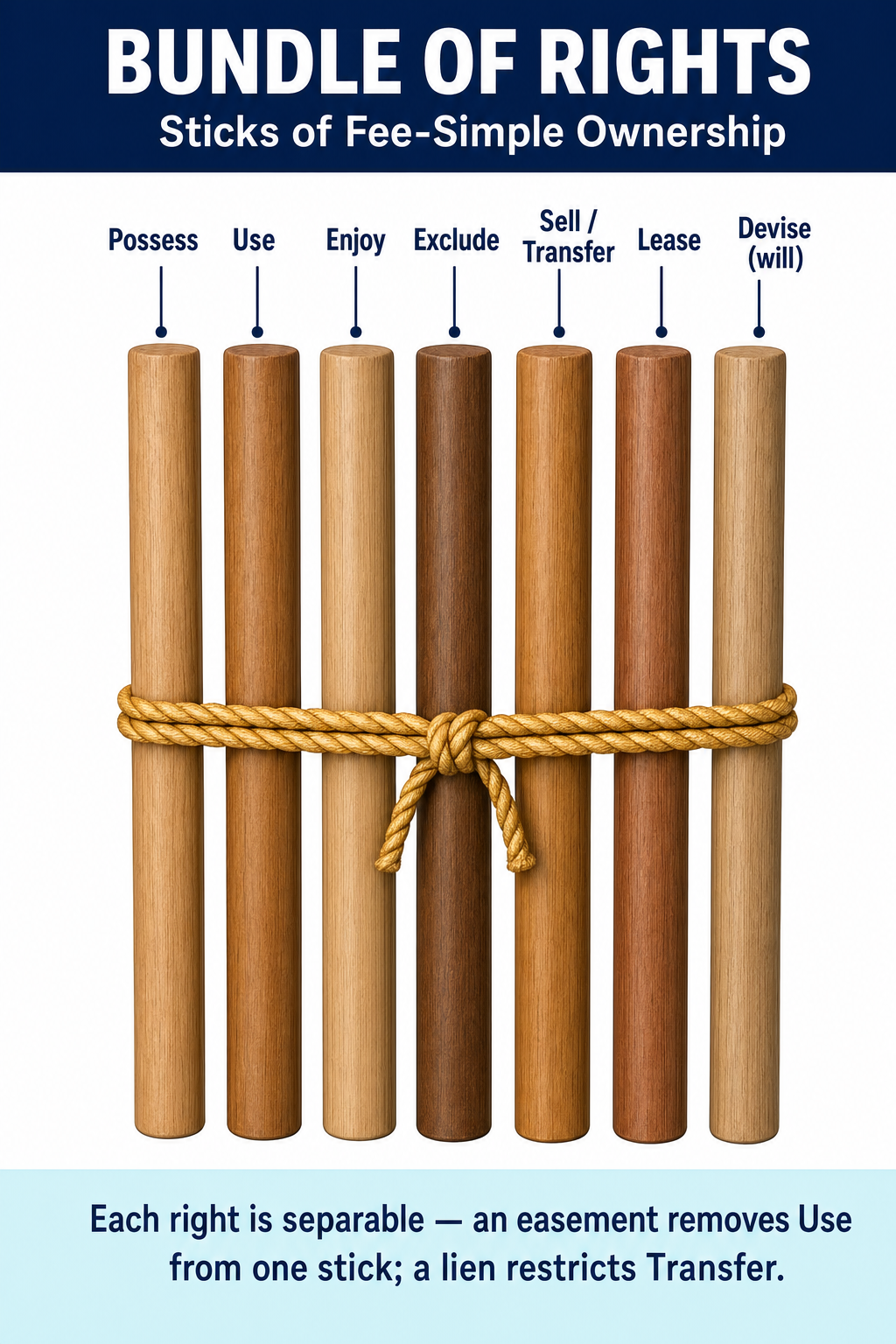
Property ownership is often described as a bundle of rights -- a collection of individual rights that the owner may exercise, transfer, or restrict:
| Right | Description |
|---|---|
| Possession | The right to occupy and use the property |
| Control | The right to determine how the property is used (subject to law) |
| Enjoyment | The right to use the property without interference |
| Exclusion | The right to prevent others from entering or using the property |
| Disposition | The right to sell, lease, gift, or will the property |
Any of these rights can be separated from the bundle and transferred to another party. For example, granting an easement transfers part of the exclusion right; leasing transfers the possession right temporarily.
Types of Estates (Ownership Interests)
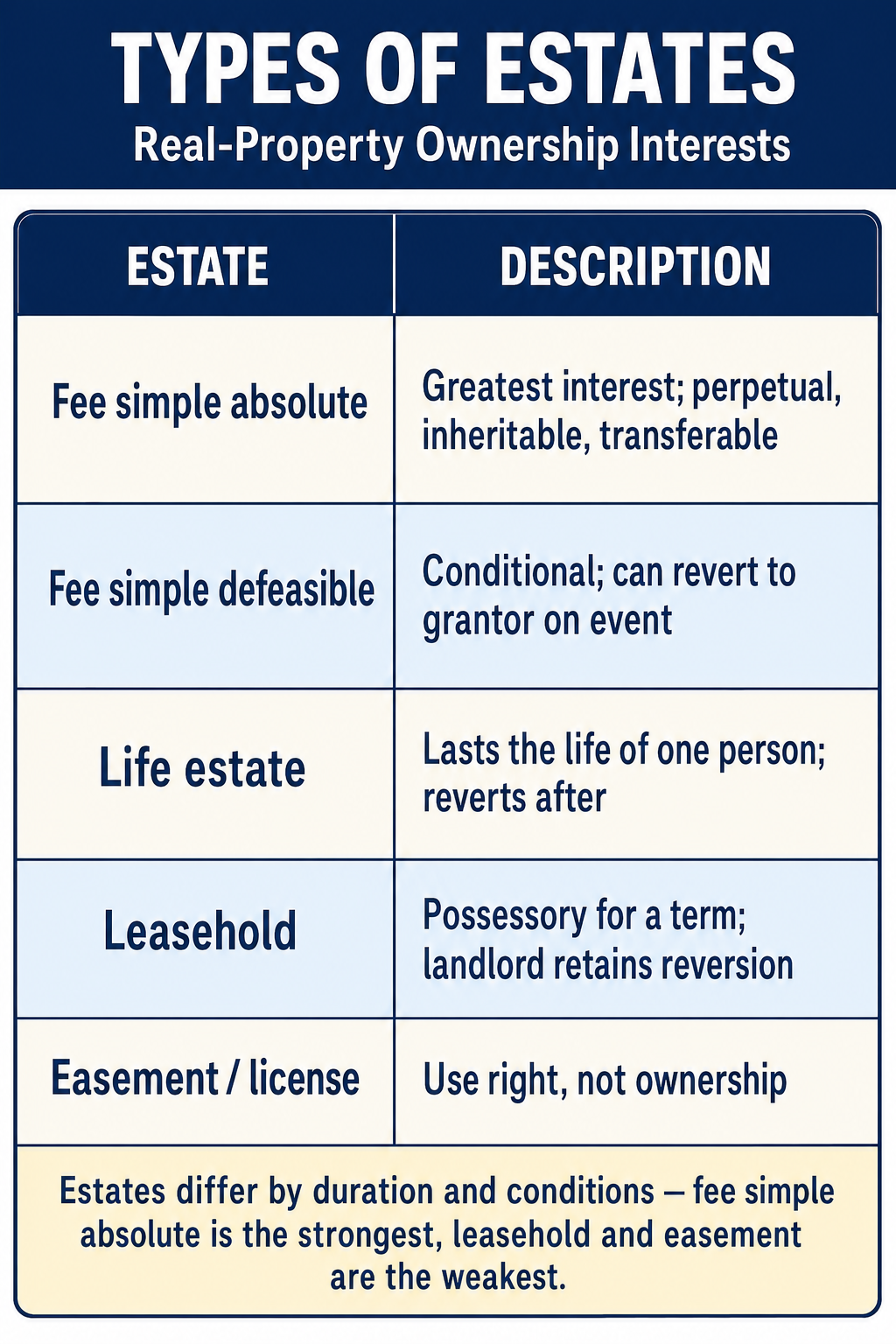
Fee simple absolute:
- The most complete form of ownership
- The owner holds all rights in the bundle
- Ownership is indefinite in duration
- Can be inherited, sold, or gifted without restriction
Fee simple defeasible:
- Ownership subject to a condition or limitation
- If the condition is violated, ownership may revert to the grantor
- Example: "To the City, so long as the property is used as a park" -- if the city stops using it as a park, it reverts to the grantor
Life estate:
- Ownership for the duration of a person's life
- When the life tenant dies, the property passes to a remainderman (specified in the creating document)
- The life tenant cannot commit waste (permanent damage to the property)
Leasehold estate:
- The right to possess and use property for a specified period
- The tenant has possession; the landlord retains ownership
- Can be for a fixed term or periodic (month-to-month, year-to-year)
Types of Encumbrances
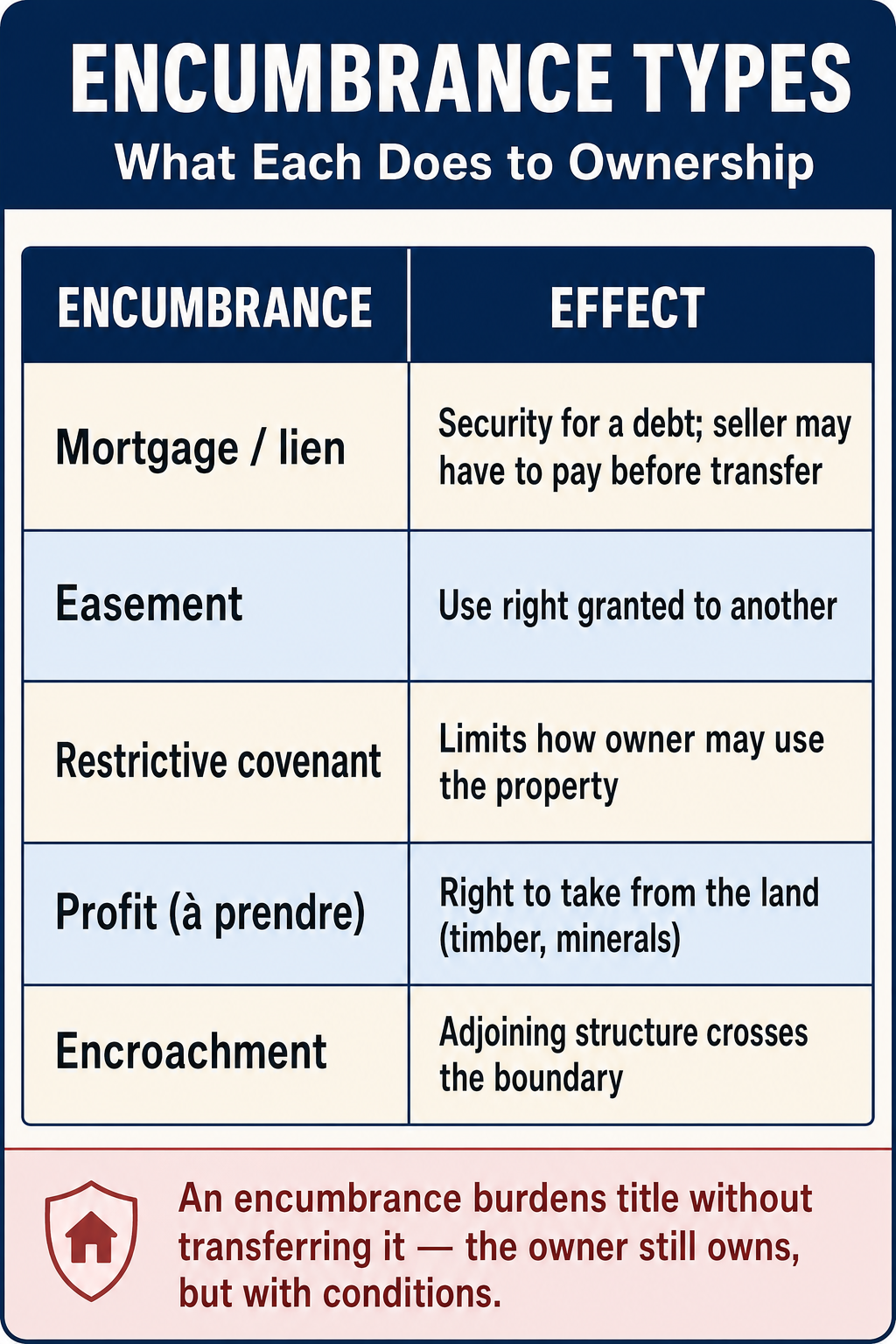
Encumbrances fall into two broad categories:
Financial encumbrances (liens):
| Type | Description |
|---|---|
| Mortgage lien | Secures a loan; the property is collateral |
| Tax lien | Government claim for unpaid property taxes; generally takes priority over other liens |
| Mechanic's lien | Filed by contractors or suppliers for unpaid work or materials |
| Judgment lien | Results from a court judgment against the property owner |
| Assessment lien | For unpaid special assessments (street improvements, utility connections) |
Non-financial encumbrances:
| Type | Description |
|---|---|
| Easements | Right of use across the property (see Topic 3.4) |
| Restrictive covenants | Limitations on how the property can be used (private restrictions) |
| Encroachments | A structure or improvement that extends onto adjacent property |
| Zoning restrictions | Government regulations controlling land use (not technically a private encumbrance but limits use) |
| Building setback lines | Minimum distances from property lines where structures cannot be built |
Restrictive Covenants
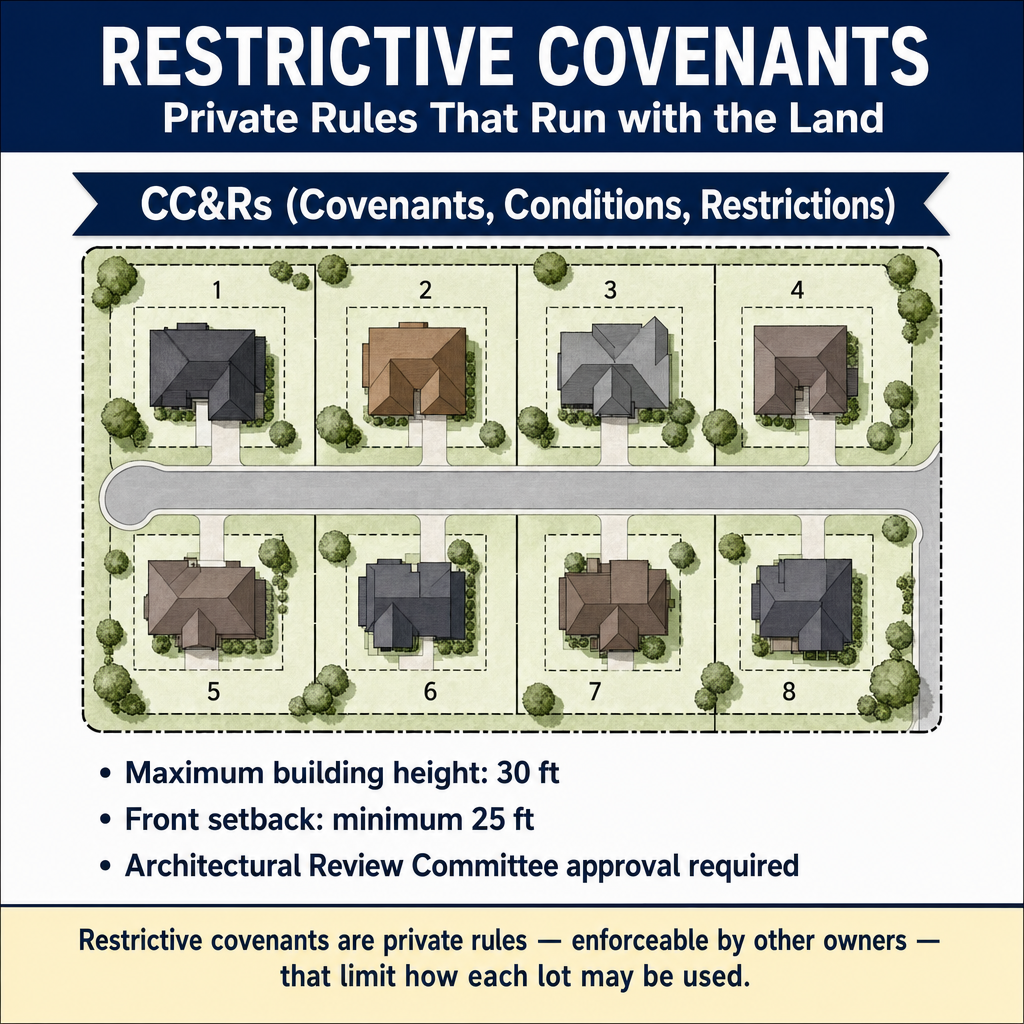
Restrictive covenants (also called deed restrictions or CC&Rs -- Covenants, Conditions, and Restrictions) are private agreements that limit how property can be used.
Common restrictions:
- Minimum lot size or building size
- Architectural style requirements
- Fence height and material restrictions
- Prohibition of certain uses (commercial, agricultural)
- Building setback requirements (beyond zoning requirements)
- Maintenance obligations
Characteristics:
- Most commonly created by the developer at the time of subdivision, but may also be added later by deed, HOA amendment, or court order
- Run with the land (binding on all future owners)
- Enforced by the property owners' association or adjacent owners
- May be more restrictive than zoning but cannot be less restrictive
Encroachments
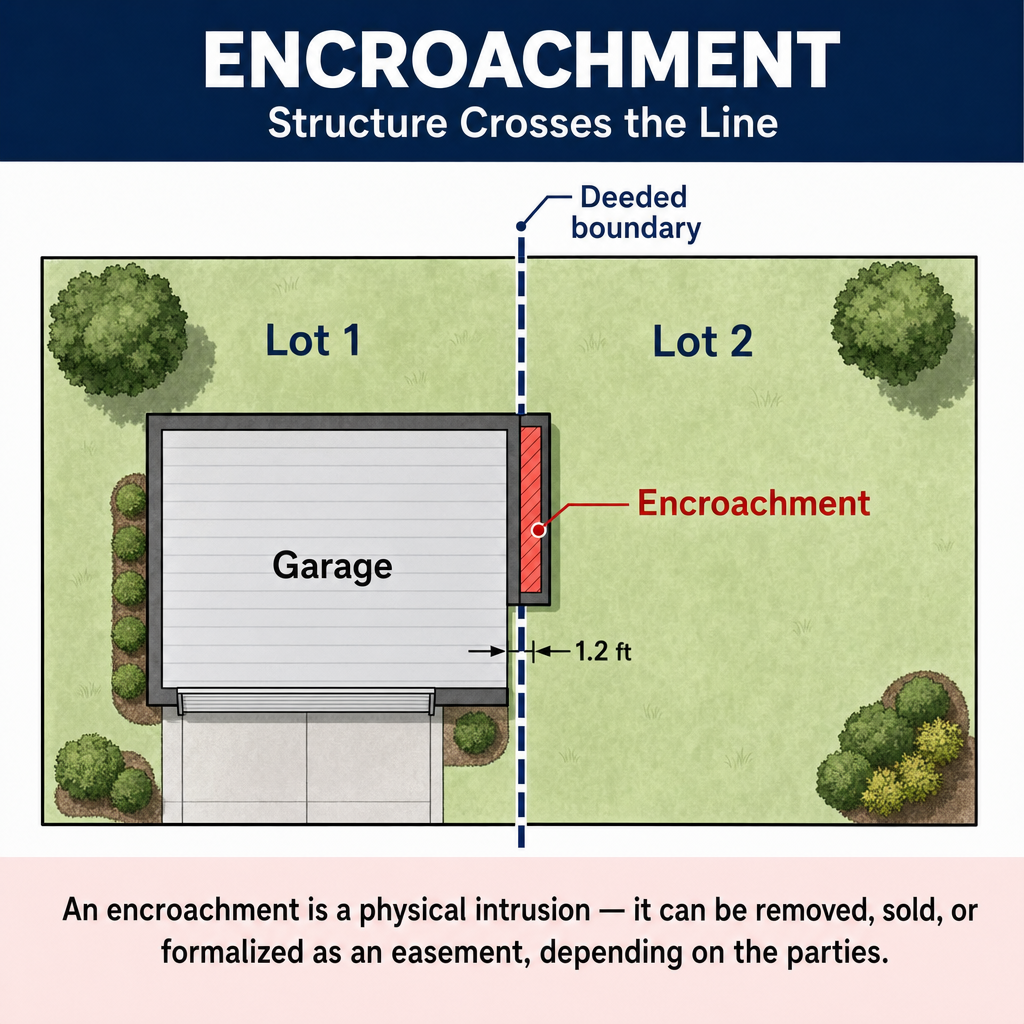
An encroachment occurs when a structure, improvement, or object extends beyond the property line onto adjacent land.
Common encroachments:
- Fences built over the property line
- Building eaves or roof overhangs extending past the line
- Driveways or patios crossing the boundary
- Tree branches or roots extending onto adjacent property
- Retaining walls built on the neighbor's side
Survey implications:
- ALTA surveys specifically require showing encroachments
- Boundary surveys should note any visible encroachments
- Encroachments may lead to prescriptive rights if left unaddressed
Common wrong path — lien priority follows recording date. Recording order is the general rule for lien priority (earliest recorded = highest priority), but tax liens are a major exception — they take priority over all other liens regardless of when they were recorded, because state statutes almost universally elevate them to super-priority status. A tax lien filed today outranks a mortgage recorded 20 years ago. Mechanic's liens, in many states, can also relate back to the date work began — even if recorded after the mortgage. Students who answer "whichever was recorded first wins" get wrong answers whenever the scenario involves tax or mechanic's liens. The safe rule on the exam: check whether the lien is tax, mechanic's, or a similar statutorily-prioritized category before applying recording date.
Quick retrieval check — try before reading on.
▶A property has the following liens: a mortgage recorded 2015, a mechanic's lien recorded 2023 (for work that began in 2022), and a property-tax lien filed in 2024. At foreclosure, in what order are these liens satisfied from the sale proceeds?
Tax lien first, then mechanic's lien (possibly), then mortgage.
- Tax lien (2024) — super-priority in most states; paid first regardless of recording date.
- Mechanic's lien (2023, work began 2022) — in many states, mechanic's liens relate back to when work began, potentially giving them priority over later mortgages. Check state law; some states do not grant relation-back, in which case the mechanic's lien is junior to the mortgage.
- Mortgage (2015) — senior by recording date to anything after 2015, except for super-priority tax liens and (possibly) mechanic's liens that relate back.
Had you applied strict recording-date priority, you would have placed the mortgage first — wrong answer. The tax-lien exception is universal; the mechanic's-lien relation-back rule varies by state. On the exam, when tax liens are in the scenario, they almost always come first.
How Encumbrances Affect Surveying
Surveyors encounter encumbrances in several contexts:
- Boundary surveys: Identifying easements that cross the property and encroachments on or by adjacent properties
- ALTA surveys: Showing all encumbrances revealed by the title commitment, including easements, setback lines, and encroachments
- Subdivision plats: Creating easements for utilities and drainage; establishing setback lines and building envelopes
- Construction surveys: Ensuring construction stays within setback requirements and easement limits
- Title surveys: Verifying that physical conditions match the title commitment
Exam Tips
- Fee simple absolute is the most complete form of ownership; all other estates have limitations
- Tax liens generally take priority over all other liens, including mortgages
- An encumbrance is any claim or interest that limits the property owner's rights
- Restrictive covenants are private restrictions that run with the land; they can be more restrictive than zoning
- An encroachment is a physical intrusion across the property line -- fences, buildings, improvements
- A life estate lasts for the duration of a person's life; the property then passes to the remainderman
- Know the bundle of rights: possession, control, enjoyment, exclusion, disposition
- The FS exam may test the difference between types of estates (fee simple vs. life estate vs. leasehold)
- Easements are the most common non-financial encumbrance encountered by surveyors
- A lien is a financial claim against property; it does not transfer ownership but must be satisfied before clear title can pass
Related Test Topics
- Easements (Topic 3.4)
- Conveyances and Title Transfer (Topic 3.5)
- Public Records and Descriptions (Topic 3.1)
- Plats, ROS, and ALTA (Module 2, Topic 2.3)
Further Reading
Authoritative sources for deeper study
Brown's Boundary Control and Legal Principles (7th Ed., Robillard & Wilson) — Standard textbook on boundary law, evidence hierarchy, and retracement.
Evidence and Procedures for Boundary Location (Robillard, Wilson, & Brown, 6th Ed., 2011) — Practical treatise on collecting, weighing, and applying boundary evidence.
Clark, A Treatise on the Law of Surveying and Boundaries — Long-standing legal reference on boundary disputes and surveyor liability.
Last updated: 2026-04-17