FS Exam Preparation
Comprehensive preparation for the Fundamentals of Surveying (FS) exam. 7 modules covering all 7 exam domains with 60 in-depth topics.
Module 1: Surveying Processes & Methods
Module 2: Mapping Processes & Methods
Module 3: Boundary Law & Real Property
Module 4: Surveying Principles & Geodesy
Module 5: Survey Computations
Module 6: Business Concepts
Horizontal Curves
Learning Objectives
After completing this topic, you should be able to:
- Define and compute all elements of a simple circular curve
- Distinguish between arc definition and chord definition of degree of curve
- Compute deflection angles for curve layout
- Determine stationing along a curve
- Solve for any curve element given sufficient information
Overview
Horizontal curves connect two straight-line (tangent) sections of a route at points where the direction changes. In highway, railway, and pipeline design, these are almost always simple circular curves defined by a constant radius. The FS exam tests your ability to compute curve elements, determine stationing, and calculate deflection angles for layout. This is one of the most formulaic and predictable topics on the exam.
Key Concepts
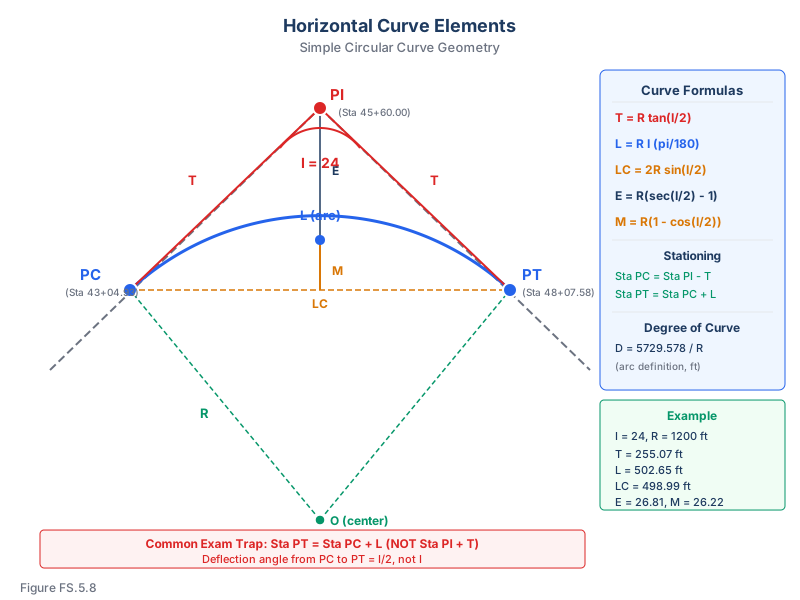
Curve Terminology
- PI (Point of Intersection): Where the two tangent lines meet
- PC (Point of Curvature): Where the curve begins (also called BC, beginning of curve)
- PT (Point of Tangency): Where the curve ends (also called EC, end of curve)
- R: Radius of the curve
- D: Degree of curve
- I (or Delta): Intersection angle (deflection angle between the tangents)
- T: Tangent distance (PI to PC, or PI to PT)
- L: Length of curve (arc from PC to PT)
- LC: Long chord (straight-line distance from PC to PT)
- E: External distance (PI to the midpoint of the curve)
- M: Middle ordinate (midpoint of the long chord to the midpoint of the curve)
Degree of Curve
Two definitions exist:
Arc definition (highway practice, used in the U.S.):
D_a = 5729.578 / R (R in feet)
Degree of curve is defined as the central angle subtended by an arc of 100 ft (Ghilani & Wolf 13th ed., p. 716; Kavanagh 7th ed., p. 383). The definition is anchored to the English unit system. For metric problems, conventional practice is to convert the radius from meters to feet before applying D_a = 5729.578/R (Ghilani 13th ed., p. 717 worked example: R = 700 m gives D_a = 5729.58/(700 × 3.28083) = 2°29′41″).
Chord definition (railroad practice):
R = 50 / sin(D_c / 2) (feet)
For most FS exam problems, the arc definition is used unless stated otherwise.
Fundamental Curve Formulas
Given the intersection angle I and radius R (Ghilani & Wolf, Elementary Surveying, 13th Ed., §24.3; Kavanagh, Surveying with Construction Applications, 7th Ed., §11.3):
| Element | Formula |
|---|---|
| Tangent (T) | T = R * tan(I/2) |
| Curve Length (L) | L = R * I * (pi/180) = (I/D) * 100 |
| Long Chord (LC) | LC = 2 * R * sin(I/2) |
| External (E) | E = R * (1/cos(I/2) - 1) = R * (sec(I/2) - 1) |
| Middle Ordinate (M) | M = R * (1 - cos(I/2)) |
Stationing
Stationing is measured along the route centerline:
- Station of PC = Station of PI - T
- Station of PT = Station of PC + L
Important: Stationing from PI to PT goes through the curve (along the arc), NOT along the tangent. The station of PT is NOT computed as Station of PI + T.
Deflection Angles for Layout
To stake out a curve from the PC, use deflection angles:
Deflection angle for an arc length a from the PC:
d = (a * D) / 200 (in degrees)
Or equivalently:
d = (a / (2 * R)) * (180 / pi)
The deflection angle to any point on the curve is half the central angle subtended by the arc from the PC to that point.
Full deflection from PC to PT = I / 2
Chord Lengths for Layout
The chord length from the PC to a point at deflection angle d:
c = 2 * R * sin(d)
For short arcs (sub-chord from PC to the first full station), compute the partial arc length first, then the deflection angle, then the chord.
Curve Problem Workflow
Horizontal curve questions become predictable if you solve them in this order:
- Identify what is given. Usually radius, degree of curve, intersection angle, PI station, or curve length.
- Convert degree of curve to radius if needed. For arc definition, R = 5729.578 / D.
- Compute T and L first. These control stationing.
- Compute PC station. PC = PI - T.
- Compute PT station. PT = PC + L.
- Compute secondary elements. LC, E, M, and deflection angles come after stationing.
The most common mistake is using tangent distance for stationing on both sides of the PI. Stationing follows the alignment centerline, so the curve length controls from PC to PT.
Mini Drill: Degree of Curve to Radius
If a curve has D = 5 degrees 00 minutes by arc definition:
R = 5729.578 / 5 = 1,145.92 ft.
If I = 20 degrees 00 minutes:
T = 1,145.92 tan(10 degrees) = 202.08 ft.
L = (I / D) x 100 = (20 / 5) x 100 = 400.00 ft.
This is why arc-definition curve problems are often quicker when you use L = (I/D) x 100 instead of converting I to radians.
Worked Example
Given: I = 24 00' 00", R = 1,200 ft, Station of PI = 45+60.00
Step 1: T = 1200 * tan(12) = 1200 * 0.21256 = 255.07 ft
Step 2: L = 1200 * 24 * (pi/180) = 1200 * 0.41888 = 502.65 ft
Step 3: Station of PC = 45+60.00 - 2+55.07 = 43+04.93
Step 4: Station of PT = 43+04.93 + 5+02.65 = 48+07.58
Step 5: LC = 2 * 1200 * sin(12) = 2400 * 0.20791 = 498.99 ft
Step 6: E = 1200 * (sec(12) - 1) = 1200 * (1.02234 - 1) = 26.81 ft
Step 7: M = 1200 * (1 - cos(12)) = 1200 * (1 - 0.97815) = 26.22 ft
Common wrong path — Station of PT = Station of PI + T. Intuition says: "I went from PI along the tangent a distance T to reach PT, so PT's station is PI + T." Wrong. Stationing follows the centerline of the route, which goes through the curve, not along the tangent. From PI, the centerline runs back along the tangent T distance to PC, then through the arc of length L to PT. So Station of PT = Station of PC + L, not Station of PI + T. The two are different because L > T for any curve (arc longer than tangent for I > 0). Exam questions test this directly — if you see "Station of PT" in the options, computed as Station of PI + T, it's the distractor. Always go PC + L.
Quick retrieval check — try before reading on.
▶A horizontal curve has I = 30° 00', R = 800 ft. What are T, L, and LC? If Station of PI is 24+50.00, what is Station of PT?
- ft
- ft
- ft
- Station of PC = 24+50.00 − 2+14.36 = 22+35.64
- Station of PT = 22+35.64 + 4+18.88 = 26+54.52
Note that Station of PI + T = 24+50.00 + 2+14.36 = 26+64.36, which is not the PT station — it differs from the correct answer (26+54.52) by L − 2T = 418.88 − 428.72 = −9.84 ft. If you added T instead of L, you'd be approximately 10 ft off for this curve, a classic exam-trap error.
Exam Tips
- T = R * tan(I/2) and L = R * I * pi/180 are the two most frequently tested formulas
- Station of PT = Station of PC + L (NOT Station of PI + T -- this is a common exam trap)
- The deflection angle from the PC to the PT is always I/2, not I
- If the problem gives degree of curve instead of radius, convert first: R = 5729.578 / D
- Know the difference between arc and chord definitions -- the FS exam typically uses arc definition
- All angles in formulas must be in the correct unit (degrees or radians) -- check your calculator
- External distance E and middle ordinate M are measured differently: E is from PI to curve, M is from long chord to curve
- If a problem gives the curve length and intersection angle, you can find R: R = L * 180 / (I * pi)
Related Test Topics
- Vertical Curves (Topic 5.8)
- Coordinate Geometry (Topic 5.1)
- Slopes, Grades, and Interpolation (Topic 5.10)
Further Reading
Authoritative sources for deeper study
Wolf & Ghilani, Elementary Surveying — Chapters on horizontal and vertical curve computations.
Kavanagh, Surveying with Construction Applications (7th Ed.) — Combined surveying and construction-layout reference.
Allan, Principles of Geospatial Surveying (Ethernet Edu mirror) — Survey of geospatial principles, instruments, and adjustment.
Last updated: 2026-04-17