FS Exam Preparation
Comprehensive preparation for the Fundamentals of Surveying (FS) exam. 7 modules covering all 7 exam domains with 60 in-depth topics.
Module 1: Surveying Processes & Methods
Module 2: Mapping Processes & Methods
Module 3: Boundary Law & Real Property
Module 4: Surveying Principles & Geodesy
Module 5: Survey Computations
Module 6: Business Concepts
Easements
Learning Objectives
After completing this topic, you should be able to:
- Define an easement and distinguish it from fee ownership
- Classify easements as appurtenant or in gross
- Identify the methods by which easements are created
- Describe how easements are terminated
- Understand the scope and extent of easement rights
- Explain the surveyor's role in locating and documenting easements
Overview
An easement is a nonpossessory right to use another person's land for a specific purpose. Unlike fee ownership, an easement does not convey title or the right to exclusive possession. Easements are one of the most common property interests encountered by surveyors -- virtually every survey involves identifying, locating, or creating easements for utilities, access, drainage, or other purposes.
Key Concepts
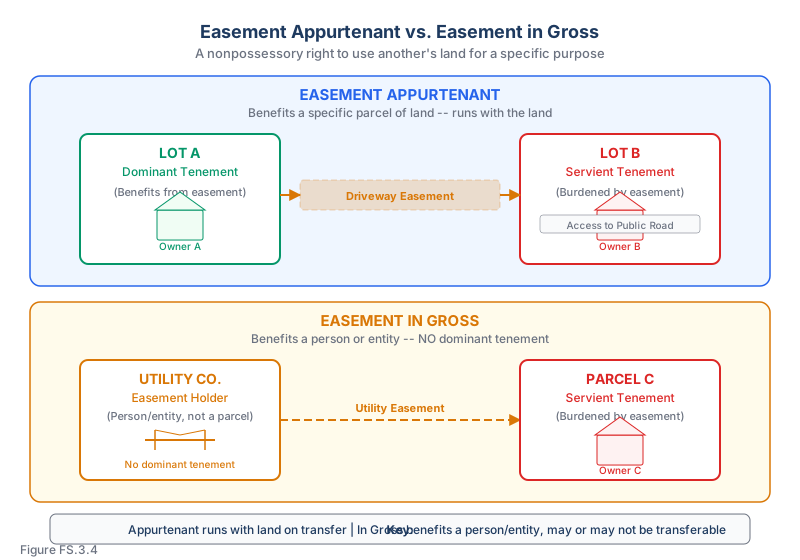
Types of Easements
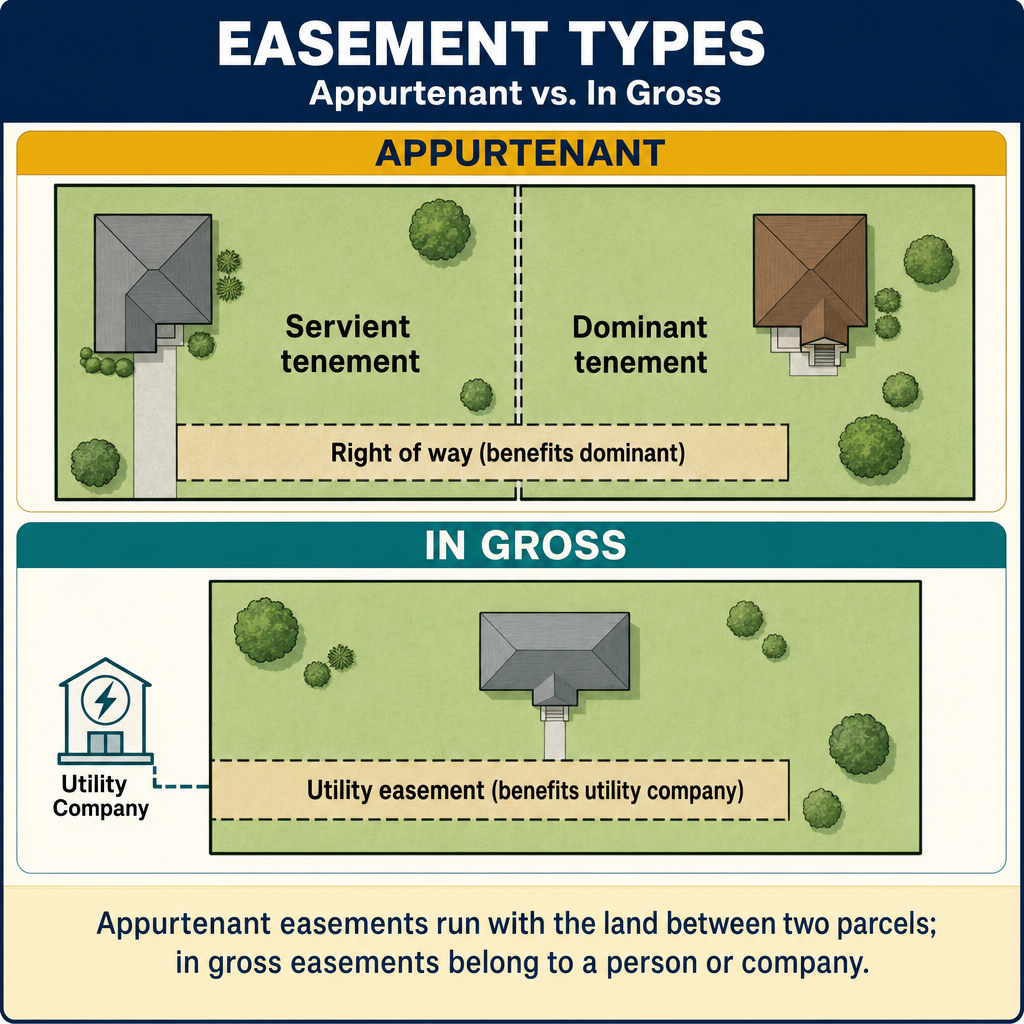
Easement appurtenant:
- Benefits a specific parcel of land (the dominant tenement)
- Burdens another parcel (the servient tenement)
- "Runs with the land" -- transfers automatically when either parcel is sold
- Example: A driveway easement across Lot B (servient) that provides access to Lot A (dominant)
Easement in gross:
- Benefits a person or entity, not a specific parcel of land
- There is a servient tenement but no dominant tenement
- May or may not be transferable, depending on the jurisdiction and the nature of the easement
- Example: A utility company's easement to install power lines across private property
Creation of Easements
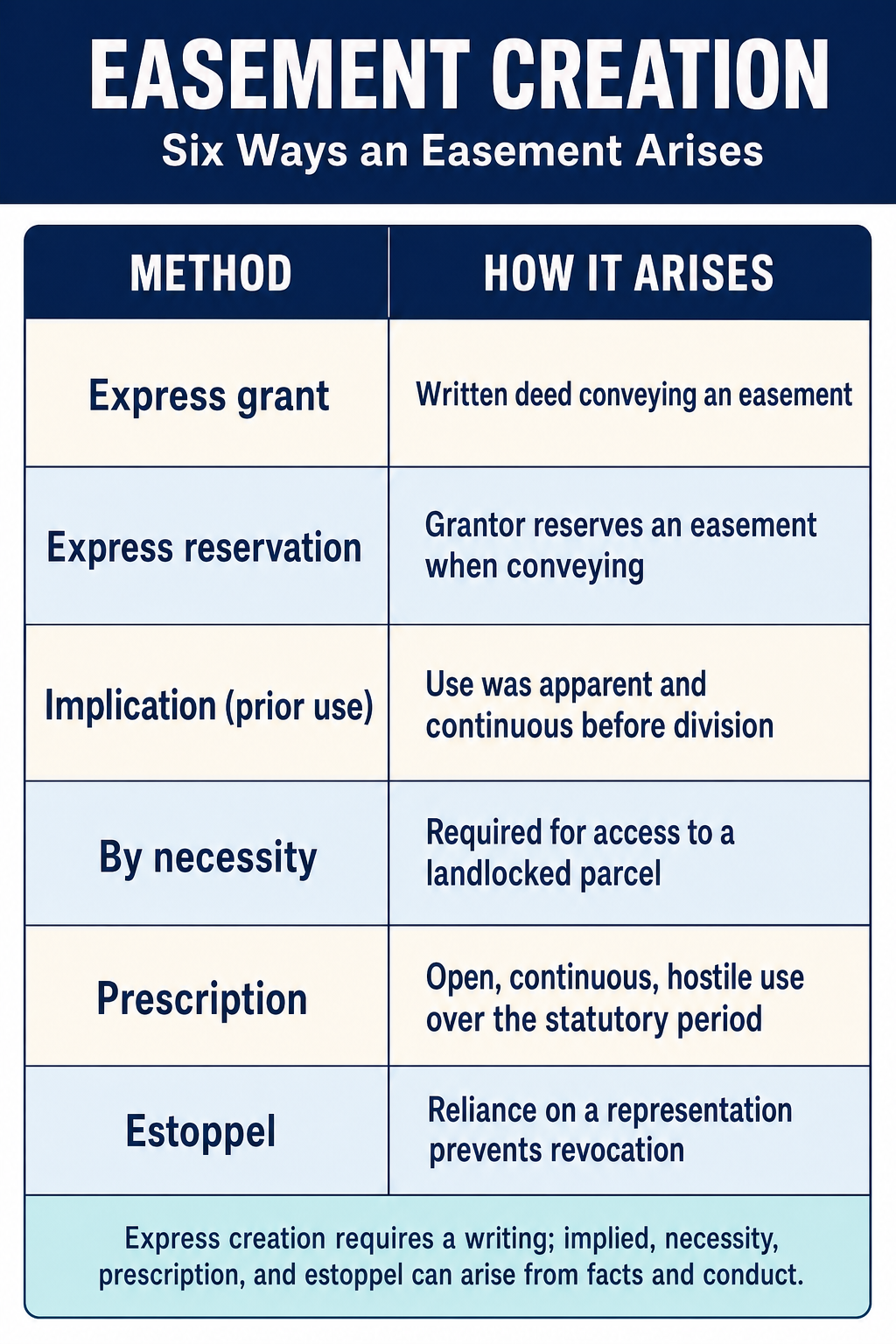
Easements can be created by several methods:
| Method | Description |
|---|---|
| Express grant | The landowner grants an easement by a written instrument (deed) |
| Express reservation | The landowner reserves an easement when selling part of their land |
| Implication | Arises from circumstances at the time of a conveyance (prior use that was apparent, continuous, and necessary) |
| Necessity | Created when a parcel is landlocked and has no legal access; arises from the conveyance that created the landlocked condition |
| Prescription | Acquired through continuous, open, hostile use for the statutory period (similar to adverse possession) |
| Condemnation | Government takes an easement through eminent domain, with compensation |
| Dedication | Landowner dedicates land for public use (common for streets and utilities in subdivisions) |
Express Easements
The most common type in modern practice. An express easement document should describe:
- The location of the easement (by metes and bounds, reference to a plat, or general description)
- The width or extent of the easement area
- The purpose of the easement (access, utilities, drainage, etc.)
- The parties (grantor/grantee or servient/dominant)
- Any restrictions or conditions on use
Easement by Necessity
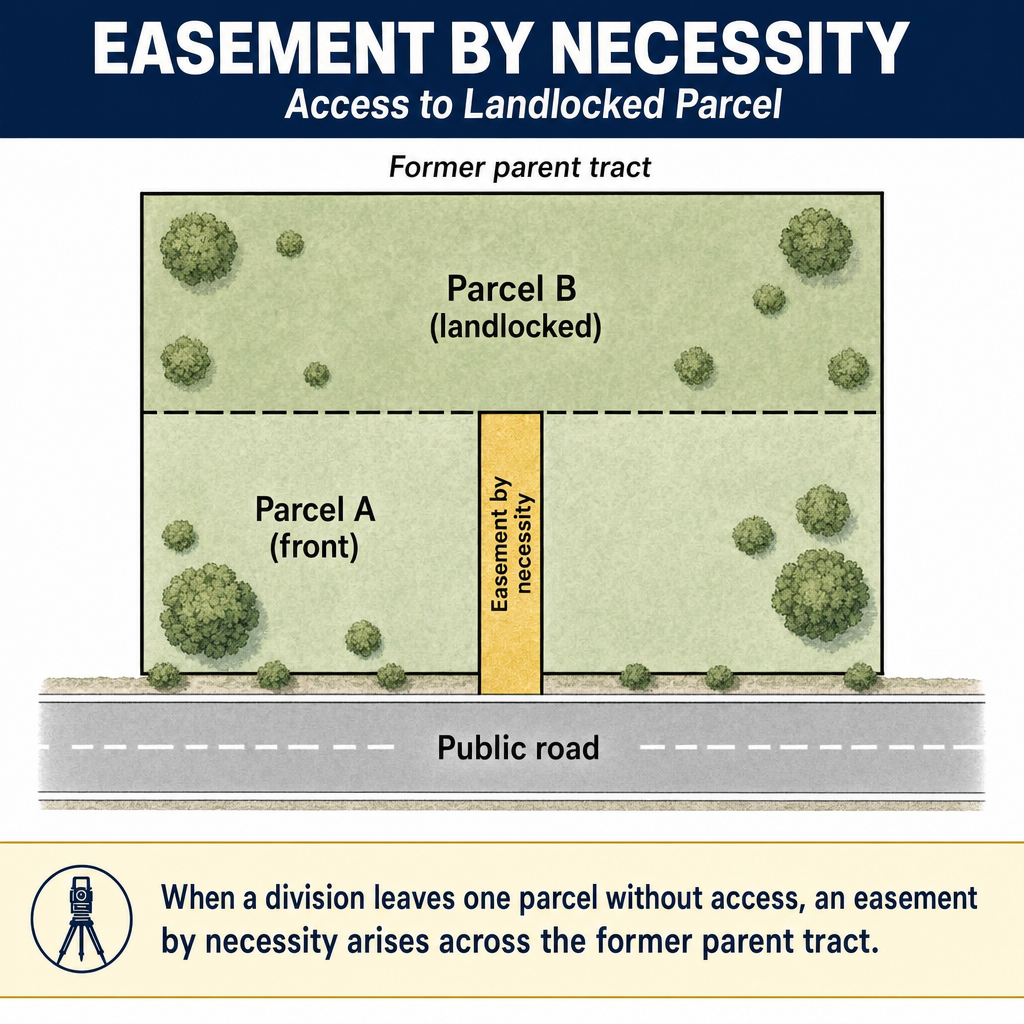
Arises when:
- A parcel is landlocked (no legal access to a public road)
- The landlocking occurred due to a conveyance (the common grantor created the condition)
- The easement is strictly necessary for access (not merely convenient)
Limitations:
- The necessity must exist at the time of the conveyance
- The easement is limited to the degree of necessity (typically basic access)
- If the necessity ends (e.g., a new public road is built), the easement may terminate
Easement by Prescription
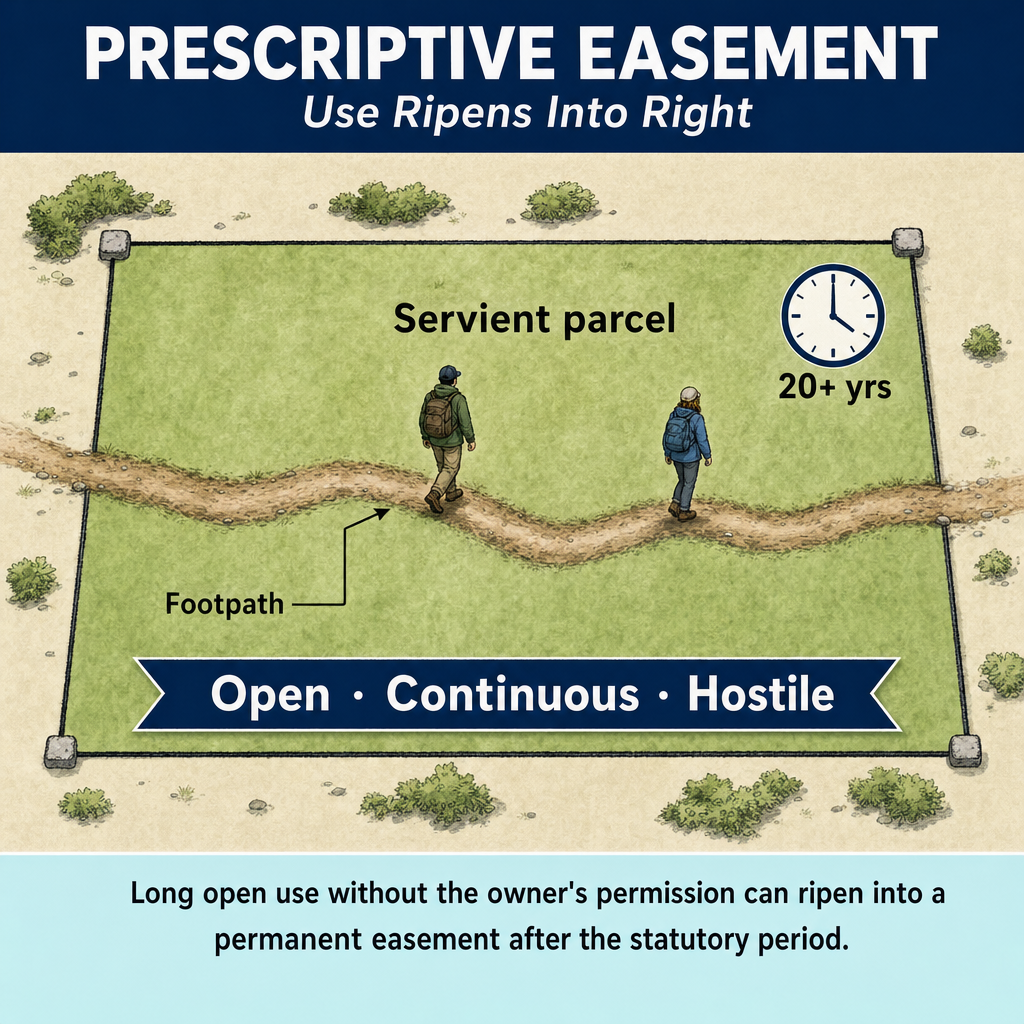
Created through long-term, hostile use of another's property:
- Open and notorious use (visible to the owner)
- Continuous use for the statutory period
- Hostile (without the owner's permission)
- No exclusivity required (unlike adverse possession)
Preventing prescriptive easements:
- Grant written permission for the use (negates the hostile element)
- Post signs stating the use is permissive
- Periodically obstruct the use to break continuity
- File a recorded license acknowledging the permissive nature of the use
Termination of Easements
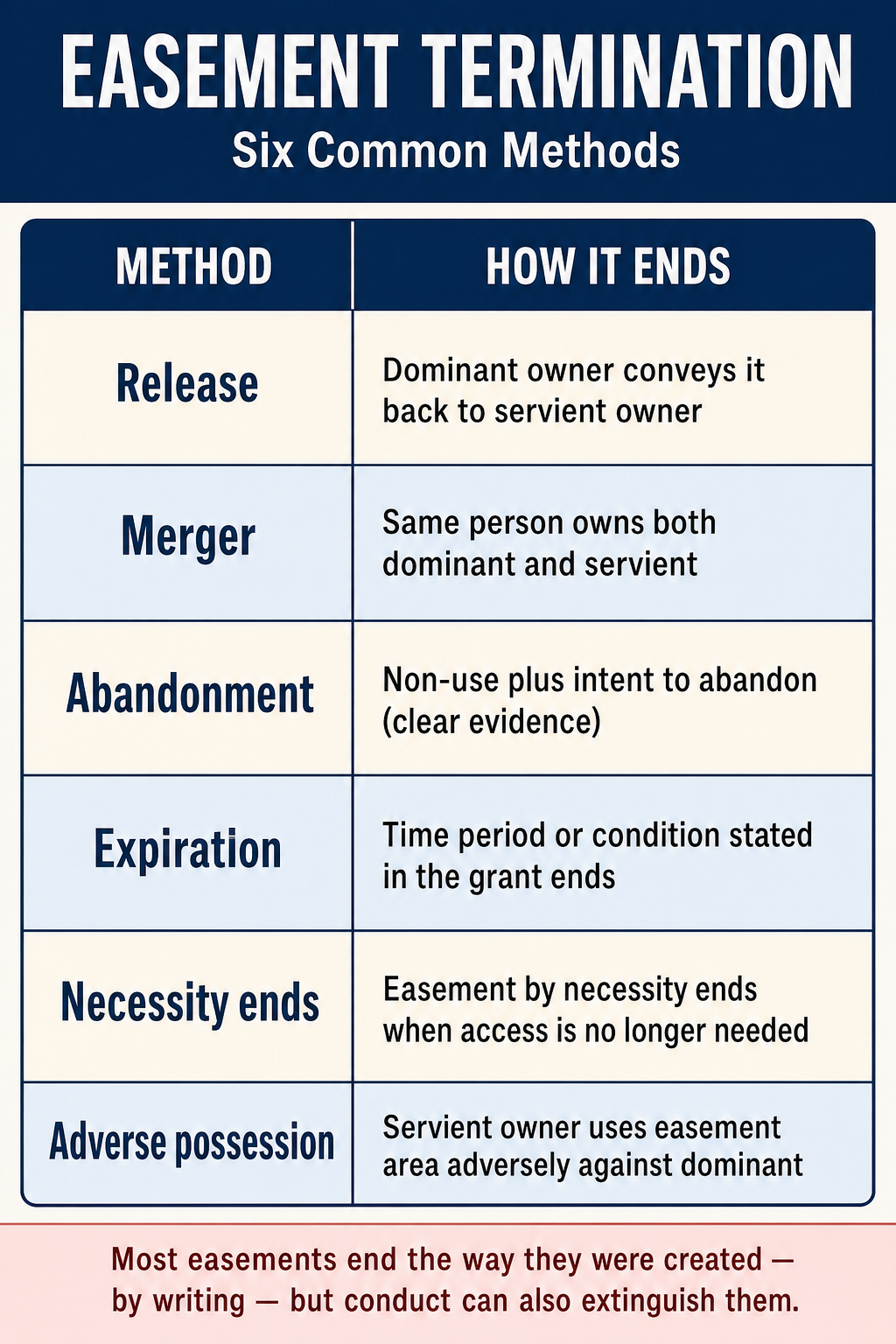
Easements can be terminated by:
| Method | Description |
|---|---|
| Release | The easement holder releases the right in writing |
| Merger | The dominant and servient tenements come into common ownership |
| Abandonment | The easement holder clearly demonstrates intent to abandon (mere nonuse is usually insufficient) |
| Expiration | If the easement was created for a specific time period |
| Necessity ends | For easements by necessity, when the necessity no longer exists |
| Condemnation | Government takes the servient estate, extinguishing the easement |
| Estoppel | The servient owner reasonably relies on the easement holder's conduct indicating abandonment |
| Adverse possession | The servient owner adversely possesses the easement area for the statutory period |
Common wrong path — appurtenant easement travels separately from dominant land. An appurtenant easement is tied to the dominant tenement. When the dominant parcel is sold, the easement passes with it automatically — no separate transfer is needed, no mention in the deed is required. Students sometimes think a grantor can "hold back" the easement and grant only the dominant land, or conversely that a new owner needs a fresh easement document to use the long-standing access. Neither is correct. Appurtenant easements travel with the land on every conveyance of the dominant estate, by operation of law. The one exception: the parties can expressly terminate the easement (by release) before or at the time of transfer, but silence in the deed does not accomplish that. Similarly, conveying an easement appurtenant apart from the dominant land is generally impossible — the easement has no independent existence separate from the parcel it serves. Exam questions plant this trap by describing a transfer and asking about the easement's status; the default correct answer is "transferred with the dominant land."
Quick retrieval check — try before reading on.
▶Lot A has a recorded appurtenant access easement across Lot B to reach the public road. Owner of Lot A sells Lot A to a new buyer; the deed does not mention the easement. Does the new owner of Lot A have the right to use the access?
Yes. An appurtenant easement runs with the land — it transfers automatically with the dominant tenement regardless of whether the deed mentions it. The new owner of Lot A steps into the shoes of the prior owner and inherits the easement over Lot B as a matter of law. The same principle applies to future transfers: as long as Lot A changes hands through valid conveyances, the access easement follows. Three exceptions to watch for on the exam: (1) the parties expressly release the easement before or at the time of transfer (requires a written release, not mere silence); (2) the servient tenement (Lot B) and dominant tenement (Lot A) come into common ownership, which terminates the easement by merger; (3) the easement has been abandoned, which requires clear intent plus affirmative acts — not just nonuse. Absent one of these, the new Lot A owner keeps the access.
The Surveyor's Role with Easements
Surveyors encounter easements in several contexts:
- Boundary surveys: Identifying and locating recorded easements that affect the property
- ALTA surveys: Showing all easements of record and evidence of easements in use
- Subdivision plats: Creating and depicting utility, drainage, and access easements
- Easement surveys: Preparing legal descriptions and exhibits for easement documents
- Construction surveys: Ensuring construction stays within easement limits
Exam Tips
- An easement appurtenant runs with the land; an easement in gross benefits a person or entity
- Know the difference: dominant tenement benefits from the easement; servient tenement is burdened
- Easement by necessity requires the parcel to be landlocked due to a conveyance by a common grantor
- Permission defeats prescription -- granting permission for use prevents a prescriptive easement
- Merger terminates an easement when both parcels come into common ownership
- Nonuse alone is generally not enough to terminate an easement; abandonment requires intent plus an affirmative act
- Easements convey a right of use, not ownership -- the servient owner still owns the underlying land
- The FS exam may test creation methods, termination methods, or the distinction between appurtenant and in gross
- Utility easements in subdivisions are typically created by dedication on the subdivision plat
Related Test Topics
- Unwritten Rights and Adverse Possession (Topic 3.3)
- Conveyances and Title Transfer (Topic 3.5)
- Encumbrances and Property Interests (Topic 3.10)
- Plats, ROS, and ALTA (Module 2, Topic 2.3)
Further Reading
Authoritative sources for deeper study
Brown's Boundary Control and Legal Principles (7th Ed., Robillard & Wilson) — Standard textbook on boundary law, evidence hierarchy, and retracement.
Evidence and Procedures for Boundary Location (Robillard, Wilson, & Brown, 6th Ed., 2011) — Practical treatise on collecting, weighing, and applying boundary evidence.
Clark, A Treatise on the Law of Surveying and Boundaries — Long-standing legal reference on boundary disputes and surveyor liability.
Last updated: 2026-04-17