FS Exam Preparation
Comprehensive preparation for the Fundamentals of Surveying (FS) exam. 7 modules covering all 7 exam domains with 60 in-depth topics.
Module 1: Surveying Processes & Methods
Module 2: Mapping Processes & Methods
Module 3: Boundary Law & Real Property
Module 4: Surveying Principles & Geodesy
Module 5: Survey Computations
Module 6: Business Concepts
Communication & Documentation
Learning Objectives
After completing this topic, you should be able to:
- Describe the standards for professional survey field notes
- Explain the importance of documentation in surveying
- Identify the components of a survey report
- Describe effective client communication practices
- Explain record retention requirements and practices
Overview
Communication and documentation are the mechanisms through which survey work is recorded, transmitted, and preserved. Field notes are the permanent record of what was observed and measured; survey reports communicate findings and conclusions; and client communication ensures that non-technical stakeholders understand the results. The FS exam tests your knowledge of documentation standards and professional communication practices.
Key Concepts
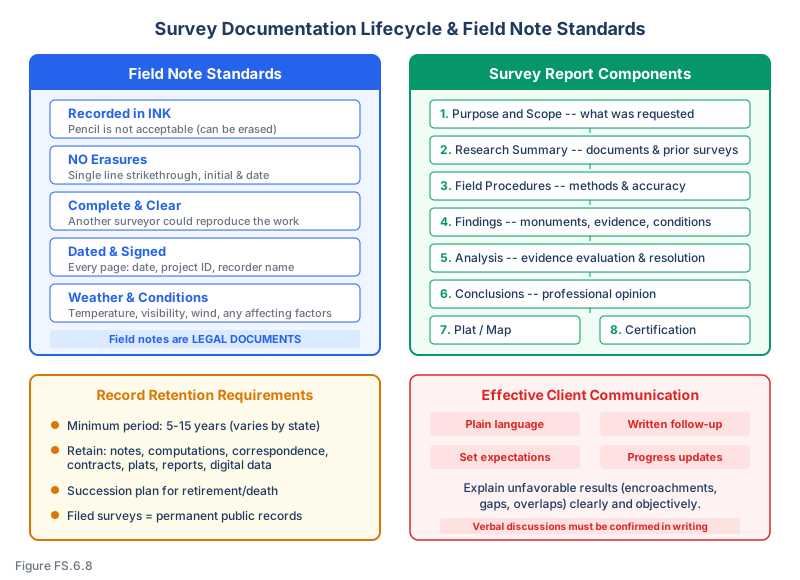
Field Notes
Field notes are the original, permanent record of all survey observations. They are legal documents that may be used as evidence in court.
Standards for field notes (Ghilani & Wolf, Elementary Surveying, 13th Ed., §2.10):
- Recorded in ink -- pencil is not acceptable because it can be erased and altered
- No erasures -- mistakes are crossed out with a single line so the original entry remains legible; the correction is written above or beside the error, initialed and dated
- Complete -- every observation, computation, and decision is recorded at the time it is made
- Clear and legible -- another surveyor should be able to understand and reproduce the work from the notes alone
- Dated and signed -- every page includes the date, project identification, and the name of the recorder
- Weather and conditions -- temperature, visibility, wind, and any conditions that might affect measurements
Types of field notes:
| Type | Purpose |
|---|---|
| Tabular notes | Structured numerical data (traverse, leveling) |
| Sketches | Relationship of features, monuments, and boundaries |
| Descriptive notes | Written descriptions of monuments, evidence, conditions |
| Digital notes | Data collector records (require backup and quality checks) |
Digital Data Collection
Modern data collection using electronic field books and data collectors requires additional protocols:
- Daily backups of all digital data
- Raw data preservation -- never overwrite or delete original observation files
- Metadata recording -- instrument type, serial number, firmware version, operator
- Quality checks -- compare digital records against independent checks
- File naming conventions -- consistent, descriptive file names with date codes
Survey Reports
A professional survey report typically includes:
- Purpose and scope: What was requested and what standards apply
- Research summary: Documents examined, prior surveys reviewed, control used
- Field procedures: Methods, equipment, and accuracy achieved
- Findings: What was found in the field (monuments, evidence, conditions)
- Analysis: How evidence was evaluated and conflicts resolved
- Conclusions: The surveyor's professional opinion based on the evidence
- Plat or map: The graphic representation of the survey
- Certification: The surveyor's professional certification of the work
Client Communication
Effective communication with clients involves:
- Plain language: Translate technical concepts into terms the client can understand
- Written confirmation: Follow up verbal discussions with written summaries
- Expectation management: Clearly communicate what the survey will and will not determine
- Progress updates: Keep the client informed of schedule, findings, and any issues
- Prompt response: Address client questions and concerns in a timely manner
- Boundary explanations: When the survey reveals unexpected results (encroachments, gaps, overlaps), explain the situation clearly and objectively
Record Retention
Survey records must be retained according to state law and professional standards:
- Minimum retention periods vary by state (commonly 5 to 15 years; some states require permanent retention)
- What to retain: Field notes, computations, correspondence, contracts, plats, reports, digital data
- Succession planning: When a surveyor retires or dies, arrangements must be made for the transfer and preservation of records
- Client access: Clients generally have the right to obtain copies of their survey records
- Public records: Filed surveys (Records of Survey, Corner Records, subdivision plats) become public records and are permanently retained by the recording agency
Interdisciplinary Communication
Surveyors frequently communicate with other professionals:
- Attorneys: Regarding boundary disputes, title issues, and legal descriptions
- Engineers: Regarding design, construction layout, and project coordination
- Architects: Regarding building location and site planning
- Title companies: Regarding easements, encumbrances, and property descriptions
- Government agencies: Regarding permits, reviews, and filing requirements
In all cases, the surveyor should communicate professionally, accurately, and within the bounds of their expertise.
FS Scenario Workflow
Communication questions usually ask for the most professional next action. Use this filter:
- Clarify scope before answering beyond the survey. Do not promise legal, engineering, or title conclusions outside your role.
- Give factual observations first. Separate what was found, what was measured, and what is your professional opinion.
- Document verbal conversations. A short written follow-up prevents later misunderstandings.
- Preserve raw records. Field notes, raw data, sketches, and correspondence are part of the project record.
- Escalate when needed. Boundary disputes, legal interpretations, unsafe conditions, and scope changes may require the client, attorney, engineer, or agency to decide.
If two answer choices both sound polite, choose the one that leaves a clear written record and stays within the surveyor's competence.
Common wrong path — erasing or tearing out a bad page of field notes. When a field-note page has a major mistake, the instinct is to erase, white-out, or tear out the page and start over. That is exactly what field-note standards prohibit. Field notes are a contemporaneous, original record — their evidentiary value in court depends on the absence of tampering. A corrected page (single-line strikethrough, correction written above, initialed and dated) with the original still legible is stronger evidence than a "clean" page, because the judge, opposing counsel, or reviewing surveyor can see exactly what was observed and how the correction was reasoned. A page that was erased or torn out looks like concealment, even when it wasn't. This applies equally to digital notes: never overwrite raw observation files; the audit trail is the evidence. Students pick "redo the page cleanly" because it feels more professional; the correct answer is always the single-line strikethrough.
Quick retrieval check — try before reading on.
▶Midway through a traverse you realize you wrote the backsight angle as 047°32'15" when the instrument actually read 047°23'15" (you transposed two digits). The next three angles depend on that station. What do you do with the field notes?
Strike the incorrect entry with a single line so the original is still legible, write the correct value above or beside it, and initial and date the correction in the margin. Do not erase. Do not tear out the page. Do not use correction fluid. If the erroneous value propagated into subsequent computations on that page, also strike those intermediate results (single line) and write the corrected values above them, again initialing each.
In a data collector, you cannot "edit" the raw observation file — the raw file is the equivalent of the original ink entry. Instead, you flag the erroneous record (most collectors have a note field or a "void" flag), enter a new observation with a note explaining the reason, and preserve the raw file for the office. In either case, the principle is the same: the record must show that a correction was made, who made it, when, and why. The value of a field book as legal evidence in a future boundary dispute depends on that audit trail. A clean-looking page with no corrections is suspicious; a page with initialed, dated strikethroughs is exactly what a court expects to see.
Exam Tips
- Field notes must be in ink and errors crossed out with a single line, never erased
- The field notes should be detailed enough that another surveyor could reproduce the work
- Digital data requires the same rigor as paper notes -- backups, raw data preservation, and quality checks
- Record retention requirements vary by state, but the FS exam tests the general principle that records must be preserved
- Client communication questions on the FS exam often test whether you can identify the most professional and clear response
- A survey report is a professional document -- it should be objective, factual, and well-organized
- The surveyor's responsibility to communicate clearly extends to explaining unfavorable results (encroachments, shortages) objectively
Related Test Topics
- Project Planning and Resources (Topic 6.1)
- Professional Ethics (Topic 6.7)
- Contracts and Scope of Work (Topic 6.5)
Further Reading
Authoritative sources for deeper study
Model Rules of Professional Conduct (Aug 2025) — Model ethics, competence, and licensure rules adopted by most state boards.
Wolf & Ghilani, Elementary Surveying — An Introduction to Geomatics (13th Ed., 2012) — Comprehensive surveying text covering instruments, field procedures, and computations.
Last updated: 2026-04-17