FS Exam Preparation
Comprehensive preparation for the Fundamentals of Surveying (FS) exam. 7 modules covering all 7 exam domains with 60 in-depth topics.
Module 1: Surveying Processes & Methods
Module 2: Mapping Processes & Methods
Module 3: Boundary Law & Real Property
Module 4: Surveying Principles & Geodesy
Module 5: Survey Computations
Module 6: Business Concepts
Contracts & Scope of Work
Learning Objectives
After completing this topic, you should be able to:
- Identify the essential elements of a valid contract
- Distinguish between common contract types used in surveying
- Describe the components of a scope of work
- Explain the purpose and process of change orders
- Recognize common contract pitfalls in surveying practice
Overview
Contracts define the legal relationship between the surveyor and the client. A well-drafted contract protects both parties by clearly defining the work to be performed, the compensation, the timeline, and the allocation of risk. The scope of work is the technical heart of the contract -- it describes exactly what the surveyor will do and deliver. The FS exam tests your understanding of contract fundamentals, scope definition, and the management of scope changes.
Key Concepts
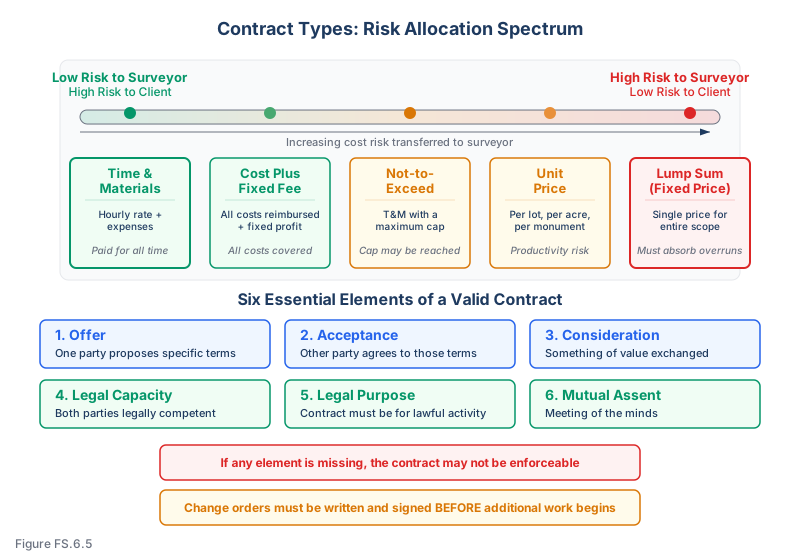
Essential Elements of a Valid Contract
A legally enforceable contract requires:
- Offer: One party proposes specific terms (the surveyor's proposal)
- Acceptance: The other party agrees to those terms (the client signs)
- Consideration: Something of value is exchanged (services for payment)
- Legal capacity: Both parties must be legally competent to enter a contract
- Legal purpose: The contract must be for a lawful activity
- Mutual assent (meeting of the minds): Both parties understand and agree to the same terms
Common Contract Types
| Contract Type | Description | Risk to Surveyor | Risk to Client |
|---|---|---|---|
| Lump sum (fixed price) | A single price for the entire scope of work | Higher (must absorb cost overruns) | Lower (knows total cost upfront) |
| Time and materials (T&M) | Billed at hourly rates plus expenses | Lower (paid for all time spent) | Higher (final cost is uncertain) |
| Cost plus fixed fee | Reimbursed for costs plus a fixed profit amount | Low (all costs covered) | Moderate (costs may exceed expectations) |
| Unit price | Billed per unit (per lot, per acre, per monument) | Moderate (depends on productivity assumptions) | Moderate (total depends on actual quantities) |
| Not-to-exceed (NTE) | Time and materials with a maximum cap | Moderate (cap may be reached) | Lower (cost is bounded) |
Scope of Work Components
A comprehensive scope of work includes:
- Project description: Location, purpose, and background
- Work to be performed: Specific tasks listed in detail
- Accuracy standards: Which standards apply (e.g., ALTA/NSPS, state minimum standards)
- Deliverables: Exactly what products will be provided (maps, plats, reports, digital files, staking)
- Schedule: Start date, milestones, and completion date
- Exclusions: What is NOT included (prevents scope creep)
- Client responsibilities: What the client must provide (access, records, prior surveys, permits)
- Assumptions: Conditions assumed to be true (e.g., "assumes clear line of sight between control points")
- Limitations: Constraints on the work or the deliverables
Change Orders
When the scope of work changes after the contract is signed:
- Change order: A formal written amendment to the contract that documents the change in scope, schedule, and/or cost
- Authorization: Must be signed by both parties before the additional work begins (in an ideal scenario)
- Documentation: The original scope, the requested change, the reason for the change, and the cost impact
Common reasons for change orders:
- Client requests additional services (e.g., additional lots to survey)
- Unforeseen field conditions (dense vegetation, lack of access, missing monuments)
- Changes in design or requirements
- Errors or omissions in the original scope (discovered during work)
- Regulatory changes requiring additional work
Key Contract Clauses
| Clause | Purpose |
|---|---|
| Limitation of liability | Caps the surveyor's liability (often to the fee or insurance limit) |
| Indemnification | Defines who bears responsibility for specific risks |
| Termination | Conditions under which either party can end the contract |
| Dispute resolution | Mediation, arbitration, or litigation procedures |
| Payment terms | When and how the surveyor will be paid |
| Ownership of documents | Who owns the survey work product |
| Standard of care | Defines the professional standard the surveyor will meet |
Common wrong path — doing the extra work first and billing for it later. A client calls mid-project and asks you to "just stake the driveway too while you're out there" or "just add that extra lot to the survey." The work sounds small. You do it. You invoice for the additional hours. The client refuses to pay because "I never agreed to that cost." You have no contract defense — you performed extra services without a signed change order, and in most jurisdictions you cannot enforce payment for scope beyond the written contract unless the client authorized it in writing. The same rule applies even when the "extra" is triggered by unforeseen field conditions (missing monuments, denied access, additional research required): stop, document the change, get a written authorization, then proceed. Students pick "do the work to keep the client happy" because it feels like good service; the correct answer is always to halt, issue a written change order, and get sign-off before proceeding. "Keeping the client happy" with unbilled extras erodes fee and trains the client to expect scope creep for free.
Quick retrieval check — try before reading on.
▶You are on-site completing a topographic survey under a lump-sum contract for $12,000. The client arrives and asks you to also stake the corners of a proposed accessory building. You estimate 3 hours of field work at $150/hr. The client says "just add it to the bill." What is the correct professional response?
Decline to begin the additional work until you have a written change order signed by the client specifying the additional scope (stake four accessory-building corners per provided plan), additional fee ($450 or your rate × estimated time), and any schedule impact. Confirm the change in writing on the spot — a signed email, a change-order form, or even a short handwritten amendment to the contract signed by both parties is sufficient. Only then perform the work.
Why this matters: lump-sum contracts define a fixed price for a defined scope. The staking is outside that scope. Verbally adding it creates three problems: (1) if the client later disputes the charge, you have no written authorization and may not be paid; (2) the staking work may require a different liability allocation than the topo scope, exposing you to uninsured risk; (3) if the building position was computed from plans that later change, without a documented scope the client may try to shift that responsibility to you. "Just add it to the bill" is not a contract modification — a change order is. Pausing 5 minutes to document the change protects the fee, the liability, and the professional relationship. Clients who object to written change orders for trivial extras are exactly the clients who later dispute the invoice, so the friction of asking is itself a useful filter.
Exam Tips
- A contract requires all essential elements -- if one is missing, the contract may not be enforceable
- Lump sum contracts put the most risk on the surveyor (must complete the work regardless of actual cost)
- T&M contracts put the most cost risk on the client (the final cost is not known in advance)
- Change orders should be written and signed before additional work begins -- verbal agreements create disputes
- The scope of work should clearly state what is excluded to prevent scope creep
- On the FS exam, contract questions often present scenarios where something went wrong -- identify whether the scope was clear and whether a change order was needed
- "Meeting of the minds" means both parties understood the same thing -- ambiguity in the scope invites disputes
Related Test Topics
- Project Planning and Resources (Topic 6.1)
- Cost Estimation and Budgeting (Topic 6.2)
- Liability and Insurance (Topic 6.4)
- Communication and Documentation (Topic 6.8)
Further Reading
Authoritative sources for deeper study
Model Rules of Professional Conduct (Aug 2025) — Model ethics, competence, and licensure rules adopted by most state boards.
2026 ALTA/NSPS Land Title Survey Standards — Current minimum standard detail requirements for ALTA/NSPS land title surveys (effective February 23, 2026).
Last updated: 2026-05-30