FS Exam Preparation
Comprehensive preparation for the Fundamentals of Surveying (FS) exam. 7 modules covering all 7 exam domains with 60 in-depth topics.
Module 1: Surveying Processes & Methods
Module 2: Mapping Processes & Methods
Module 3: Boundary Law & Real Property
Module 4: Surveying Principles & Geodesy
Module 5: Survey Computations
Module 6: Business Concepts
Project Planning & Resource Management
Learning Objectives
After completing this topic, you should be able to:
- Identify the components of a survey project plan
- Describe the process of defining project scope
- Explain resource allocation for survey projects
- Distinguish between different scheduling methods
- Recognize factors that affect project timelines
Overview
Project planning is the process of defining what work needs to be done, how it will be accomplished, what resources are required, and when it will be completed. For surveying projects, effective planning ensures that field crews arrive with the right equipment, adequate control information, and a clear understanding of the deliverables. Poor planning leads to return trips, missed deadlines, and cost overruns.
Key Concepts
Components of a Project Plan
A comprehensive survey project plan includes:
- Scope definition: What is to be surveyed, to what accuracy, and what deliverables are expected
- Research phase: Record research, control monument recovery, prior survey review
- Field plan: Crew assignments, equipment list, control network design, observation schedule
- Office plan: Data processing workflow, quality checks, deliverable preparation
- Schedule: Timeline with milestones and dependencies
- Budget: Cost estimate tied to the scope and schedule
- Risk assessment: Potential problems and contingency plans
Scope Definition
The scope of work defines the boundaries of the project -- what is included and what is not. A well-defined scope includes:
- Geographic extent: The area to be surveyed, defined by legal description, map, or coordinates
- Accuracy requirements: The precision and accuracy standards the survey must meet
- Deliverables: Maps, plats, coordinate files, reports, staking, or monument setting
- Standards: Which professional standards apply (ALTA/NSPS, state standards, agency requirements)
- Exclusions: What is explicitly NOT included to prevent scope creep
Resource Allocation
Survey resources fall into three categories:
Personnel:
- Party chief / crew chief
- Instrument operator
- Rod person / chain person
- Office technician / CAD drafter
- Project surveyor (licensed)
Equipment:
- Total stations, GNSS receivers, levels
- Data collectors and field software
- Vehicles and transportation
- Safety equipment and PPE
- Monumentation materials
Information:
- Prior surveys and record documents
- Control point data sheets
- Aerial imagery and LiDAR
- Title reports and deeds
- Agency requirements and permits
Scheduling
Common scheduling approaches:
- Gantt charts: Bar charts showing tasks plotted against time, with dependencies shown as links between bars
- Critical path method (CPM): Identifies the longest sequence of dependent tasks, which determines the minimum project duration. Any delay on the critical path delays the entire project
- Milestones: Key decision points or deliverable dates that mark project progress
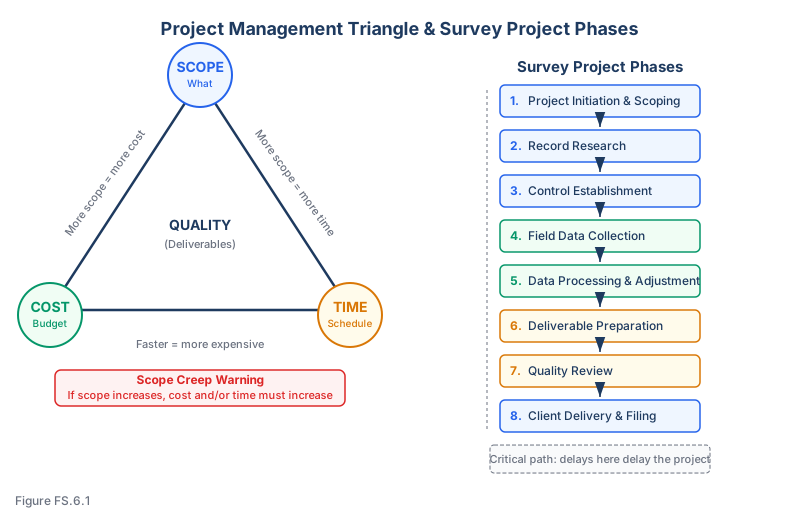
Typical survey project phases:
- Project initiation and scoping
- Record research and document gathering
- Control establishment
- Field data collection
- Data processing and adjustment
- Deliverable preparation
- Quality review
- Client delivery and filing
Factors Affecting Timelines
- Weather: Rain, snow, fog, and extreme heat affect field productivity
- Access: Property access permissions, locked gates, difficult terrain
- Vegetation: Dense growth requires clearing time and reduces visibility
- Traffic: Work in road right-of-way requires traffic control and may limit hours
- Agency reviews: Permit processing and review times are often outside the surveyor's control
- Crew availability: Experienced crews may be committed to other projects
- Equipment availability: Specialized equipment may need to be rented or shared
Common wrong path — starting fieldwork before research is complete. The instinct on a tight deadline is to put a crew in the field immediately and "start collecting data while I finish the research." This almost always costs more time than it saves. Without the research you do not know: which monuments to recover, where senior rights lie, which prior survey controls, what easements affect access, what control network already exists, and what the agency requires for filing. A crew that collects 40 hours of observations and then learns that the adjoining deed controls a line differently has just produced expensive data that may need to be re-collected or re-purposed. The correct sequence is almost always: (1) research-phase complete enough to know what to look for, (2) field-reconnaissance (often a one-person, one-day pass to verify monuments and access), (3) plan the observation network, (4) deploy the full crew. "Get out there and start working" is not a research strategy. On the FS exam, if a project-planning question offers "begin fieldwork while research continues," that answer is almost always wrong unless the question specifies that the field work is independent reconnaissance rather than boundary observations.
Quick retrieval check — try before reading on.
▶A 120-acre boundary survey is due in 4 weeks. You have done no research. Your client is pressuring you to "get the crew out there Monday." You estimate: (a) 20 hours of record research, (b) 12 hours of field reconnaissance, (c) 40 hours of crew time to collect observations, (d) 16 hours of office time to process and draft. Crew labor is $300/hr fully loaded; your own time is $200/hr. What is the fastest *and* lowest-risk sequence, and what happens if you skip straight to (c)?
Correct sequence: Research (a) first — 20 hr × 4,000. Then reconnaissance (b) — 12 hr × 3,600. Then full-crew observations (c) — 40 hr × 12,000. Then office (d) — 16 hr × 3,200. Total planned cost: $22,800, calendar time ~2–3 weeks if sequenced efficiently (research can run in parallel with reconnaissance planning), leaving schedule float.
What happens if you skip to (c): You deploy the crew Monday without knowing which record monuments to recover. Typical failure modes: (1) crew recovers the wrong monuments (or misses called ones entirely) and you discover the error during deed-retracement at the office — redo ≈ 40% of the observations, adding ~16 hr × 4,800 and a mobilization day; (2) access is denied at a parcel because easement research would have told you to contact the neighbor first — crew waits or leaves, half-day loss ≈ 4 hr × 1,200; (3) you observe in the wrong coordinate system or against the wrong control because record research would have identified the published control network — full re-tie ≈ 8 hr × 2,400; (4) the final boundary opinion conflicts with senior-rights calls you did not research, forcing either additional field work or an uncomfortable call to the client. Expected cost of skipping research: 8,000–$12,000 of rework.
Professional project-management triangle: scope × schedule × budget. You cannot speed up the schedule by skipping research; you can only trade budget (hire a second crew to parallelize) or scope (reduce area, or deliver a preliminary map now and a final map later). "Start Monday without research" is a false economy in almost every real scenario — and the FS exam tests this principle directly.
Exam Tips
- Scope creep is one of the biggest risks in project management -- know what it means and how to prevent it
- The critical path determines the minimum project duration; tasks not on the critical path have float (slack time)
- Always plan for research BEFORE fieldwork -- arriving in the field without adequate record research wastes time
- The FS exam may present scenarios where you must identify what went wrong in a project plan
- Resource allocation questions typically test whether you understand the relationship between scope, budget, and schedule (the "project management triangle")
- If scope increases, either budget or schedule (or both) must also increase
Related Test Topics
- Cost Estimation and Budgeting (Topic 6.2)
- Contracts and Scope of Work (Topic 6.5)
- Communication and Documentation (Topic 6.8)
Further Reading
Authoritative sources for deeper study
Model Rules of Professional Conduct (Aug 2025) — Model ethics, competence, and licensure rules adopted by most state boards.
Kavanagh, Surveying with Construction Applications (7th Ed.) — Combined surveying and construction-layout reference.
Last updated: 2026-04-17