FS Exam Preparation
Comprehensive preparation for the Fundamentals of Surveying (FS) exam. 7 modules covering all 7 exam domains with 60 in-depth topics.
Module 1: Surveying Processes & Methods
Module 2: Mapping Processes & Methods
Module 3: Boundary Law & Real Property
Module 4: Surveying Principles & Geodesy
Module 5: Survey Computations
Module 6: Business Concepts
Area Calculations
Learning Objectives
After completing this topic, you should be able to:
- Compute area using the coordinate method (cross-multiply)
- Compute area using Double Meridian Distances (DMD)
- Apply the trapezoidal rule for irregular areas
- Apply Simpson's one-third rule for irregular areas
- Convert between square feet, acres, square meters, and hectares
- Determine when each method is most appropriate
Overview
Area calculation is a fundamental surveying computation required for property surveys, land development, earthwork, and legal descriptions. The FS exam tests several methods: the coordinate method (most common), DMD/DPD method, and numerical integration methods (trapezoidal rule and Simpson's rule) for irregular boundaries. You must know when to apply each method and how to execute the calculations.
Key Concepts
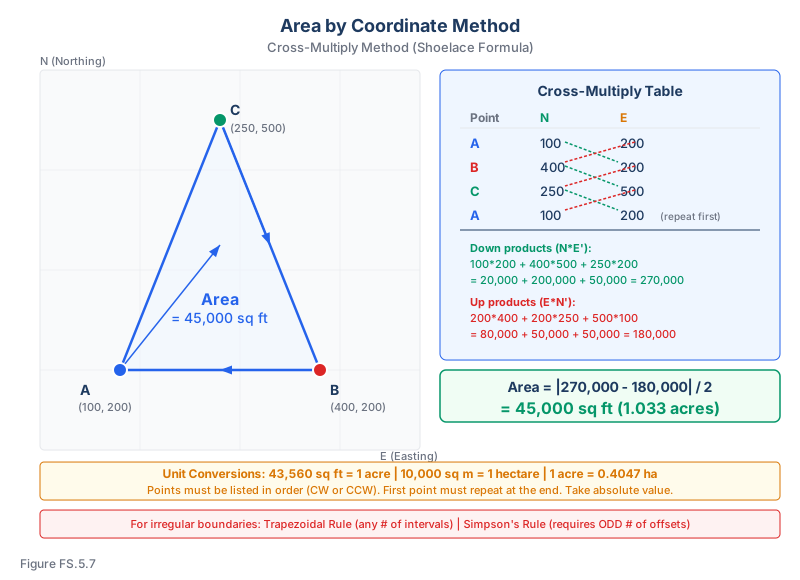
The Coordinate Method
The most widely used method. Given n vertices with coordinates (N_i, E_i) listed in order around the boundary:
Area = (1/2) × |Σ (N_i × E_(i+1) − N_(i+1) × E_i)|
This is often organized as a "cross-multiply" table:
| Point | N (Northing) | E (Easting) |
|---|---|---|
| A | N_A | E_A |
| B | N_B | E_B |
| C | N_C | E_C |
| A | N_A | E_A |
Multiply each northing by the next easting (downward diagonal), sum them. Then multiply each easting by the next northing (upward diagonal), sum them. Take the absolute value of the difference and divide by 2.
Example: Triangle with vertices A(N=100, E=200), B(N=400, E=200), C(N=250, E=500):
Downward products: (100×200) + (400×500) + (250×200) = 20,000 + 200,000 + 50,000 = 270,000
Upward products: (200×400) + (200×250) + (500×100) = 80,000 + 50,000 + 50,000 = 180,000
Area = (1/2) × |270,000 − 180,000| = (1/2) × 90,000 = 45,000 sq ft
Double Meridian Distance (DMD) Method
The DMD method computes area from latitudes and departures:
Rules for computing DMDs:
- DMD of the first course = Departure of the first course
- DMD of any course = DMD of the previous course + Departure of the previous course + Departure of the current course
- DMD of the last course should equal the negative of the departure of the last course (verification check)
Double area = Sum of (DMD_i * Latitude_i)
Area = |Double area| / 2
Double Parallel Distance (DPD) Method
Similar to DMD but uses latitudes instead of departures:
Rules for computing DPDs:
- DPD of the first course = Latitude of the first course
- DPD of any course = DPD of the previous course + Latitude of the previous course + Latitude of the current course
Double area = Sum of (DPD_i * Departure_i)
Trapezoidal Rule
For irregular boundaries (e.g., a stream or road) with offsets measured at regular intervals:
Area = (d/2) * (h_1 + 2h_2 + 2h_3 + ... + 2*h_(n-1) + h_n)
Where:
- d = equal spacing between offset measurements
- h_i = offset distance at each measurement point
- n = number of measurements
The trapezoidal rule works with any number of intervals.
Simpson's One-Third Rule
A more accurate numerical integration method for irregular boundaries:
Area = (d/3) * (h_1 + 4h_2 + 2h_3 + 4h_4 + 2h_5 + ... + 4*h_(n-1) + h_n)
Critical requirement: Simpson's rule requires an odd number of offsets (even number of intervals).
The pattern of multipliers is: 1, 4, 2, 4, 2, 4, ..., 2, 4, 1.
Common wrong path — Simpson's rule with the wrong count. Simpson's one-third rule requires an even number of intervals (an odd number of offsets). Students often memorize "odd number" without clarifying which thing is odd, then apply the rule to 4 offsets (3 intervals — odd number of intervals) and get a nonsensical result. The mechanical fix: count your measurement points (offsets). If the count is odd (1, 3, 5, 7, 9...), Simpson's works. If it's even (2, 4, 6, 8...), Simpson's one-third rule does not apply across the whole strip. Use the trapezoidal rule instead, or apply Simpson's to the largest valid odd-offset subset and trapezoidal rule to the remaining interval(s). Exam questions that slip in an even-offset count are testing whether you notice.
Quick retrieval check — try before reading on.
▶A streambed has offsets at 10-ft intervals: 5.2, 7.8, 6.4, 9.1, 8.2, 7.6, 6.9 ft. What is the area by Simpson's rule?
Seven offsets (odd) → six intervals (even) → Simpson's applies.
sq ft.
Quick sanity check with trapezoidal: sq ft. The two methods agree within ~3% for this smoothly varying data — consistent with Simpson's rule being more accurate.
Unit Conversions
| From | To | Factor |
|---|---|---|
| sq ft | acres | divide by 43,560 |
| sq m | hectares | divide by 10,000 |
| acres | hectares | multiply by 0.4047 |
| hectares | acres | multiply by 2.471 |
| sq ft | sq m | multiply by 0.0929 |
Choosing the Area Method
The FS exam often hides the method choice inside the data format:
| Given data | Best method | Why |
|---|---|---|
| Ordered coordinates | Coordinate method | Fastest and least ambiguous |
| Traverse latitudes and departures | DMD or coordinate method | Uses data already computed |
| Regular offsets to an irregular boundary | Trapezoidal or Simpson's rule | Treats the boundary as sampled offsets |
| Spot elevations or grid depths | Volume/grid method, not parcel area | The data describes a surface, not a boundary |
Before calculating, ask whether the problem describes a closed polygon or an irregular strip. Coordinate and DMD methods solve closed polygons. Trapezoidal and Simpson's rules solve strip/offset problems.
Common Unit Traps
Area units square the linear unit. If coordinates are in feet, the coordinate method returns square feet. If coordinates are in meters, it returns square meters. Do not convert feet to acres until after the area is computed.
For mixed-unit problems:
- Complete the geometric calculation in the units given.
- Convert the final area once.
- Round only at the end.
Example: 130,680 sq ft / 43,560 = 3.000 acres. If you round intermediate coordinate products too early, the acre conversion can drift enough to pick the wrong multiple-choice answer.
Exam Tips
- The coordinate method is the most versatile -- it works for any polygon and is the most common on the FS exam
- For the coordinate method, points must be listed in order (clockwise or counterclockwise) and the first point must be repeated at the end
- The DMD method is useful when you already have latitudes and departures from a traverse computation
- Simpson's rule requires an odd number of offsets -- if you have an even number, you cannot use it (use trapezoidal instead)
- Simpson's rule is more accurate than the trapezoidal rule for the same data
- Know the unit conversions cold: 43,560 sq ft = 1 acre; 10,000 sq m = 1 hectare
- Watch for exam problems that give coordinates in meters but ask for area in acres, or vice versa
- If the coordinate method gives a negative number, you simply take the absolute value -- the sign just indicates the direction you traversed around the boundary
Related Test Topics
- Coordinate Geometry (Topic 5.1)
- Traverse Computations and Closure (Topic 5.2)
- Volume Calculations and Earthwork (Topic 5.9)
Further Reading
Authoritative sources for deeper study
Wolf & Ghilani, Elementary Surveying — Chapter on area computation by coordinates and DMD/DPD.
Wolf & Ghilani, Elementary Surveying — An Introduction to Geomatics (13th Ed., 2012) — Comprehensive surveying text covering instruments, field procedures, and computations.
Allan, Principles of Geospatial Surveying (Ethernet Edu mirror) — Survey of geospatial principles, instruments, and adjustment.
Last updated: 2026-04-17