FS Exam Preparation
Comprehensive preparation for the Fundamentals of Surveying (FS) exam. 7 modules covering all 7 exam domains with 60 in-depth topics.
Module 1: Surveying Processes & Methods
Module 2: Mapping Processes & Methods
Module 3: Boundary Law & Real Property
Module 4: Surveying Principles & Geodesy
Module 5: Survey Computations
Module 6: Business Concepts
Professional Ethics
Learning Objectives
After completing this topic, you should be able to:
- Identify the Model Rules of Professional Conduct for surveyors
- Recognize conflicts of interest and know how to handle them
- Explain the surveyor's obligations to the public, clients, and other professionals
- Distinguish between ethical violations and mere differences of professional opinion
- Apply ethical principles to exam-style scenarios
Overview
Professional ethics govern how surveyors conduct themselves in practice. As licensed professionals with the power to establish property boundaries that affect property rights, surveyors hold a position of public trust. The FS exam tests your knowledge of the Model Rules of Professional Conduct and your ability to apply ethical principles to realistic scenarios. Ethics questions are concept-based and require careful reading.
Key Concepts
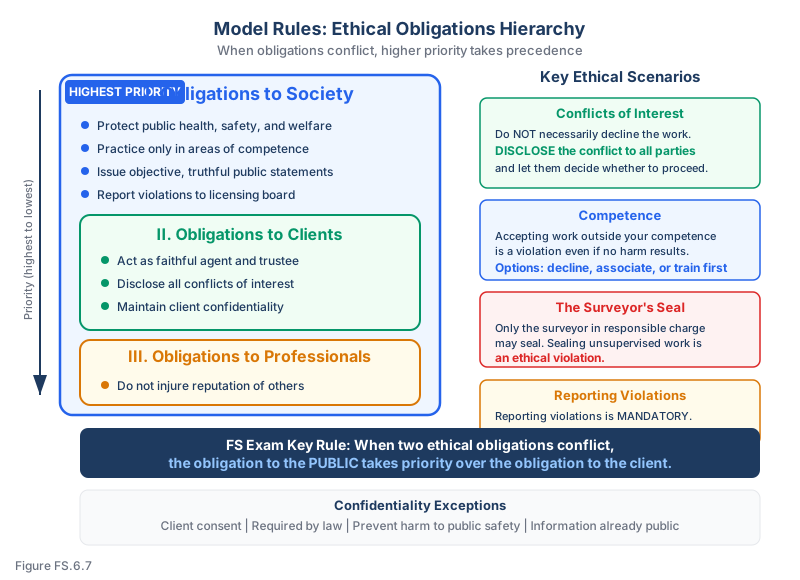
Model Rules of Professional Conduct
The Model Rules establish three categories of ethical obligation:
I. Obligations to Society
The surveyor's primary obligation is to protect the health, safety, and welfare of the public:
- Hold paramount the safety, health, and welfare of the public
- Practice only in areas of competence
- Issue public statements only in an objective and truthful manner
- Do not participate in fraudulent or dishonest activities
- Report violations of the rules of professional conduct to the appropriate authority
II. Obligations to Clients and Employers
- Act as faithful agents and trustees
- Disclose all known or potential conflicts of interest
- Do not accept compensation from more than one party for the same service without full disclosure and consent
- Do not solicit or accept financial consideration from material or equipment suppliers for specifying their products
- Maintain confidentiality of client information (unless required by law to disclose)
- Avoid conflicts between the interests of current clients and former clients
III. Obligations to Other Professionals
- Do not attempt to injure, maliciously or falsely, the professional reputation of others
- Give proper credit for professional work
- Do not compete unfairly (e.g., undercutting fees to the point of compromising quality)
- Cooperate with licensing boards in investigations
- Do not aid the unlicensed practice of surveying
Conflicts of Interest
A conflict of interest exists when the surveyor's personal or financial interests could influence professional judgment. Examples:
- Surveying property in which the surveyor has a financial interest
- Accepting work from opposing parties in a boundary dispute
- Having a financial relationship with a contractor on the same project
- Surveying property owned by a family member without disclosure
The ethical response is NOT necessarily to decline the work -- it is to disclose the conflict to all affected parties and let them decide whether to proceed.
Competence
A surveyor must practice only within areas of demonstrated competence. If asked to perform work outside your expertise:
- Decline the work, or
- Associate with a competent professional and disclose the arrangement to the client, or
- Acquire the necessary competence before accepting the work (through education, training, or mentoring)
Accepting work you are not competent to perform is an ethical violation, even if the result happens to be correct.
Confidentiality
Client information is confidential unless:
- The client consents to disclosure
- Disclosure is required by law (court order, subpoena, mandatory reporting)
- Disclosure is necessary to prevent harm to public safety
- The information becomes public through other means
Reporting Ethical Violations
If a surveyor becomes aware that another surveyor has violated the rules of professional conduct:
- The surveyor has an obligation to report the violation to the appropriate licensing board
- This obligation exists regardless of the relationship with the other surveyor
- Failure to report is itself an ethical violation
- The reporting surveyor should have factual basis for the report, not mere speculation
Ethical Decision Ladder
Use this ladder on FS scenario questions:
- Protect the public. Public safety and welfare outrank client convenience.
- Stay competent. Decline, get supervision, or associate with someone qualified when the work is outside your ability.
- Disclose conflicts. Many conflicts can be managed by full written disclosure and consent.
- Tell the truth. Public statements, reports, and testimony must be objective and complete.
- Document the decision. Ethical action should leave a record showing what you knew, what you disclosed, and what you did.
This ladder helps when every answer choice sounds partly reasonable. The best answer usually protects the public while preserving professional objectivity and documentation.
Common wrong path — "decline the work" as the default conflict-of-interest answer. Many students instinctively answer "decline the work" whenever a conflict of interest appears in the question. This is often wrong. The Model Rules require disclosure and consent, not automatic refusal. A surveyor can ethically work through many conflicts if all affected parties are informed in writing and consent to the surveyor proceeding. Declining is appropriate only when (a) the conflict cannot be managed by disclosure, (b) any party refuses consent, or (c) the conflict creates an unavoidable appearance of impropriety. Exam questions bait this by presenting a disclosable conflict and offering both "disclose and proceed with consent" and "decline the work" as options — pick disclosure unless the scenario describes a conflict that disclosure cannot cure (e.g., surveyor owns the adjacent property with a financial stake in where the boundary falls; no amount of disclosure fixes that).
Quick retrieval check — try before reading on.
▶A potential client asks you to prepare a boundary survey of a 5-acre parcel. During the initial call, you realize that the client is the ex-spouse of a good friend, and the parcel is the subject of a pending divorce-property-division case. What is the correct ethical response?
Disclose the relationship to the client, obtain written consent to proceed, and document the disclosure. The relationship creates a potential conflict of interest — your personal friendship could influence professional judgment, and the opposing party in the divorce case might perceive the survey as biased. However, the conflict is manageable through full disclosure:
- Inform the client (in writing) of your friendship with the ex-spouse
- Recommend the client consider whether they want a surveyor with no personal connection to the case
- If the client consents to proceed after disclosure, obtain that consent in writing and document it in the project file
- Perform the survey with professional objectivity, as you would any other survey
- Be prepared to testify in deposition or court that your work was objective despite the relationship
Decline only if (a) the client declines consent after disclosure, (b) you determine you cannot be objective, or (c) the opposing party in the divorce retains you to review the survey (that second engagement would be a true conflict that disclosure cannot cure). Automatic refusal is not required — disclosure plus documented consent is the ethical path.
The Surveyor's Seal
- The seal represents the surveyor's personal certification that the work meets professional standards
- Only the surveyor in responsible charge may seal a document
- Sealing work you did not supervise or review is an ethical violation
- A seal carries legal weight -- it is a warranty that the work meets the standard of care
- Most states require that the seal be accompanied by the surveyor's signature and date
Exam Tips
- Public safety comes first -- in any ethical dilemma, the answer that best protects the public is usually correct
- Conflicts of interest must be disclosed, not necessarily avoided -- disclosure and consent is the ethical path
- A surveyor must NEVER seal work that was not performed under their responsible charge
- Accepting work outside your competence is an ethical violation even if no harm results
- When two ethical principles conflict, the obligation to the public generally takes priority over obligations to the client
- The FS exam presents ethics questions as scenarios -- read carefully and identify which rule applies
- "Faithful agent and trustee" means the surveyor acts in the client's best interest, subject to the overriding duty to the public
- Reporting violations is mandatory, not discretionary -- it is an affirmative ethical obligation
Related Test Topics
- Liability and Insurance (Topic 6.4)
- Supervision and Personnel (Topic 6.6)
- Communication and Documentation (Topic 6.8)
Further Reading
Authoritative sources for deeper study
Model Rules of Professional Conduct (Aug 2025) — Model ethics, competence, and licensure rules adopted by most state boards.
Brown's Boundary Control and Legal Principles (7th Ed., Robillard & Wilson) — Standard textbook on boundary law, evidence hierarchy, and retracement.
Last updated: 2026-04-17