FS Exam Preparation
Comprehensive preparation for the Fundamentals of Surveying (FS) exam. 7 modules covering all 7 exam domains with 60 in-depth topics.
Module 1: Surveying Processes & Methods
Module 2: Mapping Processes & Methods
Module 3: Boundary Law & Real Property
Module 4: Surveying Principles & Geodesy
Module 5: Survey Computations
Module 6: Business Concepts
Unwritten Rights & Adverse Possession
Learning Objectives
After completing this topic, you should be able to:
- Define adverse possession and list its required elements
- Explain prescriptive easements and how they differ from adverse possession
- Describe the doctrine of acquiescence
- Understand boundary by agreement and practical location
- Identify the statutory period requirements for adverse possession
- Explain the concept of tacking in adverse possession claims
Overview
Unwritten rights are property rights that arise not from recorded deeds or plats but from actions, possession, and the passage of time. They can modify, override, or even extinguish written boundaries. The three primary doctrines are adverse possession (acquiring title through continuous, hostile occupation), prescriptive easements (acquiring a right of use through continuous, hostile use), and acquiescence (acceptance of a boundary through long-standing recognition).
Surveyors must be aware of unwritten rights because they can affect where the legal boundary actually lies, regardless of what the deed describes.
Key Concepts
Adverse Possession
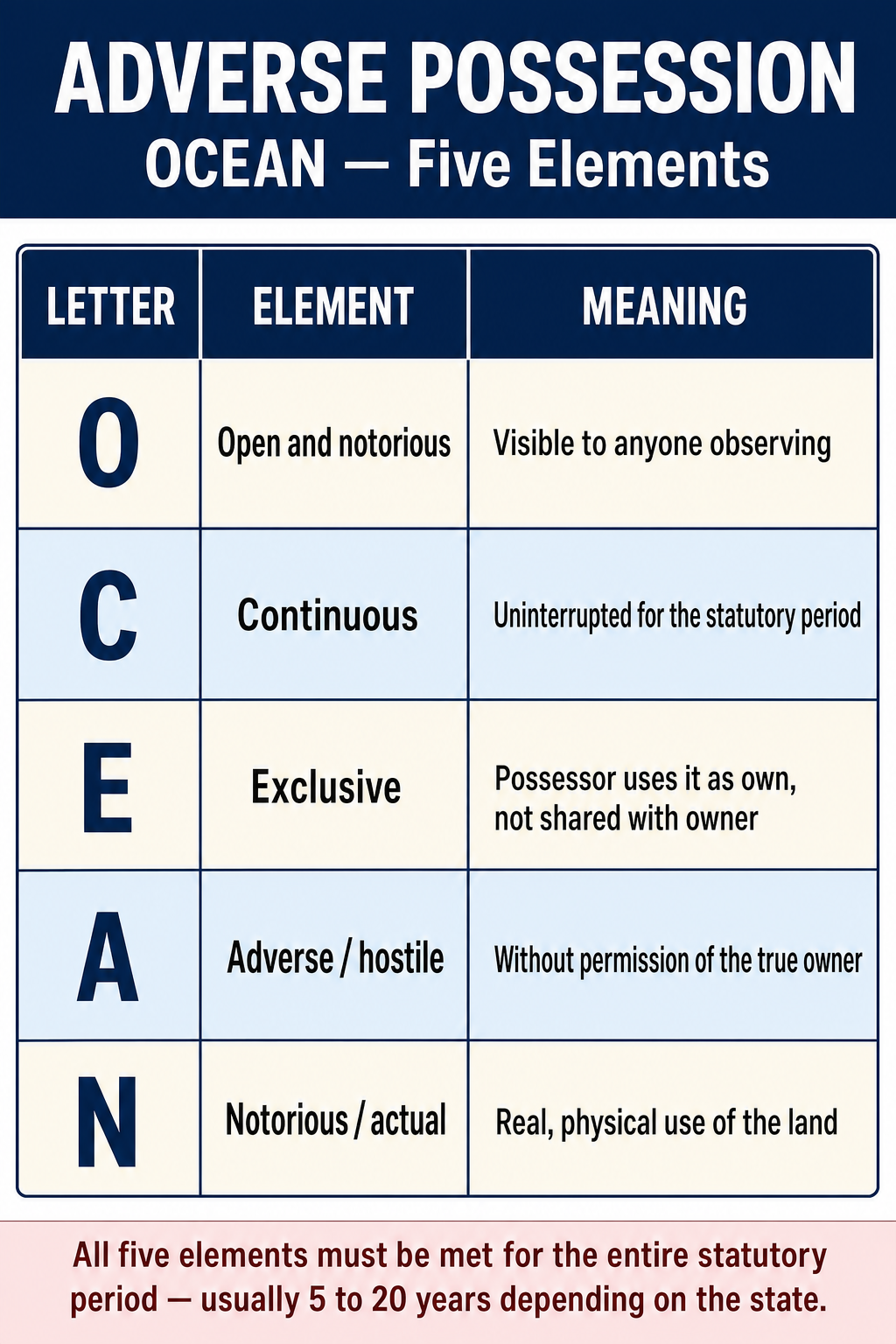
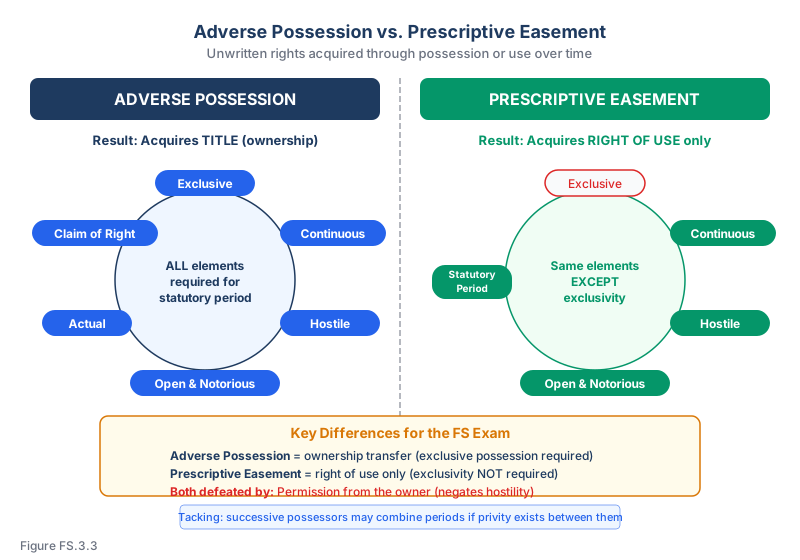
Adverse possession allows a person who has continuously occupied another's land for the required statutory period to acquire legal title to that land. The possessor must prove all of the following elements (Brown's Boundary Control and Legal Principles, 7th Ed., ch. on Title by Prescription; Restatement (Third) of Property: Servitudes §2.16; Powell on Real Property §91.01):
The elements (commonly remembered as OCEAN — Open, Continuous, Exclusive, Adverse [hostile], Notorious — with some jurisdictions adding "Actual" and "Under claim of right" as separate elements rather than folding them into OCEAN):
| Element | Meaning |
|---|---|
| Exclusive | The possessor's use is not shared with the true owner |
| Continuous | Possession is uninterrupted for the entire statutory period |
| Hostile (Adverse) | Possession is without the owner's permission (adverse to the owner's interest) |
| Open and notorious | Possession is visible and obvious enough that the true owner should be aware of it |
| Actual | The possessor physically occupies and uses the land |
| Under claim of right | The possessor treats the land as their own (some jurisdictions also require color of title or payment of taxes) |
Statutory periods vary by state (commonly 5 to 21 years). Some states require additional elements such as payment of property taxes or possession under "color of title" (a written document that appears to give title but is legally defective).
Effect: If all elements are met for the statutory period, the adverse possessor acquires title to the land. The true owner's title is extinguished.
Prescriptive Easements
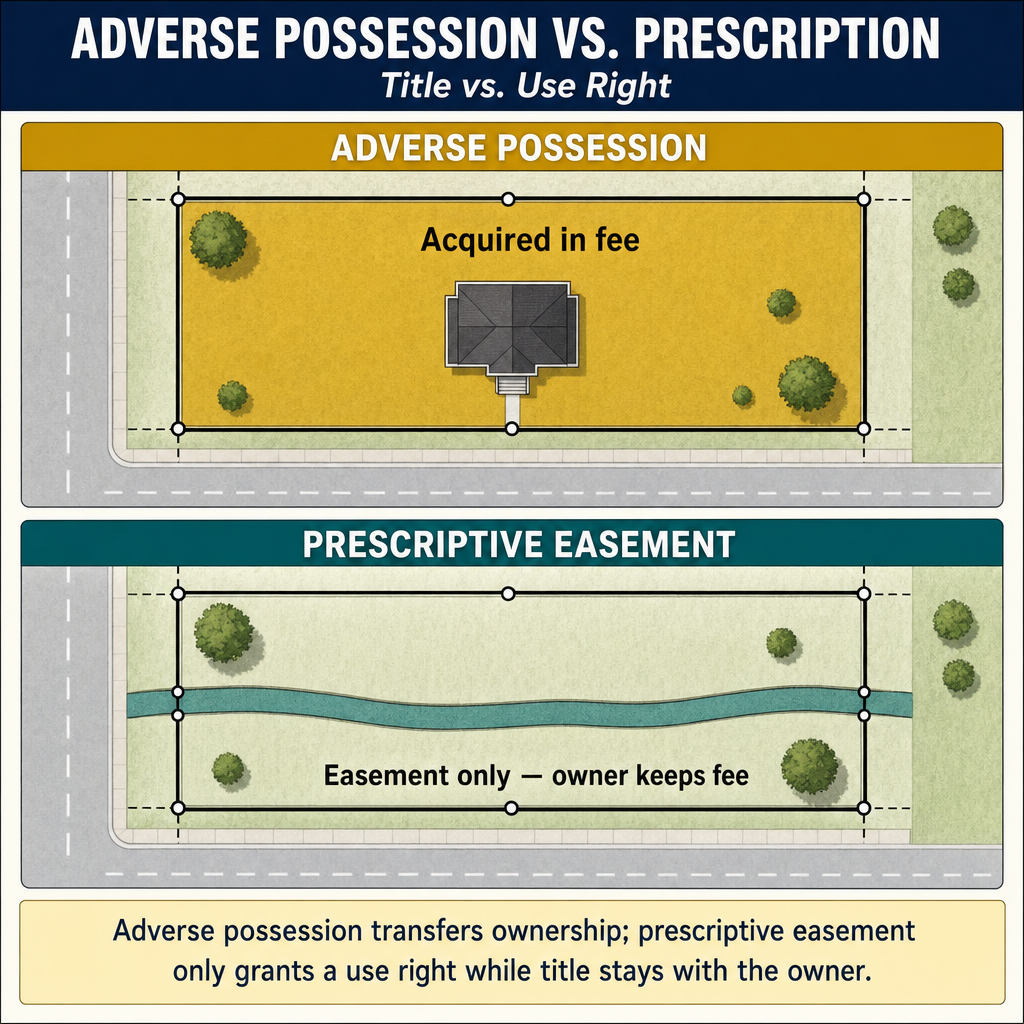
A prescriptive easement is the right to use another's land (not to own it) acquired through continuous, hostile use for the statutory period.
Elements (same as adverse possession except "exclusive"):
- Open and notorious use
- Continuous and uninterrupted use
- Hostile (without permission)
- For the required statutory period
Key difference from adverse possession:
- Adverse possession transfers title (ownership)
- A prescriptive easement grants only a right of use
- Prescriptive easements do not require exclusive use
Common examples: A well-worn path across a neighbor's property, a driveway that has been used for access to a landlocked parcel, drainage across adjacent property.
Tacking
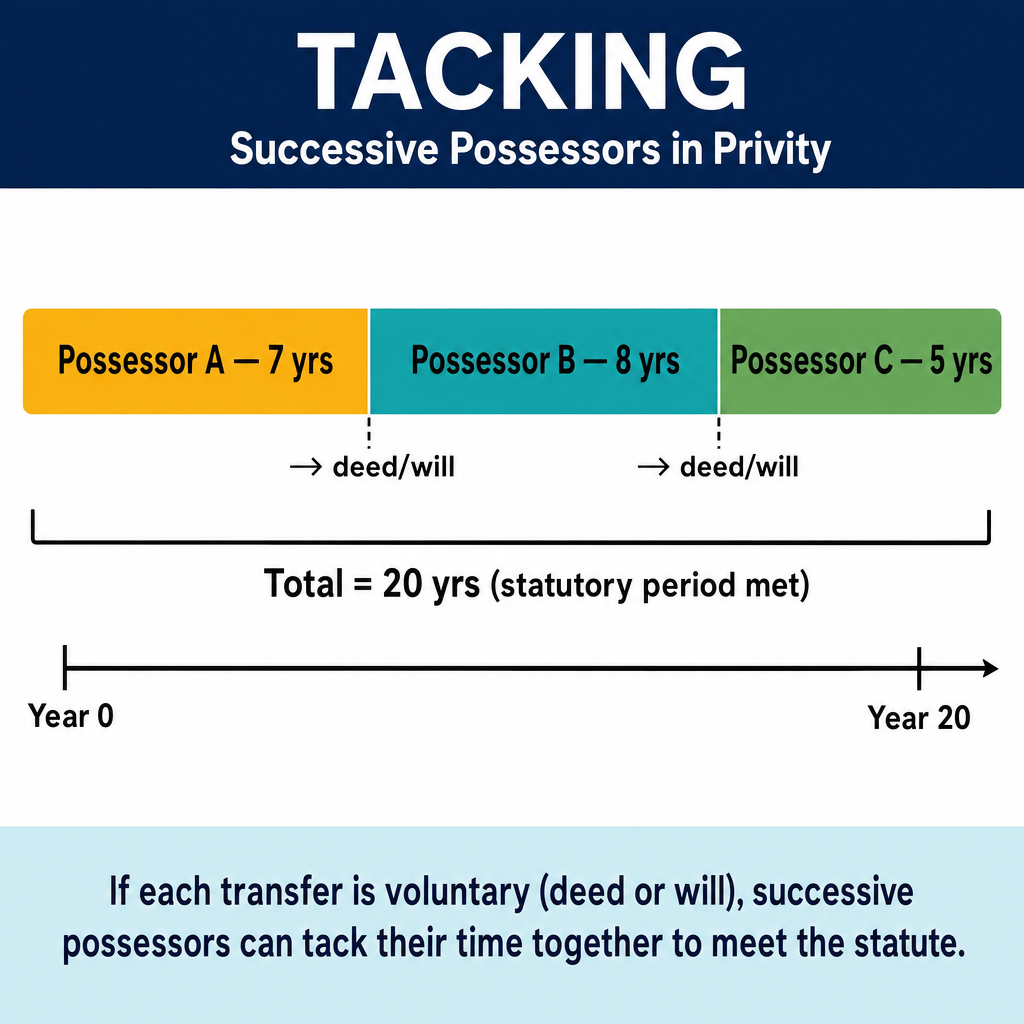
Tacking allows successive adverse possessors to add their periods of possession together to meet the statutory requirement, provided there is privity (a legal connection) between them.
Requirements for tacking:
- Each successive possessor must be in privity with the prior possessor (typically through a conveyance, inheritance, or similar transfer)
- The character of possession (hostile, open, continuous, etc.) must be maintained throughout
- There must be no gap in possession between successive claimants
Example: Possessor A occupies a strip of neighbor's land for 8 years, then sells their property (including the disputed strip) to Possessor B, who continues possession for 7 more years. In a state with a 15-year statutory period, A and B together have 15 years of continuous adverse possession, and tacking allows B to claim title.
Acquiescence
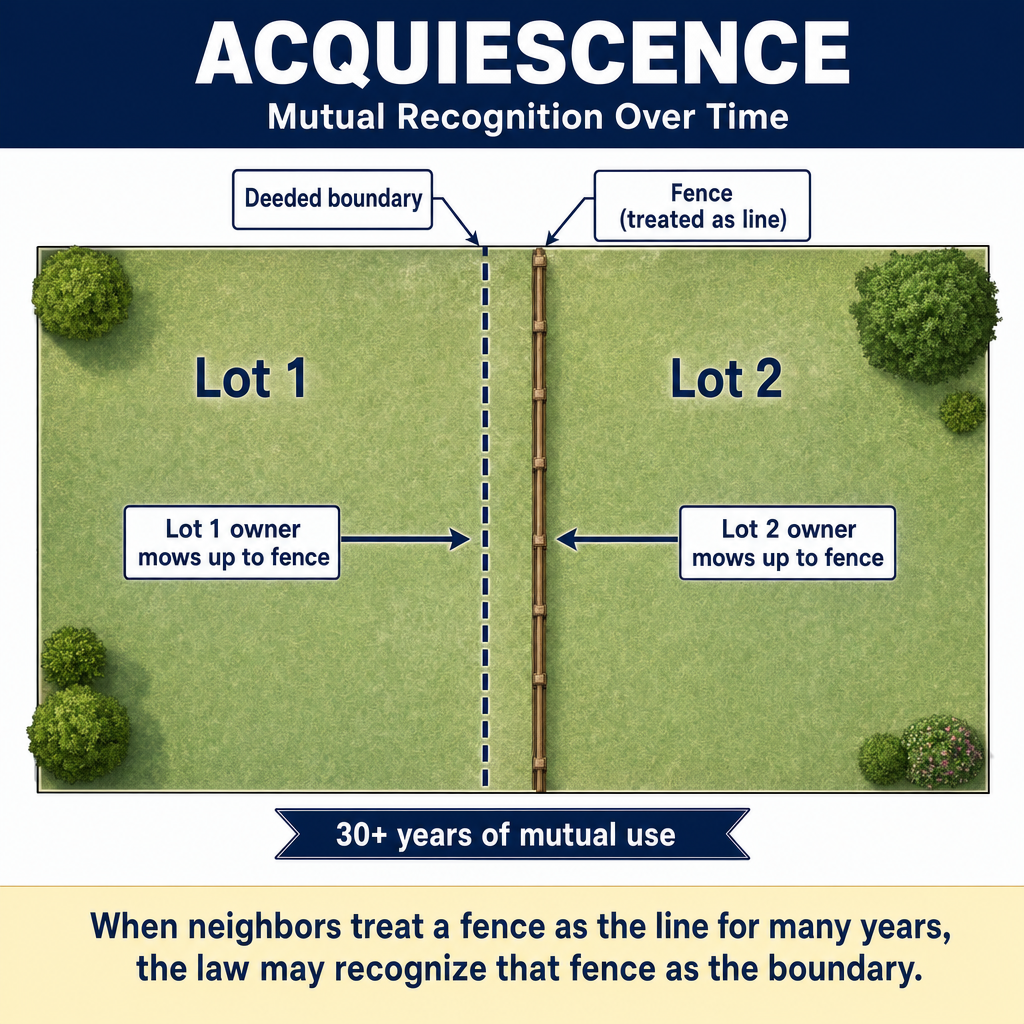
Acquiescence is the acceptance of a boundary line through long-standing mutual recognition by adjacent landowners. Unlike adverse possession, acquiescence does not require hostile intent -- it is based on the agreement or acceptance of the parties.
Elements typically required:
- A recognizable boundary line (usually a fence, wall, hedge, or other physical marker)
- Mutual recognition or acceptance of the line as the boundary by both adjacent landowners
- For the required statutory period (varies by jurisdiction)
- Some jurisdictions require that the acquiescence was based on uncertainty about the true boundary location
Effect: The acquiesced line becomes the legal boundary, even if it differs from the deed description.
Boundary by Agreement
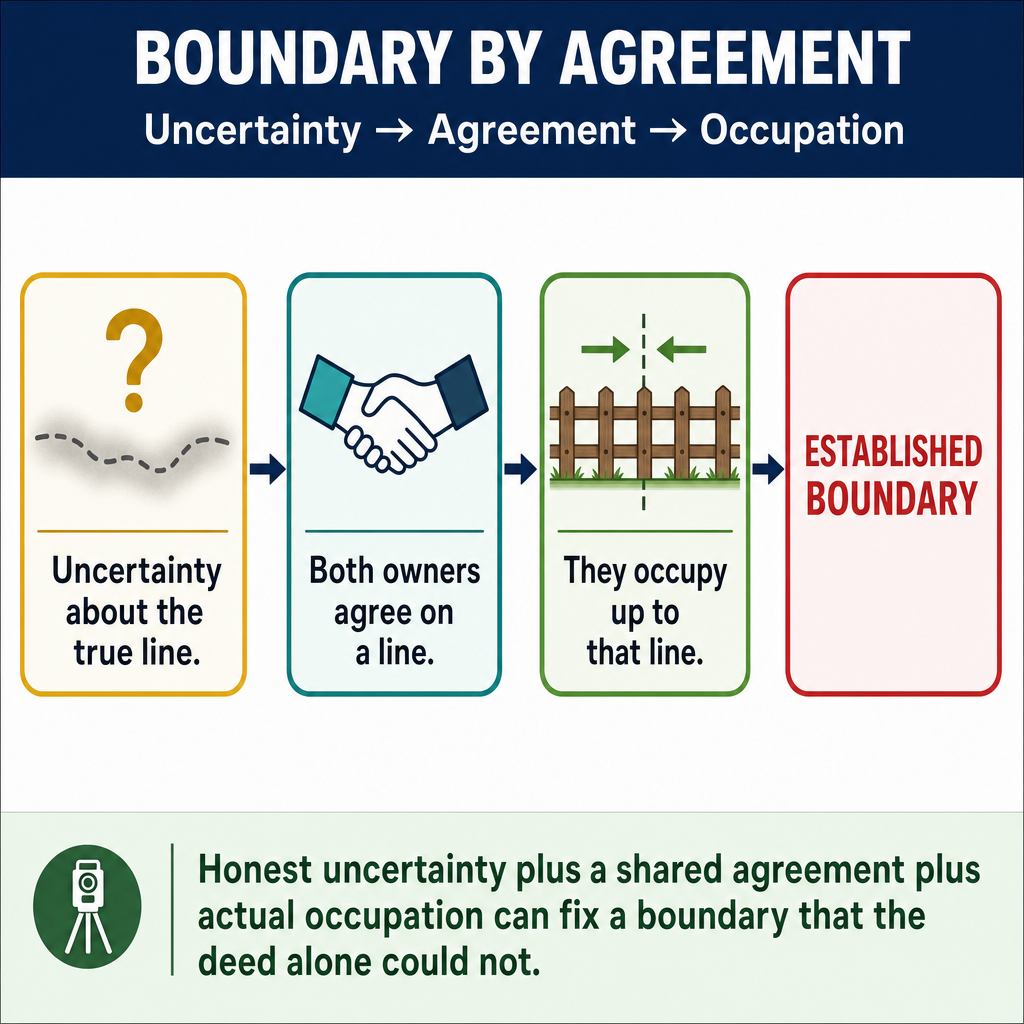
Adjacent landowners who are uncertain about the true boundary location may agree to establish a line as the boundary. If both parties then treat the agreed line as the boundary for a sufficient period, it becomes the legal boundary.
Requirements:
- An actual or implied agreement between the parties
- Uncertainty about the true boundary (not a knowing encroachment)
- Recognition and observance of the agreed line
- For a sufficient period of time
Practical Location
Practical location occurs when the original grantor and grantee, at or near the time of the conveyance, physically mark or agree upon the boundary location. If the grantor then acquiesces in the located line, it becomes the boundary, even if it differs from the deed description.
This doctrine is powerful because it represents the actual intent of the parties at the time of the conveyance.
Common wrong path — the surveyor opining on whether elements are met. Identifying evidence of potential adverse possession is the surveyor's job; deciding whether the elements are legally satisfied is not. The elements involve legal questions (what counts as "hostile," whether permission was implied, whether privity exists for tacking) that only a court can answer. Students sometimes assume that because they can observe fence lines, cultivation patterns, and worn paths, they can render an opinion on unwritten title. They cannot — that opinion is title work, outside the surveyor's scope and often a violation of professional licensing law. Exam questions test this by asking what the surveyor should do when observing potential adverse-possession evidence: the correct answer is always to document the physical evidence clearly on the plat, note the apparent duration and character of use, and recommend that the client consult an attorney for the legal determination.
Quick retrieval check — try before reading on.
▶You are retracing a 1955 deed. You find a fence that has been in place since at least 1965 (old aerial photos confirm), clearly visible from both properties, and the occupying neighbor has maintained only the strip inside the fence. The fence is 8 ft inside the record boundary. The statutory period in this jurisdiction is 15 years. How do you show this on the survey, and what opinion (if any) can you render?
On the plat, show both: the record boundary (derived from the deed) and the fence line (the apparent occupation boundary). Note the 8-ft difference with a clear label such as "fence in occupation since at least 1965; record line varies." Do NOT render any opinion on whether adverse possession has been established — that question involves elements (hostility, exclusivity, continuous possession, payment of taxes if required, etc.) that require legal evaluation by an attorney and ultimately a court. Your boundary-survey letter or report may note that the physical evidence suggests a potential unwritten-rights question and recommend the client consult legal counsel. A surveyor who writes "the adverse possessor has acquired title to the 8-ft strip" is engaging in title work and exposes themselves to liability; a surveyor who writes "the fence has been in place since at least 1965 based on aerial photography, and the maintained line of occupation differs from the record boundary by approximately 8 ft" is doing their proper job.
Exam Tips
- Adverse possession requires all elements to be met for the entire statutory period -- failure of any single element defeats the claim
- Hostile does not mean angry -- it means without permission; if the owner grants permission, the use is not hostile
- Adverse possession transfers title; prescriptive easement grants only a right of use
- Tacking allows combining periods of successive possessors if there is privity between them
- Acquiescence requires mutual recognition of a boundary line; it differs from adverse possession, which is one-sided
- The statutory period varies by state; the FS exam may state the applicable period in the problem
- Permissive use defeats both adverse possession and prescriptive easement claims -- permission negates hostility
- Surveyors must look for evidence of unwritten rights in the field (long-standing fences, worn paths, cultivation lines)
- The FS exam commonly tests whether a given scenario meets all the elements of adverse possession
Related Test Topics
- Controlling Elements and Evidence (Topic 3.2)
- Easements (Topic 3.4)
- Conveyances and Title Transfer (Topic 3.5)
- Cadastral and Boundary Surveys (Module 1, Topic 1.6)
Further Reading
Authoritative sources for deeper study
Brown's Boundary Control and Legal Principles (7th Ed.), chapters on evidence hierarchy and weighing of conflicting calls.
Clark, A Treatise on the Law of Surveying and Boundaries — Long-standing legal reference on boundary disputes and surveyor liability.
Evidence and Procedures for Boundary Location (Robillard, Wilson, & Brown, 6th Ed., 2011) — Practical treatise on collecting, weighing, and applying boundary evidence.
Last updated: 2026-04-17