FS Exam Preparation
Comprehensive preparation for the Fundamentals of Surveying (FS) exam. 7 modules covering all 7 exam domains with 60 in-depth topics.
Module 1: Surveying Processes & Methods
Module 2: Mapping Processes & Methods
Module 3: Boundary Law & Real Property
Module 4: Surveying Principles & Geodesy
Module 5: Survey Computations
Module 6: Business Concepts
Cost Estimation & Budgeting
Learning Objectives
After completing this topic, you should be able to:
- Identify the major cost categories in a survey project
- Distinguish between direct and indirect costs
- Describe common estimating methods
- Explain overhead, profit, and billing rates
- Recognize factors that affect project cost
Overview
Cost estimation is the process of predicting the total cost of a survey project before work begins. Accurate estimates are essential for profitable business operations, competitive bidding, and client trust. The FS exam tests your understanding of cost categories, estimating approaches, and the relationship between scope, schedule, and budget.
Key Concepts
Cost Categories
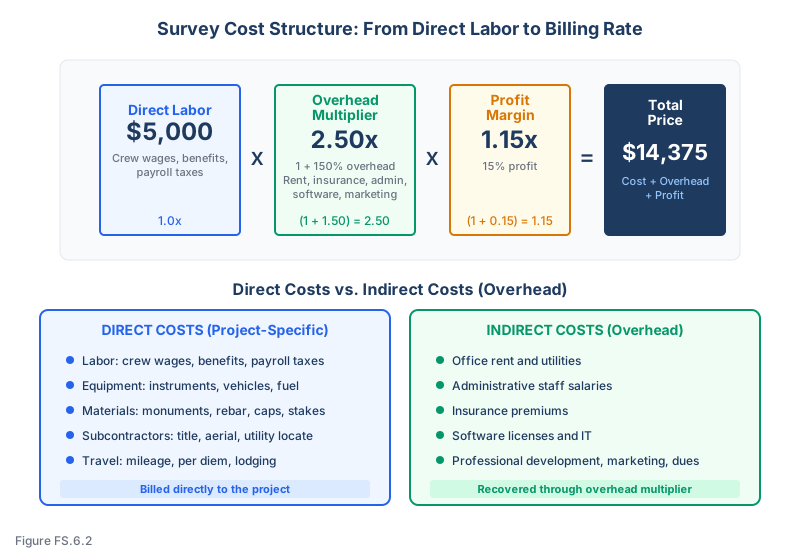
Survey project costs are classified as either direct or indirect:
Direct costs are attributable to a specific project:
- Labor: Crew wages, benefits, and payroll taxes for time spent on the project
- Equipment: Instrument costs (ownership or rental), vehicle costs, fuel
- Materials: Monuments, rebar, caps, flagging, stakes, paint
- Subcontractors: Title companies, utility locators, aerial survey providers
- Travel: Mileage, per diem, lodging for distant projects
Indirect costs (overhead) support the business but are not tied to a specific project:
- Office rent and utilities
- Administrative staff salaries
- Insurance premiums
- Professional development and continuing education
- Software licenses and IT infrastructure
- Marketing and business development
- Professional dues and license fees
Overhead and Multipliers
Firms recover indirect costs through an overhead multiplier applied to direct labor:
Total price = Direct labor * (1 + overhead rate) * (1 + profit markup)
Example: If direct labor for a project is $5,000, the overhead rate is 150%, and the desired profit markup is 15%:
Total price = 5,000 * 2.50 * 1.15 = $14,375
Overhead rates for surveying firms typically range from 100% to 200% of direct labor.
Billing Rates
A billing rate bundles direct labor cost, overhead, and profit into a single hourly rate:
Billing rate = (Direct hourly wage * overhead multiplier * profit multiplier)
Example: A survey technician earning $25/hour with a 2.5x overhead multiplier and 1.15 profit multiplier:
Billing rate = 71.88/hour
Estimating Methods
| Method | Description | Best For |
|---|---|---|
| Unit cost | Price per unit (per acre, per lot, per monument) | Repetitive work with known productivity |
| Bottom-up | Estimate each task separately and sum | Complex or unique projects |
| Analogous | Based on similar past projects | Quick estimates, proposals |
| Parametric | Statistical model based on project parameters | Large datasets of historical projects |
Budget Tracking
Once a project is underway, the budget must be monitored:
- Budget vs. actual: Compare estimated costs to actual costs at regular intervals
- Percent complete: Track how much of the scope has been completed relative to how much of the budget has been spent
- Earned value: Compare the value of work completed to the cost of work completed and the planned schedule
- Contingency: Reserve funds (typically 5-15%) for unforeseen conditions
Factors Affecting Cost
- Project complexity: Boundary disputes, complex terrain, dense vegetation increase cost
- Accuracy requirements: Higher accuracy requires more precise equipment and more field time
- Location: Remote sites increase travel costs; urban sites may require traffic control
- Season: Winter work may require additional mobilization; short days reduce productivity
- Regulatory requirements: Agency review processes add time and cost
- Scope changes: Unplanned additions increase cost; must be managed through change orders
FS Estimating Workflow
When the exam gives an estimating scenario, solve it in this order:
- List direct labor by role. Crew chief, instrument operator, CAD technician, project manager, and reviewer may have different rates.
- Add direct non-labor costs. Materials, travel, records, utility locates, traffic control, and subcontractors belong here.
- Apply overhead correctly. Overhead usually applies to labor, but the problem may specify whether it applies to all direct costs.
- Apply profit or fee. Profit is not contingency; it is the return required to keep the business viable.
- Add contingency only if the problem asks for it. Contingency covers foreseeable uncertainty inside the scope, not extra profit.
- Check whether the question asks for cost, price, or billing rate. Those are different answers.
Most wrong answers come from applying a percentage to the wrong base. If a problem says "overhead is 150% of direct labor," do not apply it to mileage, monuments, or a title-company invoice unless the problem tells you to.
Common wrong path — billing direct hourly wage instead of billing rate. A crew chief earns 35/hour, you just gave away the store — you have not recovered payroll taxes, benefits, equipment, office overhead, insurance, vehicles, software, or profit. The correct number to quote is the billing rate: direct wage × overhead multiplier × profit multiplier. With a 2.5× overhead multiplier and 1.15 profit multiplier, 100.63/hour. Students (and new firm owners) confuse cost with price because the direct wage is the number on the payroll check and therefore feels tangible; overhead and profit feel abstract. The exam tests this by giving you a direct labor number and asking you to compute the total project cost or billing rate — if you forget to apply the overhead multiplier, you under-cost the project by 60–70%. Remember: overhead multipliers are always >1.0 because rent, insurance, admin, and retirement contributions happen whether or not the project is billable.
Quick retrieval check — try before reading on.
▶Your firm has an overhead rate of 165% and a target profit markup of 12%. A 3-person crew (chief $40/hr, instrument operator $28/hr, rodperson $20/hr) will work 32 hours on a boundary survey. Direct materials and subconsultant costs are $650. What total price do you quote the client?
Step 1 — direct labor: (28 + 88/hr × 32 hr = $2,816.
Step 2 — labor with overhead: 2,816 × 2.65 = $7,462.40.
Step 3 — add direct non-labor costs: 650 = $8,112.40. (Direct materials and subs generally get a small markup; here we include them in the cost basis on which profit is computed — i.e., the 12% profit applies to the fully loaded cost of labor + non-labor.)
Step 4 — apply profit markup: 9,085.89, round to **50/9,100).
Common mistakes: (1) forgetting to multiply by the overhead multiplier (answers around 8,358); (3) adding overhead rate and profit markup additively (×(1 + 1.65 + 0.12) = ×2.77) instead of multiplicatively, which slightly undercharges. The multiplicative sequence is important because profit is earned on the fully loaded cost, not just on direct labor. Check your answer against the billing-rate form: chief billing rate = 118.72/hr; the full crew billing rate is 261.18/hr; 32 hr × 8,358, plus 728 → $9,086. Same result.
Exam Tips
- Direct costs are project-specific; indirect costs (overhead) support the overall business
- The overhead multiplier is always greater than 1.0 -- it covers rent, insurance, admin, and other business costs
- Know the difference between cost and price: cost is what it takes to do the work; price includes profit
- Unit cost estimating is fast but only reliable when you have good historical data
- Bottom-up estimating is more accurate but takes more time to prepare
- The FS exam may present a scenario and ask you to identify which costs are direct vs. indirect
- Contingency is NOT profit -- it is a reserve for unforeseen conditions within the project scope
Related Test Topics
- Project Planning and Resources (Topic 6.1)
- Contracts and Scope of Work (Topic 6.5)
- Supervision and Personnel (Topic 6.6)
Further Reading
Authoritative sources for deeper study
Model Rules of Professional Conduct (Aug 2025) — Model ethics, competence, and licensure rules adopted by most state boards.
Kavanagh, Surveying with Construction Applications (7th Ed.) — Combined surveying and construction-layout reference.
Last updated: 2026-04-17