FS Exam Preparation
Comprehensive preparation for the Fundamentals of Surveying (FS) exam. 7 modules covering all 7 exam domains with 60 in-depth topics.
Module 1: Surveying Processes & Methods
Module 2: Mapping Processes & Methods
Module 3: Boundary Law & Real Property
Module 4: Surveying Principles & Geodesy
Module 5: Survey Computations
Module 6: Business Concepts
Sources of Law & Legal Research
Learning Objectives
After completing this topic, you should be able to:
- Identify the primary sources of property law
- Explain the relationship between common law, statutory law, and case law
- Understand how regulatory agencies affect surveying practice
- Describe the role of professional licensing in surveying
- Distinguish between federal, state, and local legal authority
- Explain the doctrine of stare decisis and its importance
Overview
The surveyor operates within a framework of laws that govern property rights, professional practice, and public safety. Understanding the sources of law helps the surveyor recognize which legal principles apply to a given situation and where to find authoritative guidance. The FS exam tests your awareness of the basic legal framework, not detailed knowledge of specific statutes (which varies by state and is tested more thoroughly on the PS exam).
Key Concepts
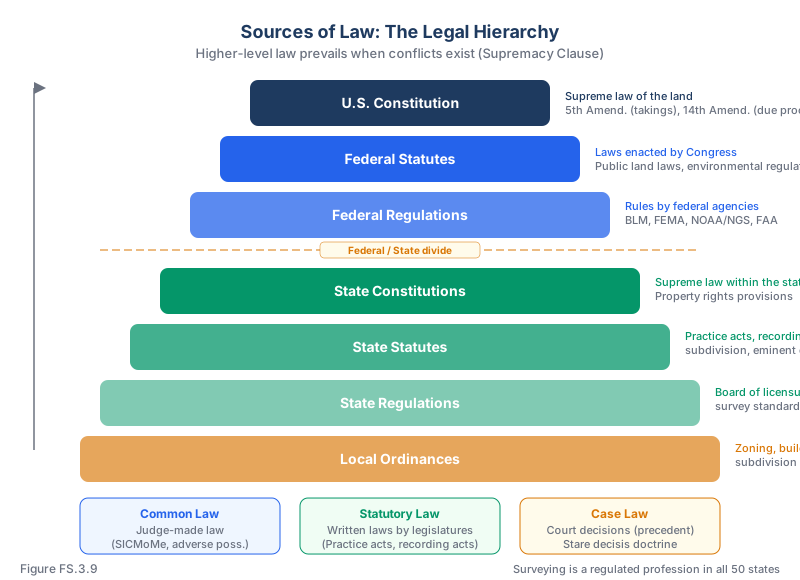
The Legal Hierarchy
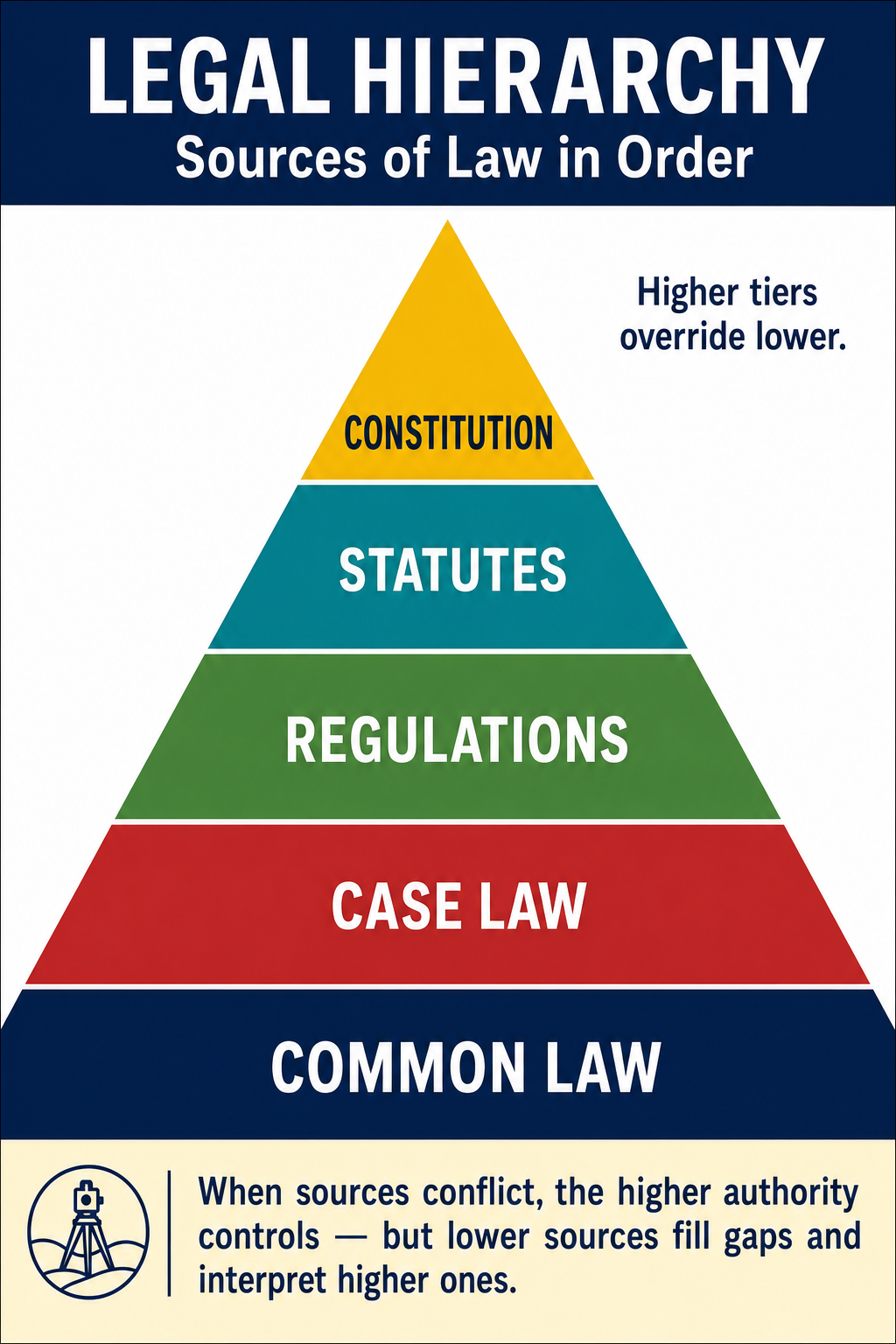
Laws in the United States exist in a hierarchy of authority:
| Level | Source | Examples Relevant to Surveying |
|---|---|---|
| U.S. Constitution | Supreme law of the land | 5th Amendment (takings), 14th Amendment (due process) |
| Federal statutes | Laws enacted by Congress | Public land laws, environmental regulations |
| Federal regulations | Rules by federal agencies | BLM regulations, EPA wetlands rules |
| State constitutions | Supreme law within the state | Property rights provisions |
| State statutes | Laws enacted by state legislatures | Surveying practice acts, recording statutes, subdivision laws |
| State regulations | Rules by state agencies | Board of licensure rules, survey standards |
| Local ordinances | Laws enacted by counties and cities | Zoning, building codes, subdivision regulations |
When conflicts exist, higher-level law prevails (federal over state, state over local).
Common Law
Common law is judge-made law developed through court decisions over centuries. Much of property law -- including boundary law -- is rooted in common law.
Key common law doctrines in surveying:
- Hierarchy of controlling elements (SICMoMe)
- Adverse possession and prescriptive rights
- Riparian and littoral rights
- Accretion, erosion, and avulsion
- Rules of deed construction
Characteristics of common law:
- Developed case by case through judicial decisions
- Based on the doctrine of stare decisis (let the decision stand) -- courts follow prior rulings on similar facts
- Evolves over time as new cases arise
- Varies by jurisdiction (different states may have different common law rules)
Statutory Law
Statutory law consists of written laws enacted by legislative bodies (Congress, state legislatures, city councils).
Statutes affecting surveying:
- Professional Land Surveyors Act (varies by state) -- defines who may practice surveying, qualifications, and standards of practice
- Recording statutes -- govern how property documents are recorded and the effect of recording
- Subdivision Map Acts -- regulate the creation of subdivisions
- Eminent domain statutes -- govern government acquisition of private property
- Environmental laws -- wetlands, endangered species, water quality
Case Law
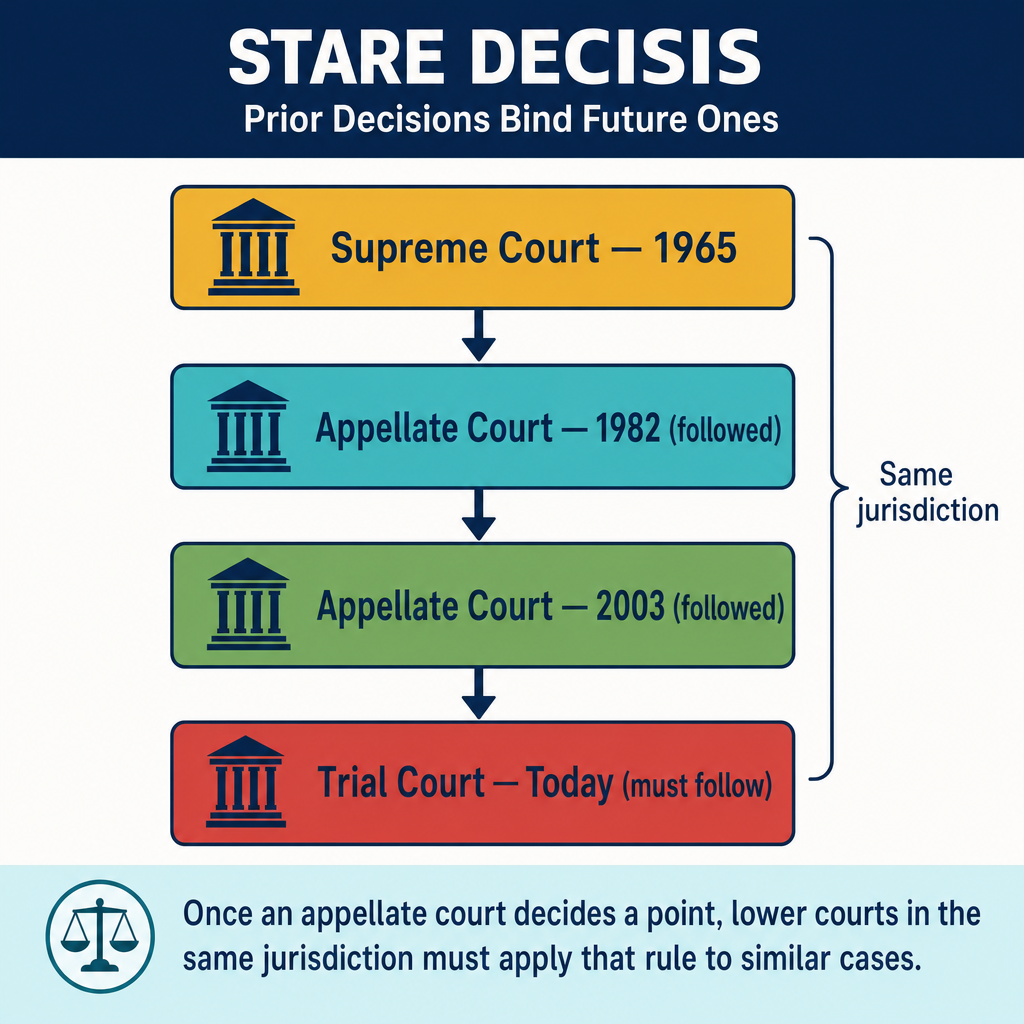
Case law (also called judicial precedent) consists of published court decisions that interpret statutes, apply common law principles, and resolve disputes.
The doctrine of stare decisis:
- Courts are generally bound by prior decisions of higher courts in the same jurisdiction
- Creates predictability and consistency in the law
- Lower courts must follow the rulings of higher courts
- A court may distinguish a prior case (explain why it does not apply) or, rarely, overturn it
How case law affects surveying:
- Court decisions define how the hierarchy of controlling elements applies in practice
- Boundary disputes resolved by courts create precedent for future similar situations
- Appellate court decisions interpreting statutes become binding legal authority
Regulatory Authority
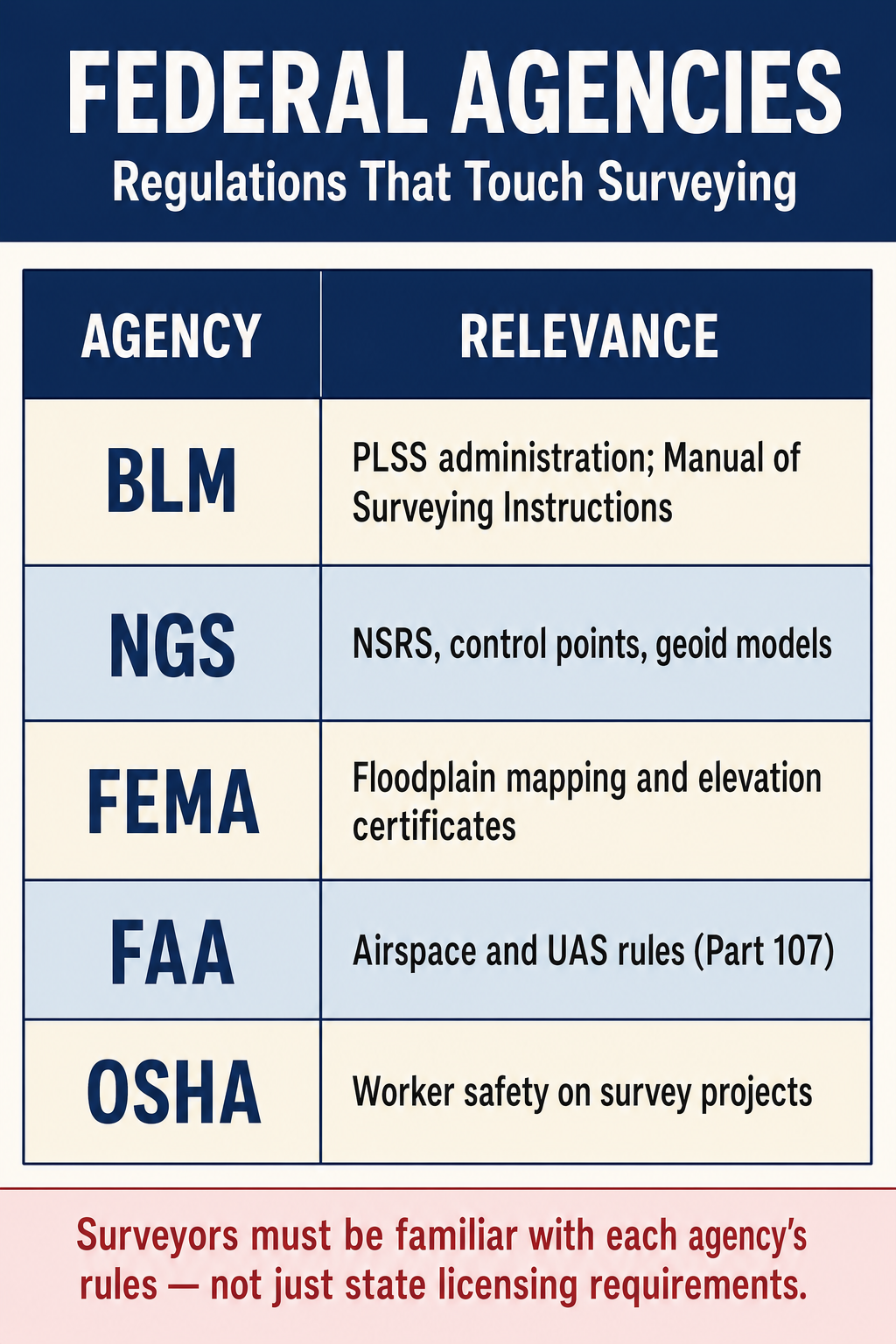
Government agencies create regulations (administrative rules) to implement statutes:
- Federal agencies: BLM (public lands), FEMA (flood mapping), NOAA/NGS (geodetic reference), FAA (UAS operations)
- State agencies: Board of Professional Surveyors/Engineers (licensing, standards of practice, discipline)
- Local agencies: Planning departments (subdivision approval, zoning), public works (construction standards)
Professional Licensing
Surveying is a regulated profession in all 50 states:
- A license (or registration) is required to practice surveying
- Licensing is typically administered by a state board (Board of Professional Surveyors, Board of Registration, etc.)
- Requirements typically include: education, experience, passing the FS and PS exams, and good moral character
- The board has the power to discipline licensees for violations of practice standards, ethics, or competency requirements
- Practice by an unlicensed person is generally a misdemeanor
Common wrong path — assuming federal law preempts state law on boundary matters. The Supremacy Clause means federal law prevails in areas where federal authority applies — but private real-property law, boundary determinations, recording requirements, surveying standards, and most boundary-dispute resolution are state matters, not federal. Students sometimes answer "federal law controls" whenever the question mentions federal agencies or interstate issues, even when the actual legal question is a state boundary dispute. Exam questions bait this by introducing federal context (a parcel adjoining BLM land, a river crossing state lines) while the legal question is really about the state-law rules for boundary location. Match the law to the question: federal law applies to federal lands, navigable waters of the U.S., and specific federal statutes; state law applies to almost everything else about private property boundaries.
Quick retrieval check — try before reading on.
▶A parcel boundary dispute involves a property adjoining federal BLM land. The neighbor argues that federal law determines the boundary location because BLM is a federal agency. Is the neighbor correct?
Partially correct but mostly wrong. The boundary between the private parcel and the federal BLM parcel is governed by federal law (BLM Manual, federal statutes, the original patent). But any boundary dispute within the private parcel, or between the private parcel and its non-federal neighbors, is governed by state boundary law. Even the boundary with BLM land may turn on federal surveying principles (PLSS, BLM Manual procedures) rather than state common law. The key distinction: the parties to the dispute determine which law applies, not merely the presence of a federal agency nearby. On the exam, read carefully to identify which parcels are in dispute; if both are private, state law controls regardless of who owns adjoining land.
Federal vs. State Authority Over Land
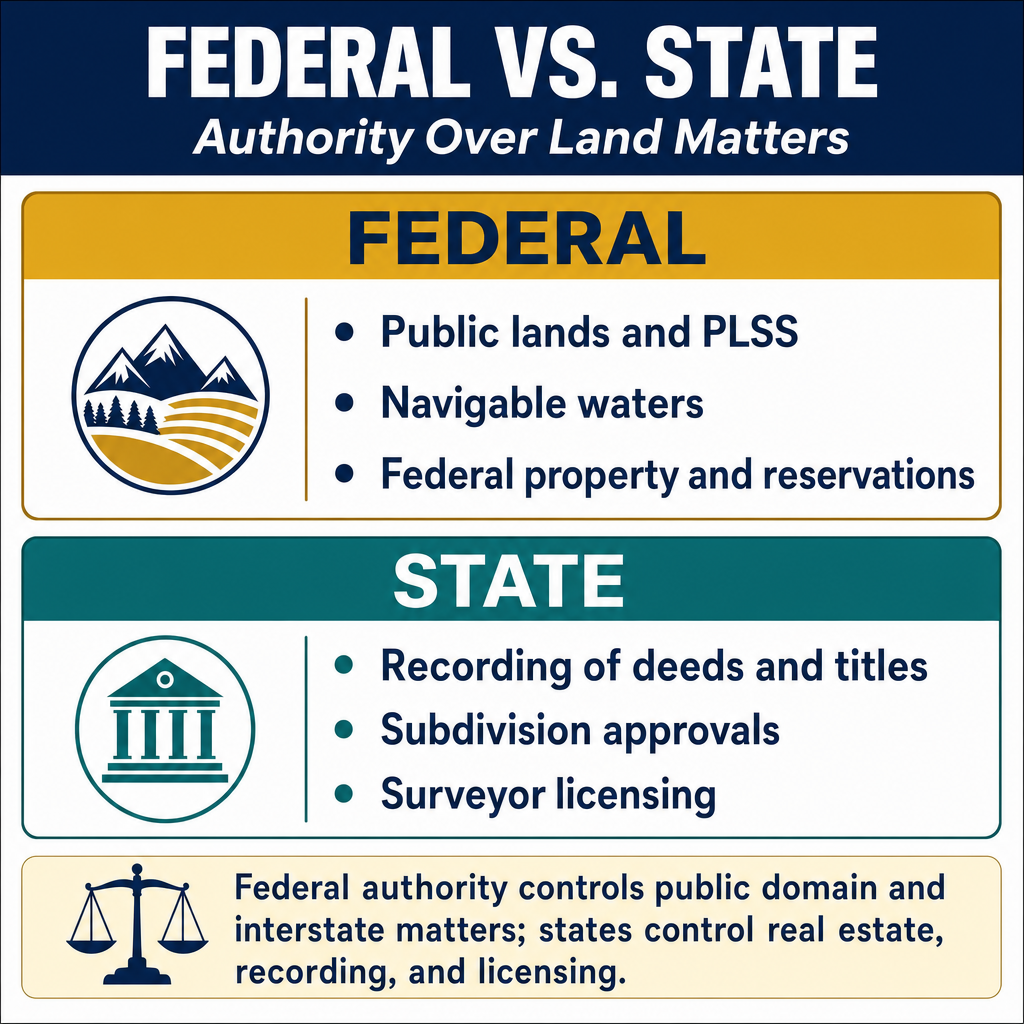
Federal authority:
- Manages public domain lands (through BLM)
- The original PLSS surveys are federal surveys
- Federal law governs certain aspects of property (navigable waters, federal lands, environmental regulations)
State authority:
- Regulates private property rights and transfers
- Enacts recording statutes, subdivision laws, and licensing requirements
- State courts resolve most boundary disputes
- State law defines the standards of practice for surveyors
Exam Tips
- Common law is judge-made law; statutory law is enacted by legislatures; case law is published court decisions
- Stare decisis means courts follow prior decisions -- this creates predictability in boundary law
- The hierarchy of controlling elements (SICMoMe) is a common law doctrine developed through centuries of court decisions
- Statutes enacted by state legislatures define who may practice surveying and establish recording requirements
- Professional surveying requires a license in all 50 states; the state board administers licensing and discipline
- Federal law governs public lands; state law governs private property rights and surveying practice
- When federal and state law conflict, federal law prevails (Supremacy Clause)
- The FS exam may test your understanding of the legal hierarchy, the difference between common and statutory law, or the role of licensing boards
- Regulatory agencies (BLM, state boards) create regulations that have the force of law within their authority
Related Test Topics
- Public Records and Descriptions (Topic 3.1)
- PLSS Fundamentals (Topic 3.7)
- Conveyances and Title Transfer (Topic 3.5)
- Encumbrances and Property Interests (Topic 3.10)
Further Reading
Authoritative sources for deeper study
Brown's Boundary Control and Legal Principles (7th Ed., Robillard & Wilson) — Standard textbook on boundary law, evidence hierarchy, and retracement.
Clark, A Treatise on the Law of Surveying and Boundaries — Long-standing legal reference on boundary disputes and surveyor liability.
Model Rules of Professional Conduct (Aug 2025) — Model ethics, competence, and licensure rules adopted by most state boards.
Last updated: 2026-04-17