FS Exam Preparation
Comprehensive preparation for the Fundamentals of Surveying (FS) exam. 7 modules covering all 7 exam domains with 60 in-depth topics.
Module 1: Surveying Processes & Methods
Module 2: Mapping Processes & Methods
Module 3: Boundary Law & Real Property
Module 4: Surveying Principles & Geodesy
Module 5: Survey Computations
Module 6: Business Concepts
Traverse Computations & Closure
Learning Objectives
After completing this topic, you should be able to:
- Compute latitudes and departures from bearings and distances
- Calculate angular misclosure and apply corrections
- Determine linear misclosure and precision ratio
- Distinguish between open and closed traverses
- Evaluate whether a traverse meets a given accuracy standard
Overview
A traverse is a series of connected lines whose lengths and directions have been measured. Traverse computations convert these field measurements into coordinates and evaluate the quality of the survey through closure analysis. This is one of the most heavily tested topics on the FS exam because it integrates angular measurement, distance measurement, and error analysis into a single problem type.
Key Concepts
Types of Traverses
- Closed traverse (loop): Starts and ends at the same point, providing a check on both angular and linear measurements
- Closed traverse (connecting): Starts and ends at different known points, also providing full closure checks
- Open traverse: Starts at a known point but does not close on a known point; no closure check is possible
Latitudes and Departures
For each traverse leg with distance D and azimuth Az:
- Latitude (north-south component): Lat = D * cos(Az)
- Departure (east-west component): Dep = D * sin(Az)
Positive latitude = north; negative latitude = south. Positive departure = east; negative departure = west.
Angular Misclosure
For a closed polygon traverse with n interior angles:
Theoretical sum of interior angles = (n - 2) * 180 degrees
Angular misclosure = Measured sum - Theoretical sum
The allowable angular misclosure depends on the accuracy standard. A common standard is:
Allowable = C * sqrt(n)
Where C is a constant (e.g., 10" for second-order, 30" for third-order) and n is the number of angles.
Angular Correction
If the angular misclosure is within tolerance, distribute the correction equally among all angles:
Correction per angle = -misclosure / n
Linear Misclosure
After computing latitudes and departures for all legs:
- Closure in latitude: Sum of all latitudes (should be zero for a loop traverse)
- Closure in departure: Sum of all departures (should be zero for a loop traverse)
Linear misclosure:
Linear error = sqrt((Sum Lat)^2 + (Sum Dep)^2)
Precision Ratio
Precision ratio = Linear error / Total traverse distance
Express as a fraction: 1 : (Total distance / Linear error)
Example: If linear error = 0.05 ft and total distance = 2,500 ft:
Precision ratio = 1 : 50,000
FS Closure Workflow
Use this sequence whenever a traverse problem asks about closure or precision:
- Convert every bearing to an azimuth. Do not compute latitudes and departures from mixed bearing notation.
- Compute latitude and departure for each leg. Latitude = D cos(Az); departure = D sin(Az).
- Sum the latitudes and departures. These sums are the north-south and east-west components of the misclosure.
- Compute linear misclosure. Use the Pythagorean relationship on the two closure components.
- Compute total traverse length. Add the measured leg distances, not the straight-line misclosure.
- Report precision as 1:N. N = total traverse length / linear misclosure.
- Compare to the required standard. A larger N is better. A traverse closing 1:25,000 meets a 1:10,000 requirement; 1:5,000 does not.
The order matters. If you compare linear misclosure before checking angular closure, you may misdiagnose an angle blunder as a distance problem.
Common Accuracy Standards
| Order | Precision Ratio | Angular Closure |
|---|---|---|
| First Order | 1:100,000 | 1.7" * sqrt(n) |
| Second Order, Class I | 1:50,000 | 3" * sqrt(n) |
| Second Order, Class II | 1:20,000 | 5" * sqrt(n) |
| Third Order, Class I | 1:10,000 | 10" * sqrt(n) |
| Third Order, Class II | 1:5,000 | 12" * sqrt(n) |
Worked Example
A 4-sided loop traverse has:
| Leg | Bearing | Distance (ft) |
|---|---|---|
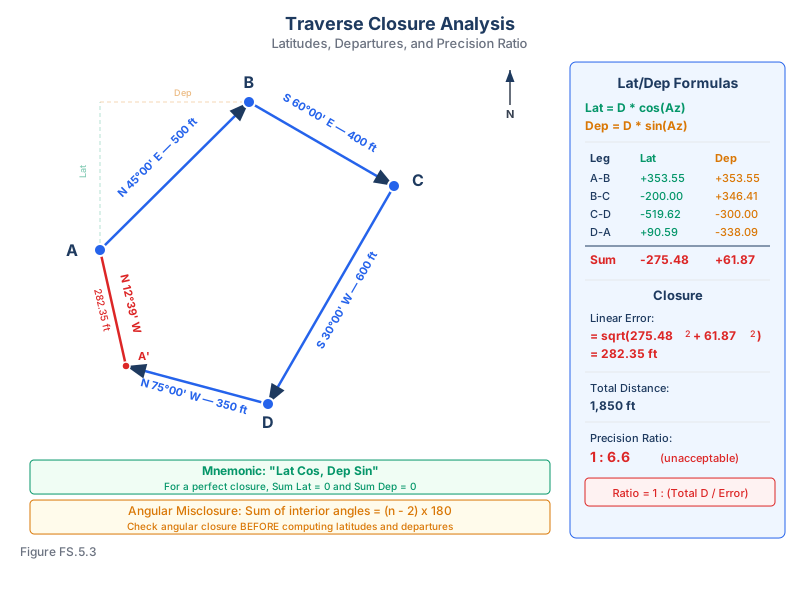
| A-B | N 45 00 00 E | 500.00 |
| B-C | S 60 00 00 E | 400.00 |
| C-D | S 30 00 00 W | 600.00 |
| D-A | N 75 00 00 W | 350.00 |
Reading the geometry. The loop is walked clockwise (keeping the interior of the polygon on your right). A clockwise loop rotates its bearing roughly one quadrant per leg — here the bearings step through NE → SE → SW → NW, which is what lets the traverse return near its start point. This is the same rotation pattern as the hands of a clock: 12 → 3 → 6 → 9 → 12. Figure FS.5.3 above shows the layout; A sits at the west, B to the NE of A, C to the SE of B, and D to the SW of C.
Step 1: Compute latitudes and departures for each leg.
| Leg | Latitude | Departure |
|---|---|---|
| A-B | +353.553 | +353.553 |
| B-C | -200.000 | +346.410 |
| C-D | -519.615 | -300.000 |
| D-A | +90.587 | -338.074 |
| Sum | -275.475 | +61.889 |
(Note: This example intentionally shows a large misclosure for illustration. Real traverses would have much smaller closure errors.)
Step 2: Linear misclosure = sqrt(275.475² + 61.889²) = 282.34 ft
Step 3: Total distance = 500 + 400 + 600 + 350 = 1,850 ft
Step 4: Precision ratio = 1 : (1850 / 282.34) = 1 : 6.6 (unacceptable -- would need remeasurement)
Common wrong path — computing lats and deps before checking angular closure. Students frequently jump straight to the bearing/distance computations without first verifying angular closure. If the angles do not close to within tolerance, the computed bearings are already wrong and every latitude/departure is built on a bad foundation. The correct order is: (1) measure all angles, (2) compute angular misclosure, (3) distribute correction across angles, (4) compute adjusted bearings, (5) then compute lats/deps from the adjusted bearings. Skipping step 1–3 and running with raw measurements produces a linear misclosure that looks like distance error but actually carries the angular blunder.
Quick retrieval check — try before reading on.
▶A 6-sided loop traverse is measured for a third-order Class I project (~1:10,000). The interior angles sum to 720° 00' 35". Is this traverse's angular closure acceptable? Before computing lats and deps, what should you do?
Theoretical sum = . Misclosure = +35". Allowable third-order Class I = . Measured (35") exceeds the allowable (24.5"), so do not proceed with compass-rule distribution. Re-observe the angles, look for a localized blunder (a misread vernier, a wrong backsight), or formally downgrade the project to third-order Class II ( — still not enough) or lower. Only once angular closure meets the standard should you compute lats and deps.
Exam Tips
- The FS exam frequently asks you to compute precision ratio -- practice this until it is automatic
- Remember: latitude uses cosine, departure uses sine (mnemonic: "Lat Cos, Dep Sin")
- Angular misclosure must be checked BEFORE computing latitudes and departures
- For a connecting traverse, the closure is the difference between computed and known ending coordinates
- Watch the units -- some problems give distances in meters and ask for answers in feet, or vice versa (1 ft = 0.3048 m exactly)
- The precision ratio is ALWAYS expressed as 1 : something (not as a decimal)
Related Test Topics
- Coordinate Geometry (Topic 5.1)
- Traverse Adjustments (Topic 5.3)
- Least Squares Adjustments (Topic 5.5)
Further Reading
Authoritative sources for deeper study
Wolf & Ghilani, Elementary Surveying — Chapters on traverse computation, balancing, and adjustment.
Ghilani & Wolf, Adjustment Computations (5th Ed., 2010) — Authoritative treatment of least-squares adjustment for surveying networks.
Kavanagh, Surveying with Construction Applications (7th Ed.) — Combined surveying and construction-layout reference.
Last updated: 2026-04-17