FS Exam Preparation
Comprehensive preparation for the Fundamentals of Surveying (FS) exam. 7 modules covering all 7 exam domains with 60 in-depth topics.
Module 1: Surveying Processes & Methods
Module 2: Mapping Processes & Methods
Module 3: Boundary Law & Real Property
Module 4: Surveying Principles & Geodesy
Module 5: Survey Computations
Module 6: Business Concepts
Safety Procedures & Equipment
Learning Objectives
After completing this topic, you should be able to:
- Identify common field hazards in surveying
- Describe OSHA requirements relevant to surveying
- List required personal protective equipment (PPE) for survey work
- Explain trenching and excavation safety requirements
- Describe traffic control procedures for highway surveying
- Recognize electrical hazard awareness requirements
Overview
Safety is the surveyor's first responsibility on every project. Survey crews work in diverse and often hazardous environments -- along highways, near heavy equipment, in trenches, around utilities, on construction sites, and in remote terrain. The FS exam tests your knowledge of fundamental safety requirements, particularly OSHA regulations that apply directly to surveying operations.
Key Concepts
Common Field Hazards
Survey crews face hazards in multiple categories:
Traffic hazards:
- Working along roadways and highways
- Exposure to moving vehicles
- Limited visibility in curves and hills
Construction site hazards:
- Heavy equipment and machinery
- Overhead loads and cranes
- Uneven ground and open excavations
Environmental hazards:
- Extreme heat and cold
- Lightning and severe weather
- Wildlife (snakes, insects, bears)
- Poisonous plants (poison ivy/oak)
- Sun exposure
Utility hazards:
- Underground utilities (gas, electric, water, sewer)
- Overhead power lines
- Unmarked utility lines
Terrain hazards:
- Steep slopes and unstable ground
- Water crossings and deep water
- Dense vegetation and limited visibility
OSHA Requirements
The Occupational Safety and Health Administration (OSHA) sets enforceable workplace safety standards:
General duty clause (Section 5(a)(1)): Employers must provide a workplace free from recognized hazards likely to cause death or serious harm.
Key OSHA standards for surveying:
| Standard | Requirement |
|---|---|
| 29 CFR 1926.651-652 (Subpart P) | Excavation and trenching safety |
| 29 CFR 1926.200-203 (Subpart G) | Signs, signals, barricades |
| 29 CFR 1910.269 (Subpart R) | Electric power generation/distribution |
| 29 CFR 1926.95-100 (Subpart E) | Personal protective equipment |
| 29 CFR 1926.502 (Subpart M) | Fall protection |
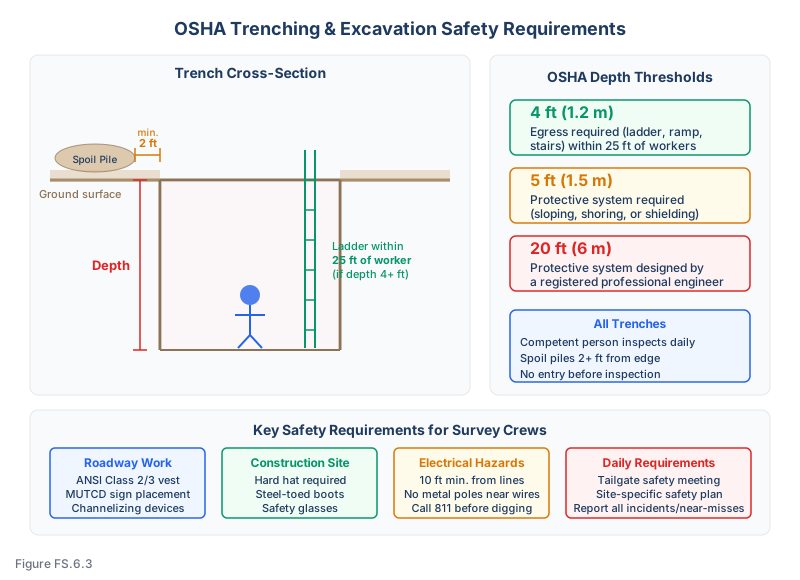
Trenching and Excavation Safety
OSHA trenching requirements are heavily tested:
- Trenches 5 feet (1.5 m) deep or more require protective systems (sloping, shoring, or shielding)
- Trenches 20 feet (6 m) deep or more require a protective system designed by a registered professional engineer
- A competent person must inspect trenches daily and after every rainstorm
- Spoil piles must be kept at least 2 feet (0.6 m) from the edge of the trench
- A means of egress (ladder, ramp, stairs) must be within 25 feet (7.6 m) of any worker in a trench 4 feet (1.2 m) or deeper
- No person may enter a trench until it has been inspected by the competent person
Traffic Control
When working along roadways:
- Follow the Manual on Uniform Traffic Control Devices (MUTCD) for sign placement and flagging procedures
- Use high-visibility safety vests (ANSI Class 2 or Class 3) at all times
- Deploy advance warning signs at appropriate distances based on speed limit
- Use channelizing devices (cones, barricades) to separate workers from traffic
- A designated flagger may be required for lane closures
- Work should be planned for off-peak hours when possible
Personal Protective Equipment (PPE)
Standard PPE for survey field crews:
| PPE Item | When Required |
|---|---|
| Hard hat | Construction sites, overhead hazards |
| Safety vest (high-visibility) | All roadway work, construction sites |
| Safety glasses | Brush clearing, construction sites, any impact hazard |
| Steel-toed boots | Construction sites, heavy equipment areas |
| Hearing protection | Near heavy equipment, loud machinery |
| Gloves | Brush clearing, monument setting, cold weather |
| Sun protection | All outdoor work (hat, sunscreen, long sleeves) |
Electrical Safety
- Maintain minimum clearance distances from overhead power lines (varies by voltage; minimum 10 feet / 3 m for lines up to 50 kV)
- Call 811 (or local equivalent) before any excavation to locate underground utilities
- Do not use metal survey equipment (range poles, leveling rods) near power lines
- Be aware that GNSS equipment and total station prisms on extended-height poles increase reach toward overhead lines
- If a vehicle contacts a power line, remain in the vehicle and call for help unless the vehicle is on fire
Safety Plans and Tailgate Meetings
- Site-specific safety plans identify hazards and mitigation measures for each project
- Tailgate safety meetings (toolbox talks) are brief meetings held at the start of each workday to discuss specific hazards for that day's work
- Incident reporting must be immediate; near-misses should be reported and analyzed
- Emergency action plans must include procedures for medical emergencies, severe weather, and evacuation
Common wrong path — entering a trench to shoot an as-built "real quick." A 6-foot-deep utility trench is open. The contractor is in a rush and asks you to drop in to shoot two invert elevations — "it'll take 30 seconds." OSHA 29 CFR 1926.651 does not have a "30-second exception." A trench 5 feet or deeper requires a protective system (sloping, shoring, or trench shield) AND a competent-person inspection before any worker enters. A trench 4 feet or deeper also requires a means of egress (ladder, ramp, or stairs) within 25 feet of any worker in the trench. If those aren't in place, you don't enter — ever. The correct alternative is to shoot the inverts with a prism pole or rod from the top of the trench, use a remote-controlled robotic total station, or wait until the trench is properly protected. Students pick "enter and shoot quickly" because it feels like helping; the correct answer is refuse, document the refusal, and offer the remote measurement method. Trench collapses are the leading cause of construction deaths in utility work, and survey crews have been killed this way. There is no measurement worth the risk.
Quick retrieval check — try before reading on.
▶You arrive at a construction site to shoot as-built elevations on a new storm drain line. The trench is 7 feet deep, unshored, with vertical walls in sandy soil. The contractor removed the trench box because it was "in the way." A wooden ladder leans against one wall. The contractor insists you get in quickly. What do you do?
You do not enter the trench under any circumstances. The trench fails multiple OSHA requirements: (1) at 7 feet deep it requires a protective system (sloping, shoring, or shielding); vertical walls in sandy soil (Type C soil) are the highest-collapse-risk configuration and require either sloping at 1.5H:1V (the maximum allowable for Type C; benching is not permitted in Type C soil per 29 CFR 1926 Subpart P Appendix B) or a trench shield/shoring; (2) only one ladder for a 7-foot trench may or may not satisfy the 25-foot-egress rule, but the missing protective system is the controlling violation; (3) a competent person must inspect the trench daily and after any event that could affect stability (rain, vibration, equipment loading) — the removal of the trench box is exactly such an event and requires a new competent-person inspection.
Correct professional response: (a) decline to enter and state the OSHA basis (29 CFR 1926.652 protective-system requirements); (b) offer to shoot the inverts from the top of the trench using a prism pole or with a robotic total station and a rod-mounted prism — invert shots can almost always be taken from above with acceptable accuracy for as-builts; (c) if those methods are not feasible for the required accuracy, tell the contractor the work will resume after the trench box is reinstalled and the competent person re-inspects; (d) document the refusal in the field notes, including date, time, conditions observed, and the names of people present. Do not report the contractor to OSHA reflexively — your obligation is to refuse unsafe work and document it; escalation decisions belong to your firm's safety officer and, in many cases, the general contractor's site safety representative. Your license, your life, and your crew's lives are not negotiable against a 30-second measurement.
Compare the right reasoning to a common wrong answer set: "Enter quickly because the ladder is adequate egress" (ignores the missing protective system — egress is necessary but not sufficient); "Enter because the contractor accepts responsibility" (the contractor cannot waive your OSHA rights; you are the worker at risk); "Enter but wear a hard hat and vest" (PPE does not protect against trench collapse). Only the refuse-and-measure-from-above answer is professionally and legally correct.
Exam Tips
- OSHA's 5-foot (1.5 m) depth trigger for trench protection is heavily tested
- High-visibility vests are required for ALL roadway work, regardless of traffic volume
- "Competent person" is an OSHA-defined term meaning someone who can identify hazards and has authority to take corrective action
- Call 811 before you dig -- this is a universal requirement
- The 10-foot (3 m) minimum clearance from power lines applies to workers AND equipment
- Safety questions on the FS exam are usually scenario-based -- they describe a situation and ask what action is required
- When in doubt, the safest answer is usually the correct one
- MUTCD is the standard for traffic control, not state DOT manuals (though state manuals supplement it)
Related Test Topics
- Liability and Insurance (Topic 6.4)
- Supervision and Personnel (Topic 6.6)
- Professional Ethics (Topic 6.7)
Further Reading
Authoritative sources for deeper study
OSHA 29 CFR 1926 Subpart P — Excavations — Federal trenching and excavation safety standards relevant to construction surveyors.
MUTCD 2023 Part 6 — Temporary Traffic Control — Federal standard for work-zone traffic control devices and surveyor safety.
APWA Uniform Color Code — Standard utility-marking colors used in one-call locates.
Last updated: 2026-04-17