FS Exam Preparation
Comprehensive preparation for the Fundamentals of Surveying (FS) exam. 7 modules covering all 7 exam domains with 60 in-depth topics.
Module 1: Surveying Processes & Methods
Module 2: Mapping Processes & Methods
Module 3: Boundary Law & Real Property
Module 4: Surveying Principles & Geodesy
Module 5: Survey Computations
Module 6: Business Concepts
Public Records & Land Descriptions
Learning Objectives
After completing this topic, you should be able to:
- Describe the purpose of the public recording system
- Explain the concept of constructive notice and actual notice
- Define chain of title and its importance in boundary surveying
- Identify the types of documents found in public records
- Understand the recording acts (race, notice, race-notice)
- Describe how surveyors research public records for boundary work
Overview
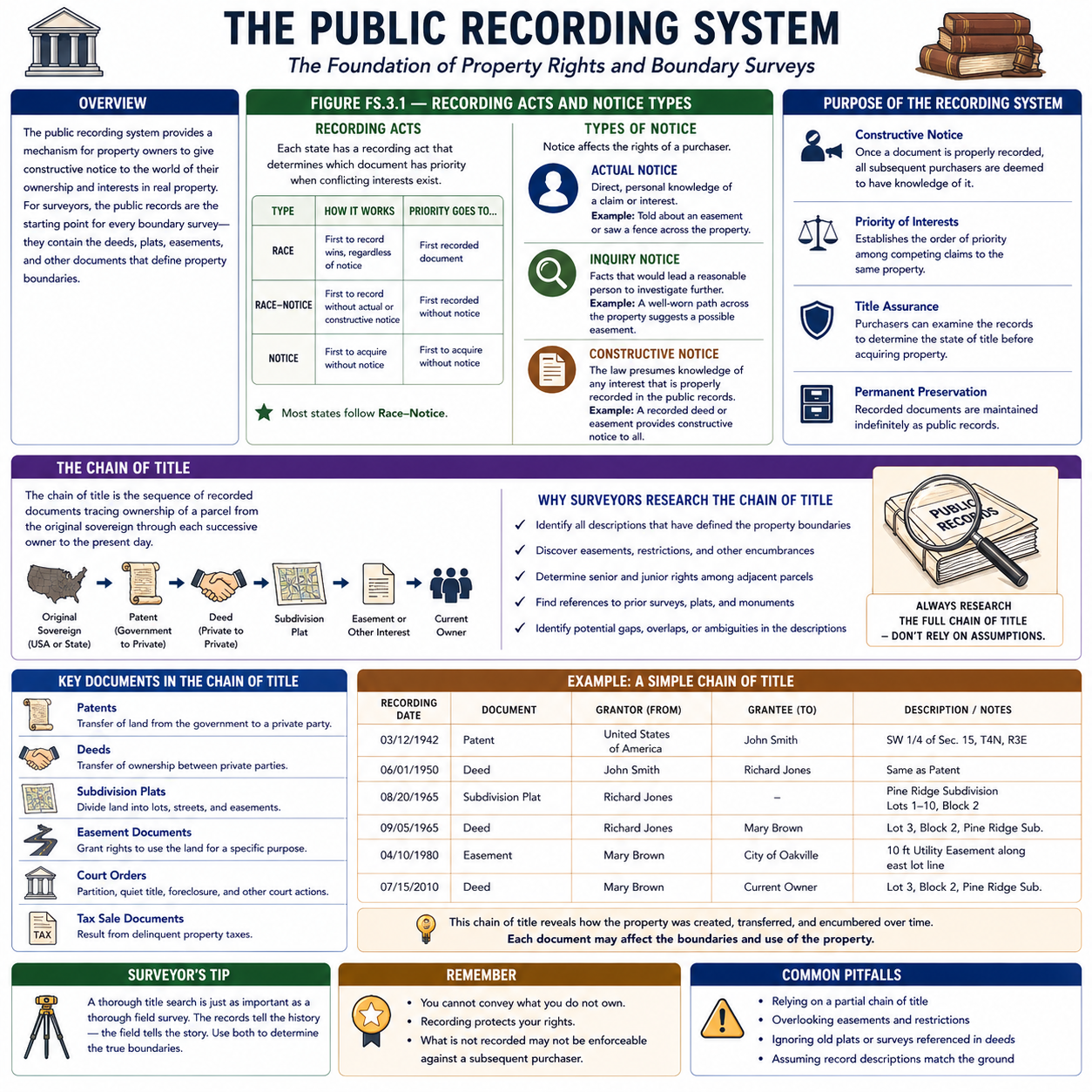
The public recording system is the foundation of property law in the United States. It provides a mechanism for property owners to give constructive notice to the world of their ownership and interests in real property. For surveyors, the public records are the starting point for every boundary survey -- they contain the deeds, plats, easements, and other documents that define property boundaries.
Key Concepts
Purpose of the Recording System
The recording system serves several critical functions:
- Constructive notice: Once a document is properly recorded, all subsequent purchasers are deemed to have knowledge of it, whether or not they actually examined the records
- Priority of interests: The recording system establishes the order of priority among competing claims to the same property
- Title assurance: Purchasers can examine the records to determine the state of title before acquiring property
- Permanent preservation: Recorded documents are maintained indefinitely as public records
Notice Types
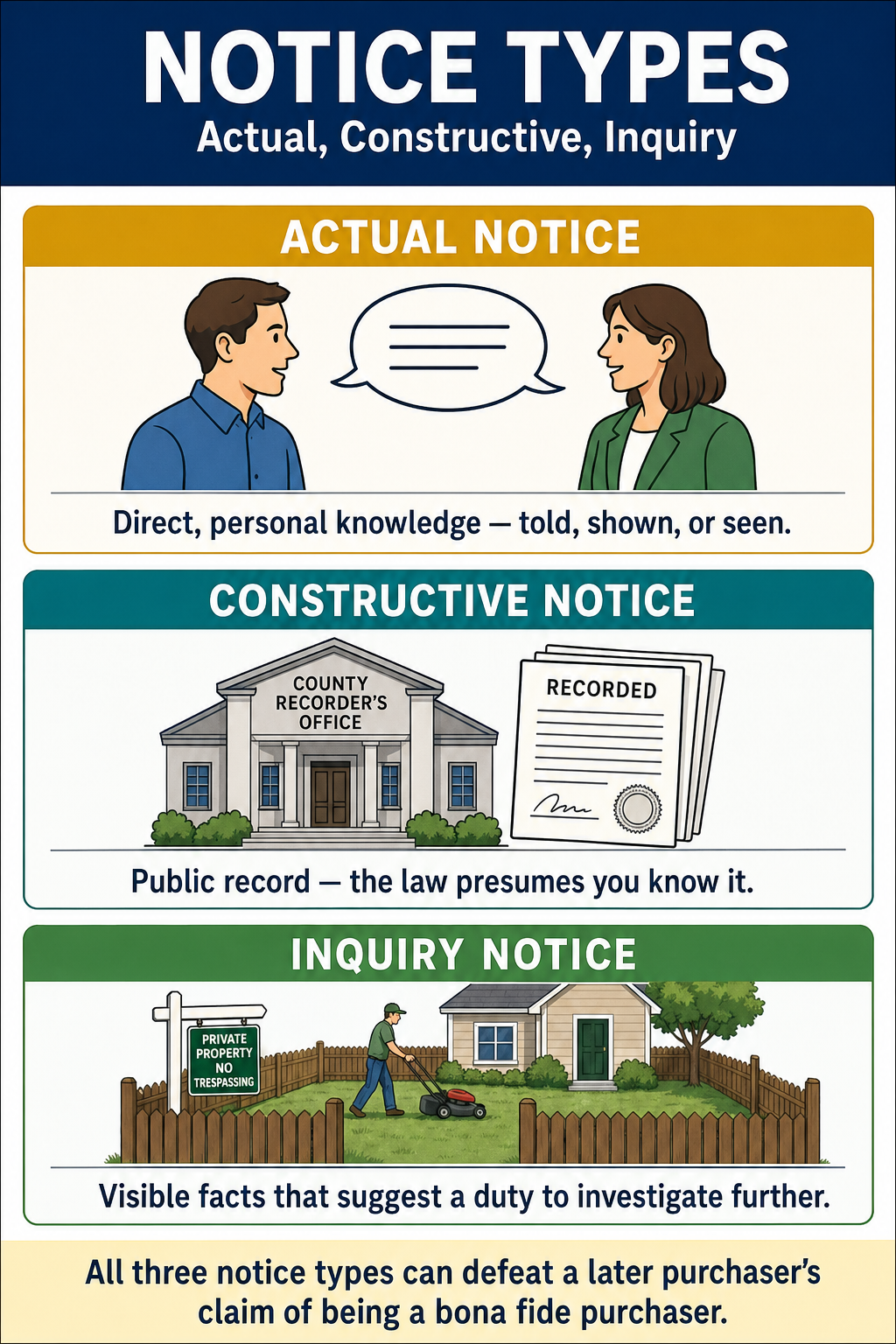
Actual notice: The buyer has direct, personal knowledge of a claim or interest (e.g., someone told them about an easement, or they saw a fence across the property).
Constructive notice: The buyer is legally deemed to know about any interest that is properly recorded in the public records, even if they never actually searched the records. Recording provides constructive notice.
Inquiry notice: Facts that would lead a reasonable person to investigate further. For example, a well-worn path across a property should prompt inquiry about a possible easement.
Chain of Title
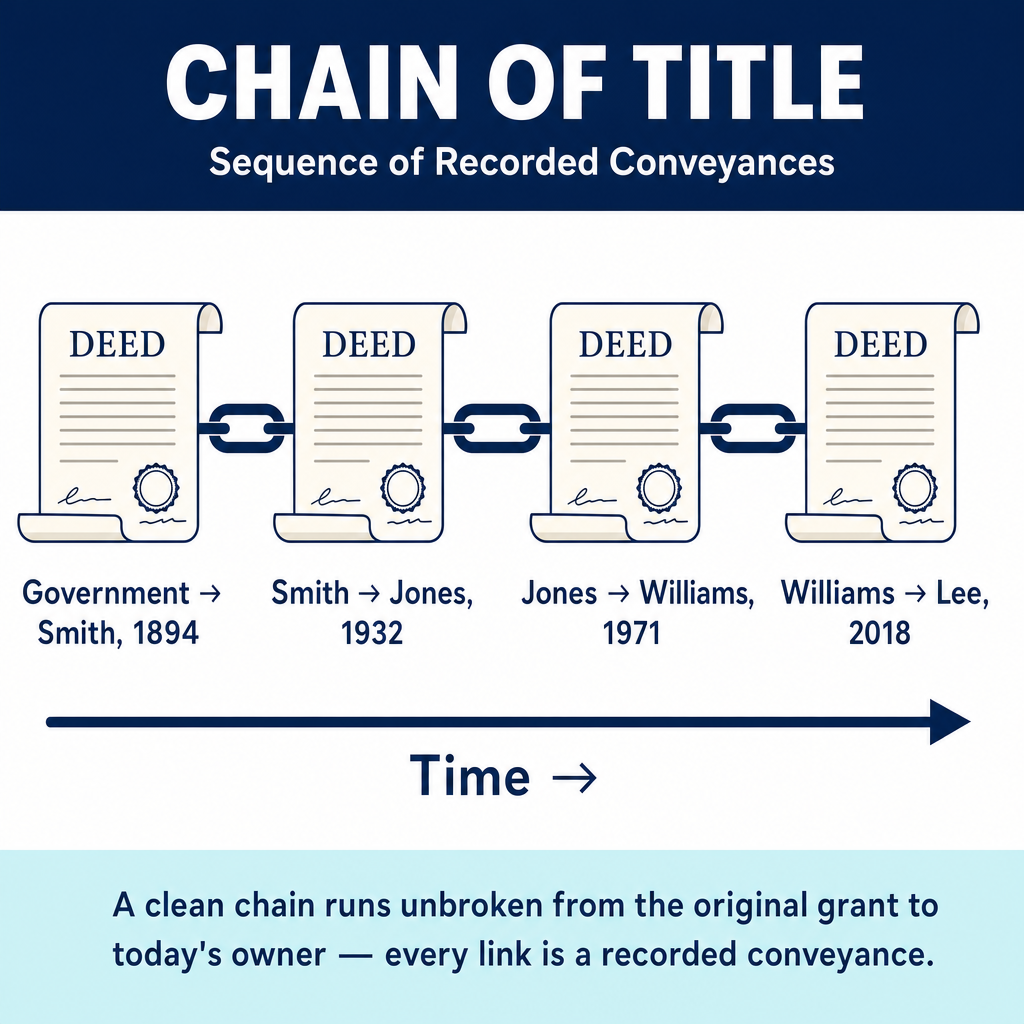
The chain of title is the sequence of recorded documents tracing ownership of a parcel from the original sovereign (usually the U.S. government or the original state) through each successive owner to the present day.
Why surveyors research the chain of title:
- To identify all descriptions that have defined the property boundaries
- To discover easements, restrictions, and other encumbrances
- To determine senior and junior rights among adjacent parcels
- To find references to prior surveys, plats, and monuments
- To identify potential gaps, overlaps, or ambiguities in the descriptions
Key documents in the chain of title:
- Patents (government-to-private transfer)
- Deeds (private-to-private transfer)
- Subdivision plats
- Easement documents
- Court orders (partition, quiet title)
- Tax sale documents
Types of Public Records
| Record Type | Location | Contains |
|---|---|---|
| Deeds | County recorder/registrar | Property descriptions, grantor/grantee, consideration |
| Plats/maps | County recorder, surveyor's office | Subdivision layouts, lot dimensions, easements |
| Records of Survey | County recorder, surveyor's office | Boundary evidence, monuments, surveyor's analysis |
| Corner Records (required in California and certain other western states; not universal) | County surveyor's office | Monument conditions, accessories, coordinates |
| Easement documents | County recorder | Easement descriptions, grantee, purpose |
| Tax records | County assessor | Parcel identification, ownership, assessed value |
| Court records | County clerk/court | Judgments, quiet title actions, partitions |
| PLSS records | BLM/GLO | Original survey plats, field notes |
Recording Acts
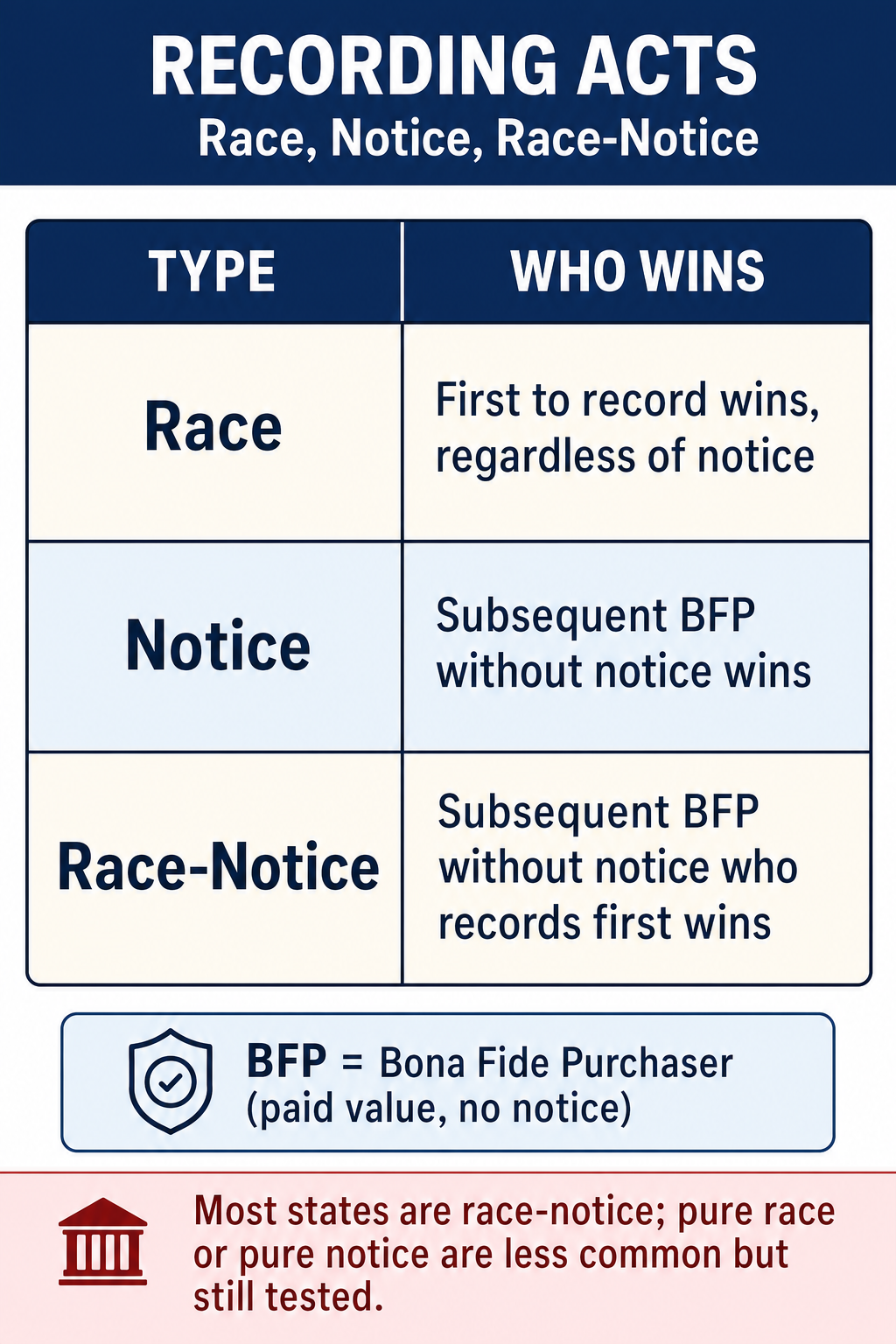
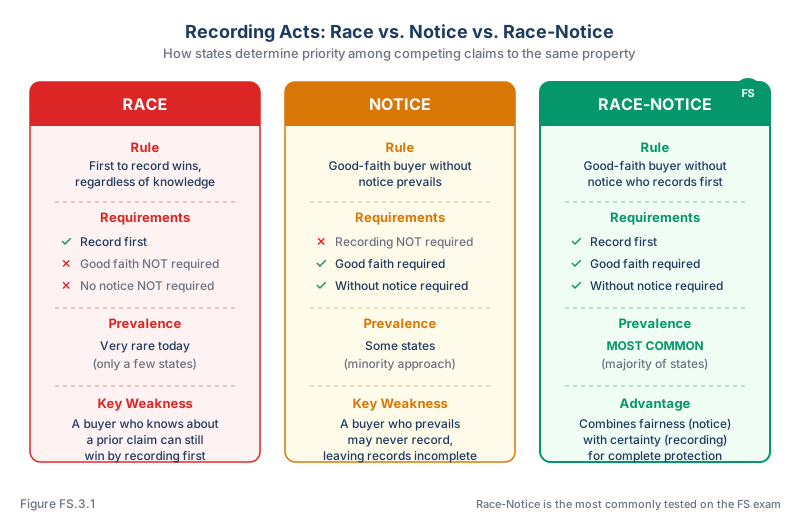
States use different recording statutes to determine priority among competing claims (Stoebuck & Whitman, The Law of Property, 3d Ed., §11.9; Restatement (Third) of Property: Servitudes §7.14):
Race statute: The first to record wins, regardless of knowledge of prior unrecorded interests. (Very rare today.)
Notice statute: A subsequent buyer who purchases in good faith and without notice of a prior unrecorded interest prevails over the prior unrecorded interest holder.
Race-notice statute: A subsequent buyer who purchases in good faith, without notice, and records first prevails. This is the most common type in the United States.
The Surveyor's Record Research Process
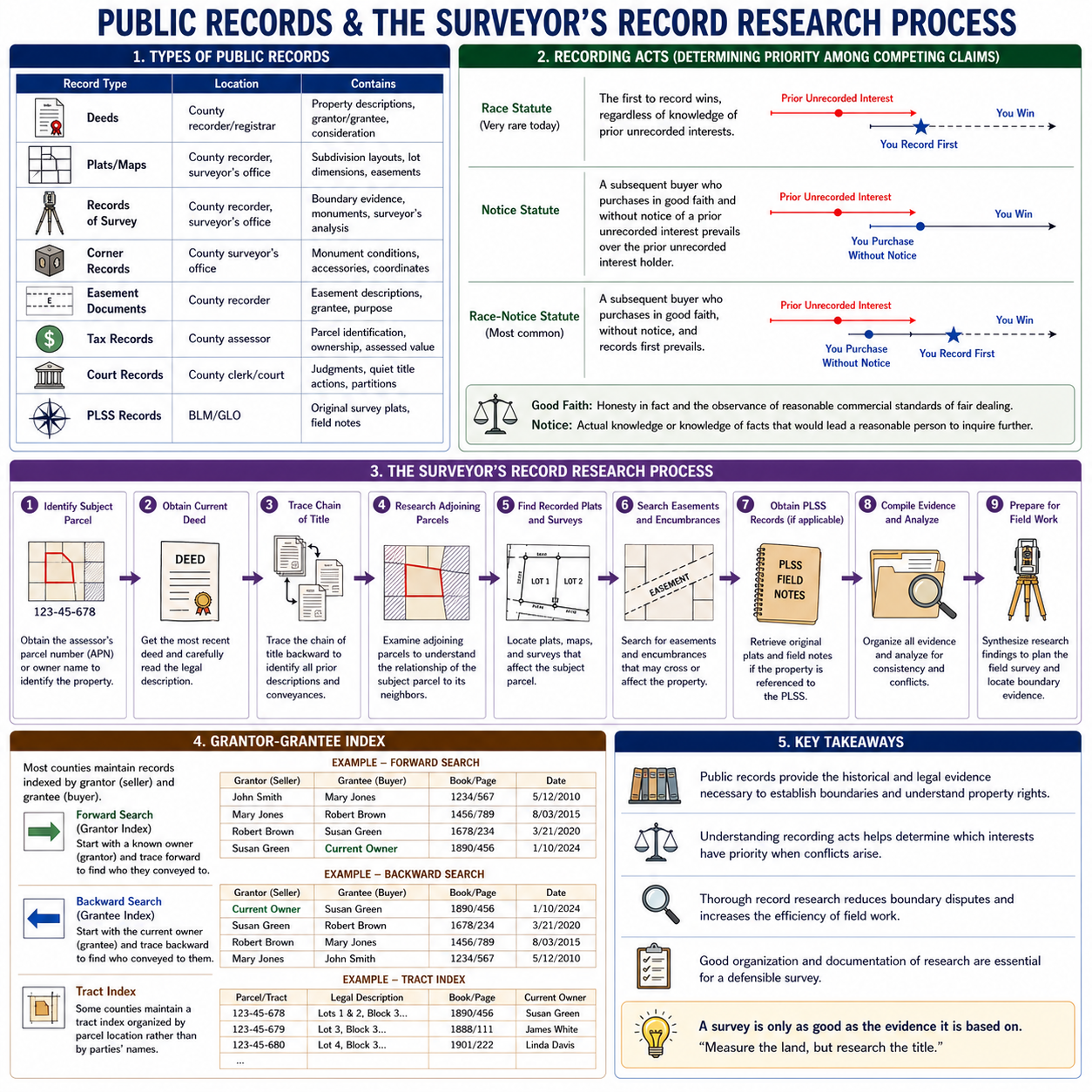
- Identify the subject parcel from the assessor's parcel number (APN) or owner name
- Obtain the current deed and read the legal description
- Trace the chain of title backward to identify all prior descriptions and conveyances
- Research adjoining parcels to understand the relationship of the subject parcel to its neighbors
- Find recorded plats and surveys that affect the subject parcel
- Search for easements and encumbrances that may cross or affect the property
- Obtain PLSS records (original plats and field notes) if the property is referenced to the PLSS
- Compile all evidence to prepare for field work
Common wrong path — "constructive notice of recorded = knowledge of everything." Constructive notice is a legal fiction: the law treats a subsequent purchaser as knowing about properly recorded documents, even if they never actually looked at the records. But constructive notice only applies to documents in the chain of title for the specific property. Documents recorded elsewhere — outside the property's chain — do not give constructive notice to purchasers of this property, even if they are technically in the public record. An easement recorded against Parcel A's earlier owner, but recorded in a way that doesn't connect to Parcel B's chain, may not give constructive notice to Parcel B's buyer. Exam questions sometimes test this by describing a recorded but "stray" document (recorded in wrong parcel's file, indexed incorrectly, or outside the chain by predating the relevant conveyance) and asking whether a subsequent purchaser had constructive notice. The answer is often no — recording alone is not enough; the record must be properly indexed and connected to the chain of title.
Quick retrieval check — try before reading on.
▶In 1980, Grantor X recorded an easement across Parcel A in favor of a utility company. In 1985, X subdivided Parcel A into Parcels A1 and A2 and sold A2 to Buyer. Buyer's title search discovered no easement (the indexing was defective). Is Buyer bound by the easement under the constructive-notice doctrine?
Probably not — at least not under constructive notice. Constructive notice requires a document to be properly recorded and indexed in the chain of title the subsequent purchaser is actually searching. A recording that is mis-indexed, filed in the wrong parcel's records, or otherwise disconnected from the chain of title may fail to provide constructive notice — the purchaser who performs a reasonable title search would not find it.
However, the buyer may still be bound by inquiry notice if there is physical evidence on the ground (e.g., visible utility infrastructure) that would prompt a reasonable person to investigate. And the easement may still be enforceable against the buyer in other ways (such as an implied or prescriptive easement based on long-standing use) even if constructive notice fails. The bottom line: constructive notice requires proper recording in the chain of title; a defectively indexed document may not provide it, even though it is technically in the public record.
Grantor-Grantee Index
Most counties maintain records indexed by grantor (seller) and grantee (buyer). To search:
- Forward search (grantor index): Start with a known owner and trace forward to find who they conveyed to
- Backward search (grantee index): Start with the current owner and trace backward to find who conveyed to them
Tract index: Some counties maintain a tract index organized by parcel location rather than by parties' names. This is more efficient for surveyors but not universally available.
Exam Tips
- Constructive notice means the law treats you as knowing about a recorded document even if you never searched the records
- The chain of title traces ownership from the sovereign (government) to the present owner
- Race-notice is the most common recording statute: the subsequent buyer must be in good faith, without notice, and record first
- Surveyors must research adjoining parcels, not just the subject parcel, to understand boundary relationships
- PLSS original plats and field notes are available from the BLM General Land Office (GLO) records
- The FS exam may test your understanding of notice types, recording systems, or the types of documents found in public records
- Always trace the chain of title backward from the current owner to understand how the property was created
- Corner Records (required in California and a handful of other western states; not universal) document the condition and location of survey monuments
Related Test Topics
- Conveyances and Title Transfer (Topic 3.5)
- Controlling Elements and Evidence (Topic 3.2)
- Metes and Bounds Descriptions (Topic 3.6)
- PLSS Fundamentals (Topic 3.7)
Further Reading
Authoritative sources for deeper study
Wattles, Writing Legal Descriptions (1976) — Gold-standard reference on metes-and-bounds, sectional, and combination descriptions.
Brown's Boundary Control and Legal Principles (7th Ed., Robillard & Wilson) — Standard textbook on boundary law, evidence hierarchy, and retracement.
Evidence and Procedures for Boundary Location (Robillard, Wilson, & Brown, 6th Ed., 2011) — Practical treatise on collecting, weighing, and applying boundary evidence.
Last updated: 2026-04-17