FS Exam Preparation
Comprehensive preparation for the Fundamentals of Surveying (FS) exam. 7 modules covering all 7 exam domains with 60 in-depth topics.
Module 1: Surveying Processes & Methods
Module 2: Mapping Processes & Methods
Module 3: Boundary Law & Real Property
Module 4: Surveying Principles & Geodesy
Module 5: Survey Computations
Module 6: Business Concepts
Volume Calculations & Earthwork
Learning Objectives
After completing this topic, you should be able to:
- Compute volumes using the average end area method
- Apply the prismoidal formula for more accurate volumes
- Use the grid method for site grading volumes
- Calculate cross-section areas for cut and fill
- Determine the balance point between cut and fill
- Convert between cubic yards and cubic meters
Overview
Volume calculations are essential for earthwork estimation in construction surveying. Whether grading a building site, constructing a roadway, or building an embankment, surveyors must compute the volume of material to be excavated (cut) or placed (fill). The FS exam tests three primary methods: average end area, prismoidal formula, and the grid method.
Key Concepts
Cross-Section Areas
Before computing volumes, you must determine the cross-sectional area at each station along the route. Cross sections are taken perpendicular to the centerline and show the existing ground and proposed grade.
Methods for computing cross-section areas:
- Coordinate method: Treat the cross section as a polygon and use the coordinate area formula
- Geometric formulas: Break the cross section into triangles, rectangles, and trapezoids
- Planimeter: Measure the area directly from a scaled drawing (less common today)
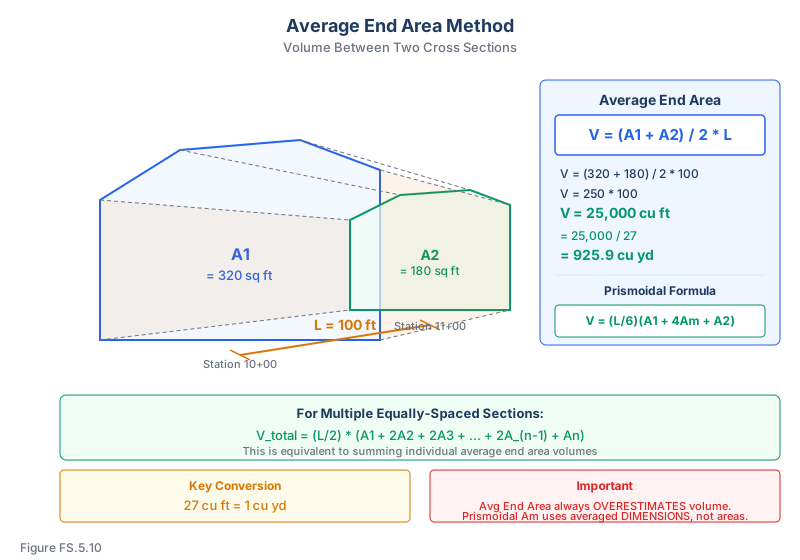
Average End Area Method
The most commonly used method on the FS exam. The volume between two cross sections is:
V = ((A1 + A2) / 2) * L
Where:
- A1 = area of cross section 1
- A2 = area of cross section 2
- L = distance between the two cross sections
For multiple stations, compute the volume between each adjacent pair and sum them:
V_total = L/2 * (A1 + 2A2 + 2A3 + ... + 2*A_(n-1) + A_n)
(This is equivalent to summing individual average end area volumes when stations are equally spaced.)
Units:
- If areas are in sq ft and L is in ft: volume is in cu ft (divide by 27 to get cu yd)
- If areas are in sq m and L is in m: volume is in cu m
Prismoidal Formula
More accurate than average end area, the prismoidal formula accounts for the variation in cross-section shape:
V = (L/6) * (A1 + 4*Am + A2)
Where:
- A1 = area of the first end section
- A2 = area of the second end section
- Am = area of the middle section (at the midpoint between the two ends)
- L = distance between the two end sections
Important: Am is NOT the average of A1 and A2. The middle section is determined by averaging the dimensions of the two end sections, then computing the area from those averaged dimensions.
Prismoidal Correction
The prismoidal correction adjusts the average end area result to approximate the prismoidal result (Ghilani & Wolf, Elementary Surveying, 13th Ed., §26.8, Eq. 26.5):
V_prismoidal = V_avg_end_area - Cp
Cp = (L/12) * (D1 - D2) * (W1 - W2)
Where D and W represent corresponding linear dimensions of the two end sections (depth and width, for example). In the common simple prismoid cases taught for surveying computations, this correction is subtracted from the average end area result because average end area is typically high. Apply the sign convention from the formula or problem statement rather than memorizing the word "always."
Grid Method
Used for site grading where the area is divided into a grid of squares or rectangles:
- Establish a grid over the site
- Determine the existing elevation and proposed elevation at each grid point
- Calculate the cut or fill depth at each grid point: depth = existing - proposed (positive = cut, negative = fill)
- Compute the volume for each grid cell
For a rectangular grid cell with depths at four corners:
V_cell = ((d1 + d2 + d3 + d4) / 4) * Area_cell
For the entire site, sum all cell volumes, keeping cut and fill volumes separate.
Four-column method: Each grid point is shared by 1, 2, 3, or 4 cells. Multiply each depth by the number of cells it contributes to, sum them, multiply by cell area, and divide by 4:
V = (Cell Area / 4) × (Σ 1·h_corner + Σ 2·h_edge + Σ 3·h_T-junction + Σ 4·h_interior)
Common wrong path — averaging Am instead of computing it. The prismoidal formula looks like a weighted average, and students often shortcut by setting — the arithmetic mean of the end areas. That substitution reduces the prismoidal formula to the average-end-area formula, eliminating exactly the correction it was designed to provide. The middle area must be computed from averaged dimensions (average depth, average width, etc.), and the resulting area is generally not the arithmetic mean of and . This is especially important when end sections have very different shapes — a narrow-deep section next to a wide-shallow section. Using averaged areas will make the prismoidal formula agree with average-end-area by construction, defeating the purpose.
Quick retrieval check — try before reading on.
▶Two cross sections 100 ft apart have areas 180 sq ft and 120 sq ft. The midpoint section, computed from averaged dimensions, has area 148 sq ft. What is the volume in cubic yards by the prismoidal formula?
cu ft.
Convert: cu yd.
Sanity check: average end area would give cu ft = 556 cu yd — larger than the prismoidal result, as expected. If you had used by mistake, you'd get cu ft = 556 cu yd — exactly the average-end-area result, missing the correction entirely.
Mass Diagram (Balance Point)
The mass diagram plots cumulative earthwork volume along the route:
- Rising portions indicate cut (material available)
- Falling portions indicate fill (material needed)
- Where the diagram crosses a horizontal line, cut and fill are balanced
- The balance point is where no material needs to be imported or exported
Unit Conversions
| From | To | Factor |
|---|---|---|
| cu ft | cu yd | divide by 27 |
| cu m | cu yd | multiply by 1.308 |
| cu yd | cu m | multiply by 0.7646 |
Choosing the Volume Method
The data format usually tells you which method to use:
| Given data | Best method |
|---|---|
| Areas at roadway stations | Average end area |
| End areas plus a true midpoint area | Prismoidal formula |
| Grid of cut/fill depths | Grid method |
| Cumulative cut/fill along alignment | Mass diagram |
Do not mix cut and fill unless the question specifically asks for net volume. Contractors, estimators, and exam questions often care about separate cut and fill quantities because excavation, embankment, shrinkage, swell, and haul costs are different.
Shrinkage and Swell
Earthwork quantities may change between in-place, loose, and compacted states:
- Bank volume: material in its natural, in-place condition.
- Loose volume: excavated material after it expands.
- Compacted volume: material after placement and compaction.
If a problem gives a swell or shrinkage factor, apply it after computing the geometric volume. Example: 1,000 bank cu yd with 20% swell becomes 1,200 loose cu yd. If that same material compacts with 10% shrinkage from bank volume, it becomes 900 compacted cu yd.
Exam Tips
- Average end area is the default method unless told otherwise -- it is simpler and more commonly tested
- Average end area is an approximation; prismoidal volume is more accurate when a true midpoint section is available
- The prismoidal formula middle section Am is computed from averaged dimensions, not averaged areas
- For the grid method, count how many cells each corner point contributes to (1, 2, 3, or 4)
- Remember: 27 cu ft = 1 cu yd. This conversion appears in almost every earthwork problem
- Keep cut and fill volumes separate -- they may have different costs
- Cross-section area problems often pair with volume problems; compute areas first, then volumes
- If given equally spaced stations, the average end area formula simplifies significantly
Related Test Topics
- Area Calculations (Topic 5.6)
- Vertical Curves (Topic 5.8)
- Slopes, Grades, and Interpolation (Topic 5.10)
Further Reading
Authoritative sources for deeper study
Wolf & Ghilani, Elementary Surveying — An Introduction to Geomatics (13th Ed., 2012) — Comprehensive surveying text covering instruments, field procedures, and computations.
Kavanagh, Surveying with Construction Applications (7th Ed.) — Combined surveying and construction-layout reference.
Last updated: 2026-04-17