FS Exam Preparation
Comprehensive preparation for the Fundamentals of Surveying (FS) exam. 7 modules covering all 7 exam domains with 60 in-depth topics.
Module 1: Surveying Processes & Methods
Module 2: Mapping Processes & Methods
Module 3: Boundary Law & Real Property
Module 4: Surveying Principles & Geodesy
Module 5: Survey Computations
Module 6: Business Concepts
Trigonometry & Analytic Geometry
Learning Objectives
After completing this topic, you should be able to:
- Apply the six trigonometric functions to right and oblique triangles
- Use the law of sines and law of cosines to solve oblique triangles
- Convert between degrees-minutes-seconds and decimal degrees
- Apply the distance formula and midpoint formula in coordinate geometry
- Work with equations of lines, circles, and other conic sections
- Perform coordinate transformations (translation, rotation, scaling)
Overview
Trigonometry is the mathematical language of surveying. Nearly every surveying computation involves trigonometric functions -- from computing latitudes and departures to solving for unknown distances and angles in triangles. Analytic geometry extends these concepts into the coordinate plane, where points, lines, and curves are described by equations. The FS exam requires fluent application of both.
Key Concepts
Right Triangle Trigonometry
For a right triangle with angle A, opposite side a, adjacent side b, and hypotenuse c:
- sin(A) = a / c (opposite / hypotenuse)
- cos(A) = b / c (adjacent / hypotenuse)
- tan(A) = a / b (opposite / adjacent)
- csc(A) = c / a = 1 / sin(A)
- sec(A) = c / b = 1 / cos(A)
- cot(A) = b / a = 1 / tan(A)
Pythagorean theorem: a^2 + b^2 = c^2
Mnemonic: SOH-CAH-TOA (Sine = Opposite/Hypotenuse, Cosine = Adjacent/Hypotenuse, Tangent = Opposite/Adjacent)
Angle Conversions
DMS to decimal degrees:
Decimal degrees = Degrees + Minutes/60 + Seconds/3600
Example: 45° 30' 15" = 45 + 30/60 + 15/3600 = 45 + 0.5 + 0.004167 = 45.504167°
Decimal degrees to DMS:
- Degrees = integer part (45)
- Minutes = (decimal part) * 60 = 0.504167 * 60 = 30.25
- Seconds = (decimal minutes) * 60 = 0.25 * 60 = 15
- Result: 45° 30' 15"
Degrees to radians: radians = degrees * (pi / 180)
Radians to degrees: degrees = radians * (180 / pi)
Law of Sines
For any triangle with sides a, b, c opposite angles A, B, C:
a / sin(A) = b / sin(B) = c / sin(C)
Use when you know:
- Two angles and one side (AAS or ASA)
- Two sides and an angle opposite one of them (SSA -- ambiguous case)
The ambiguous case (SSA): When given two sides and an angle opposite one of them, there may be 0, 1, or 2 solutions. Check whether the sine of the unknown angle yields a valid result.
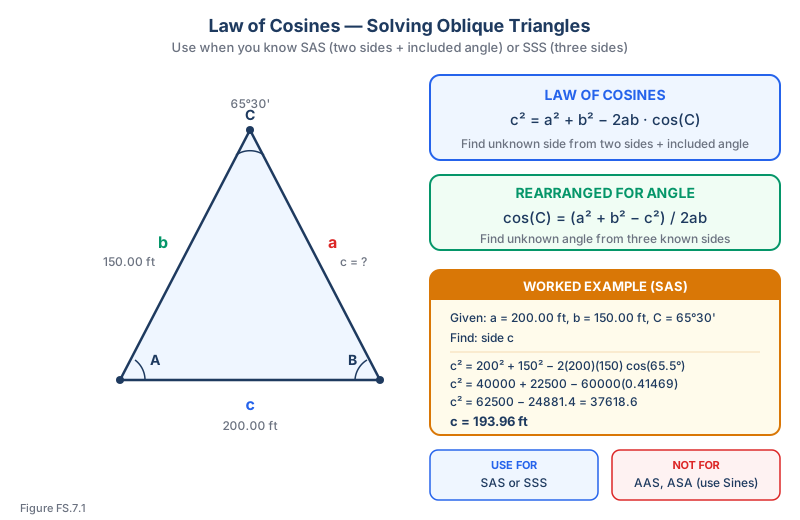
Law of Cosines
For any triangle:
c^2 = a^2 + b^2 - 2ab * cos(C)
Rearranged to find an angle:
cos(C) = (a^2 + b^2 - c^2) / (2ab)
Use when you know:
- Two sides and the included angle (SAS)
- All three sides (SSS)
Analytic Geometry Fundamentals
Distance between two points:
d = sqrt((x2 - x1)^2 + (y2 - y1)^2)
Midpoint of a line segment:
M = ((x1 + x2)/2, (y1 + y2)/2)
Equation of a line:
- Slope-intercept form: y = mx + b
- Point-slope form: y - y1 = m(x - x1)
- General form: Ax + By + C = 0
Slope: m = (y2 - y1) / (x2 - x1)
Perpendicular slopes: If line 1 has slope m, a perpendicular line has slope -1/m
Parallel slopes: Parallel lines have equal slopes
Equations of Circles
(x - h)^2 + (y - k)^2 = r^2
Where (h, k) is the center and r is the radius.
Coordinate Transformations
Translation (shift by dx, dy):
- x' = x + dx
- y' = y + dy
Rotation (by angle theta about the origin):
- x' = x * cos(theta) - y * sin(theta)
- y' = x * sin(theta) + y * cos(theta)
Scaling (by factor s):
- x' = s * x
- y' = s * y
Combined transformation (2D conformal / Helmert / 4-parameter) — see Ghilani, Adjustment Computations: Spatial Data Analysis, 5th Ed., Ch. 18:
- x' = a * x - b * y + tx
- y' = b * x + a * y + ty
Where a = s * cos(theta), b = s * sin(theta), and (tx, ty) is the translation.
Common wrong path — calculator in radian mode for surveying problems. Nearly all surveying angle measurements are in degrees (or degrees-minutes-seconds), but calculators default to — or are frequently left in — radian mode from earlier math classes. Computing sin(45°) in radian mode gives sin(45 radians) ≈ 0.851, not the correct sin(45°) = 0.707. Exam questions producing inexplicably wrong answers often come from radian-mode confusion. Before starting any trig problem, verify the calculator is in degree (DEG) mode. The typical giveaway is an answer that's wildly off — if sin(45°) on your calculator returns anything other than ≈0.707, check the mode immediately. The exception: when the formula explicitly uses radians (like arc length L = R × θ in radians), make sure you convert from degrees to radians before multiplying.
Quick retrieval check — try before reading on.
▶Your total station reports a vertical angle of 4° 30' 00". You compute Δh = S sin(α) for a slope distance S = 450 ft. With your calculator in radian mode, you get Δh ≈ −440 ft. With the calculator in degree mode, you get Δh = +35.3 ft. Which is correct, and what's the practical lesson?
Degree mode: Δh = +35.3 ft is correct. In degree mode, sin(4.5°) ≈ 0.0785, so Δh = 450 × 0.0785 = +35.3 ft.
In radian mode, the calculator treats 4.5 as radians (a nonsense quantity for this context), returning sin(4.5 rad) ≈ −0.9775, giving Δh = 450 × (−0.9775) = −440 ft — wildly wrong, and with the opposite sign because sin is negative at ~4.5 radians (in the third quadrant of the unit circle).
The practical lesson: always verify calculator mode before starting any trig problem. A surveyor reporting Δh = −440 ft for a target 4.5° above horizontal at 450 ft would be hundreds of feet off in elevation — obviously wrong, but easy to miss if you don't sanity-check the sign and magnitude. Better: memorize rough values for common angles (sin(30°) = 0.5, cos(45°) = 0.707, etc.) so you can catch mode errors with a quick mental cross-check.
Worked Examples
Example 1: Law of Cosines
Two sides of a triangle are 150.00 ft and 200.00 ft, with an included angle of 65 30' 00". Find the third side.
c^2 = 150^2 + 200^2 - 2(150)(200) * cos(65.5)
c^2 = 22500 + 40000 - 60000 * 0.41469
c^2 = 62500 - 24881.4
c^2 = 37618.6
c = 193.96 ft
Example 2: Law of Sines
In a triangle, angle A = 42, angle B = 73, and side a = 120.00 m. Find side b.
120 / sin(42) = b / sin(73)
b = 120 * sin(73) / sin(42) = 120 * 0.9563 / 0.6691 = 171.51 m
Exam Tips
- Make sure your calculator is in degree mode for surveying problems (not radians)
- The law of cosines is more commonly tested than the law of sines on the FS exam
- For the ambiguous case (SSA), always check whether sin of the unknown angle exceeds 1.0 (no solution) or yields two valid angles (two solutions)
- Know how to convert DMS to decimal degrees quickly -- this operation is needed in almost every problem
- The combined 4-parameter transformation appears in coordinate conversion problems
- The distance formula is just the Pythagorean theorem in coordinate form
- Practice perpendicular and parallel line problems -- they appear in offset and alignment calculations
- On the FS exam, "analytic geometry" means working with equations in the coordinate plane, not abstract geometry
Related Test Topics
- Coordinate Geometry (Topic 5.1)
- Traverse Computations (Topic 5.2)
- Horizontal Curves (Topic 5.7)
- Linear Algebra and Matrices (Topic 7.2)
Further Reading
Authoritative sources for deeper study
Wolf & Ghilani, Elementary Surveying — An Introduction to Geomatics (13th Ed., 2012) — Comprehensive surveying text covering instruments, field procedures, and computations.
Ghilani & Wolf, Adjustment Computations (5th Ed., 2010) — Authoritative treatment of least-squares adjustment for surveying networks.
Last updated: 2026-04-17