FS Exam Preparation
Comprehensive preparation for the Fundamentals of Surveying (FS) exam. 7 modules covering all 7 exam domains with 60 in-depth topics.
Module 1: Surveying Processes & Methods
Module 2: Mapping Processes & Methods
Module 3: Boundary Law & Real Property
Module 4: Surveying Principles & Geodesy
Module 5: Survey Computations
Module 6: Business Concepts
Professional Liability & Insurance
Learning Objectives
After completing this topic, you should be able to:
- Define professional liability (errors and omissions)
- Explain the elements of negligence
- Distinguish between types of insurance relevant to surveying
- Describe the standard of care for surveying professionals
- Identify common sources of liability in surveying practice
Overview
Liability is the legal responsibility for one's actions or failures to act. Surveyors face professional liability when their work product causes harm to a client or third party due to errors, omissions, or negligence. Understanding liability and maintaining appropriate insurance protects both the professional and the public. The FS exam tests fundamental concepts of professional responsibility, negligence, and the insurance mechanisms that manage risk.
Key Concepts
Professional Liability (Errors and Omissions)
Professional liability arises when a surveyor's work fails to meet the standard of care and that failure causes damages. This is distinct from general liability (slip-and-fall) or product liability.
Common sources of professional liability in surveying:
- Incorrect boundary determination leading to encroachments or property disputes
- Surveying errors that cause construction to be built in the wrong location
- Failure to discover easements that affect property use
- Incorrect elevation data leading to flooding or drainage problems
- Missing utilities resulting in damage during construction
- Failure to set monuments as required by law
Elements of Negligence
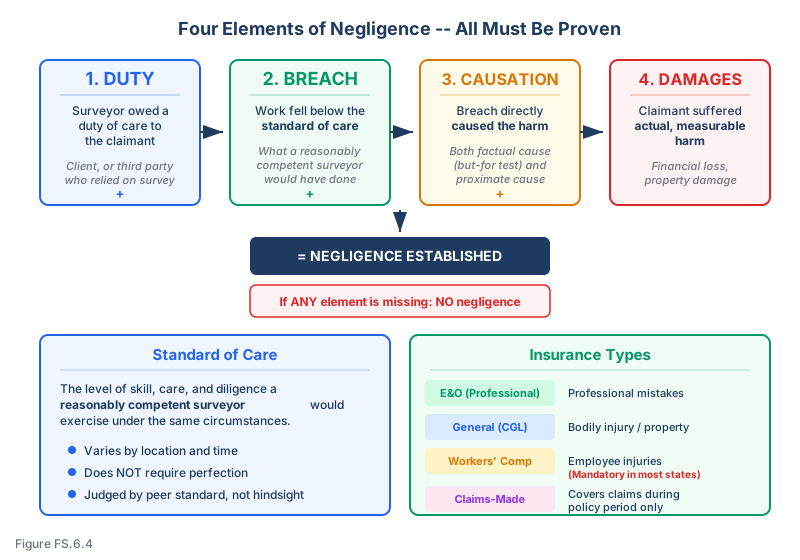
To establish negligence, a claimant must prove all four elements (Restatement (Second) of Torts §§281, 299A; Brown's Boundary Control and Legal Principles, 7th Ed.; Clark on Surveying and Boundaries):
- Duty: The surveyor owed a duty of care to the claimant (established by the professional relationship or by statute)
- Breach: The surveyor's work fell below the standard of care (what a reasonably competent surveyor would have done under the same circumstances)
- Causation: The breach directly caused the damages (both factual and proximate cause)
- Damages: The claimant suffered actual, measurable harm (financial loss, property damage)
If any element is missing, there is no negligence.
Standard of Care
The standard of care is NOT perfection. It is typically articulated (paraphrasing Restatement (Second) of Torts §299A and the formulation used in Brown's Boundary Control and Legal Principles, 7th Ed.) as:
The level of skill, care, and diligence that a reasonably competent surveyor would exercise under the same or similar circumstances, in the same geographic area, at the same time.
Key points about the standard of care:
- It varies by location (local practice and standards may differ)
- It varies by time (technology and standards evolve)
- It does NOT require the best possible result, only a competent one
- It is judged by what other competent surveyors would have done, not by hindsight
- Expert testimony is usually required to establish the standard of care in legal proceedings
Types of Insurance
| Insurance Type | What It Covers |
|---|---|
| Professional liability (E&O) | Claims arising from professional errors or omissions in surveying work |
| General liability (CGL) | Bodily injury and property damage from business operations (e.g., someone trips over a survey stake) |
| Workers' compensation | Employee injuries and illnesses arising from work; required by law in most states |
| Commercial auto | Vehicle accidents involving company vehicles |
| Umbrella/excess liability | Additional coverage above the limits of underlying policies |
| Property insurance | Damage to office, equipment, and instruments |
Professional Liability Insurance Details
- Claims-made vs. occurrence: Most professional liability policies are claims-made, meaning they cover claims made during the policy period, regardless of when the work was performed. The surveyor must maintain coverage continuously or purchase tail coverage (extended reporting period) when retiring or changing insurers
- Deductible/retention: The amount the surveyor pays before insurance coverage begins
- Policy limits: The maximum the insurer will pay (per claim and aggregate per year)
- Defense costs: May be inside or outside the policy limits
- Exclusions: Intentional acts, criminal conduct, work outside the scope of licensure
Risk Management
Proactive measures to reduce liability exposure:
- Written contracts with clear scope, limitations, and terms
- Quality control procedures including independent checks of all work
- Documentation of all field observations, decisions, and communications
- Continuing education to maintain current knowledge and skills
- Peer review for complex or high-risk projects
- Clear communication with clients about limitations and assumptions
- Proper record retention (state requirements vary, but 10+ years is common for survey records)
Common wrong path — canceling E&O when you retire. Most professional liability (E&O) policies are claims-made, not occurrence-based. That means they cover claims made during the policy period, regardless of when the underlying work was performed. If you retire and simply cancel your E&O policy, a claim filed a year later — about work you did decades ago — is uncovered, even though the work itself was performed while you had continuous coverage. The fix is tail coverage (also called an Extended Reporting Period endorsement), which extends the right to report claims after cancellation for a defined period (often the full statute of limitations window, sometimes with an unlimited option). Students and practitioners confuse claims-made with occurrence coverage because "I had a policy in 2010 when I did that survey" feels like it should be enough. With claims-made coverage, it is not. The same issue applies when switching insurers: either obtain prior-acts coverage from the new insurer covering the retroactive date back to the original policy, or buy tail coverage from the old insurer. Never let there be a gap.
Quick retrieval check — try before reading on.
▶A surveyor carried claims-made professional liability insurance continuously from 2005 until retiring at the end of 2024. In 2024 they canceled the policy. In 2026 a former client sues, alleging an error on a 2019 boundary survey. Is the claim covered?
No — not under the expired 2024 policy. Claims-made policies cover claims reported during the policy period, not claims based on work performed during the policy period. The 2024 policy expired when it was canceled; a 2026 claim cannot be reported to an expired 2024 policy. The 2019 work itself was performed while coverage was in place, but that is irrelevant under a claims-made form — what matters is when the claim is made, not when the work was done. (This is the opposite of an occurrence policy, which covers events that occurred during the policy period regardless of when the claim is made. Most professional liability is written as claims-made because tail liabilities make occurrence coverage prohibitively expensive.)
The correct risk management step — which the surveyor should have taken before canceling in 2024 — is to purchase tail coverage (an Extended Reporting Period endorsement). A tail endorsement extends the period during which claims can be reported after cancellation. A common configuration is a tail equal to the jurisdiction's statute of limitations for professional negligence (often 5–10 years, sometimes longer from date of discovery). Without that tail, the retired surveyor's personal assets are exposed to any claim filed after the cancellation date. This is why retirement planning for licensed professionals should always include a tail-coverage line item — often a one-time premium roughly equal to 100–300% of the final annual premium. Surveyors who switch insurers face the same issue: either the new policy writes a retroactive date back to the original coverage start, or tail coverage bridges the gap. Never self-insure the gap.
Exam Tips
- All four elements of negligence must be present -- if any one is missing, there is no negligence
- The standard of care is NOT perfection; it is what a reasonably competent surveyor would do
- Professional liability (E&O) insurance covers professional mistakes, not general accidents
- Workers' compensation is typically mandatory -- it is not optional
- Claims-made policies require continuous coverage; an expired policy may not cover past work
- The FS exam may present a scenario and ask whether negligence exists -- apply the four-element test systematically
- Surveyors can owe a duty to third parties (not just their clients) who reasonably rely on the survey
Related Test Topics
- Professional Ethics (Topic 6.7)
- Contracts and Scope of Work (Topic 6.5)
- Safety Procedures and Equipment (Topic 6.3)
Further Reading
Authoritative sources for deeper study
Model Rules of Professional Conduct (Aug 2025) — Model ethics, competence, and licensure rules adopted by most state boards.
Brown's Boundary Control and Legal Principles (7th Ed., Robillard & Wilson) — Standard textbook on boundary law, evidence hierarchy, and retracement.
Clark, A Treatise on the Law of Surveying and Boundaries — Long-standing legal reference on boundary disputes and surveyor liability.
Last updated: 2026-04-17